
tam improbus, tam perditus, tam tui similis
Towards the end of section 5 near the beginning of today's post this little phrase appears: cum iam nemo tam improbus, tam perditus, tam tui similis and while it is only 10 words long it has a certain beauty to it. Read it over several times in your head. Notice how often the 'mmm' sound occurs, I believe this is an example of asyndeton - where the same sound repeats, and not just the sound but the word tam occurs 3 times along with its near neighbour iam.
tam
is classified as an adverb that is not comparable and generally means: so, so much, to such an extent, to such a degree. When it is being used in the sense I believe it might be as a demonstrative adverb of intensity, a correlative with ut, that (Charlton T. Lewis and Charles Short (1879))
I think this is no accidental use of the 'mm' sound as it occurs 8 times in 10 words.
JUMP To Dictionary Free Interactive Text
Thank you for joining me in this journey through the classical texts of Rome...
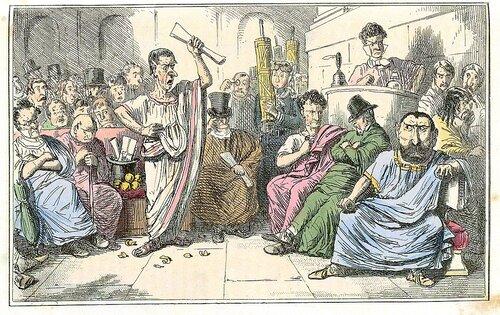
Image by John Leech, from: The Comic History of Rome by Gilbert Abbott A Beckett.
Bradbury, Evans & Co, London, 1850s
Cicero denouncing Catiline

Here is a text only version. (See below for an interactive version)
[5...] verum ego hoc quod iam pridem factum esse oportuit certa de causa nondum adducor ut faciam. tum denique interficiere, cum iam nemo tam improbus, tam perditus, tam tui similis inveniri poterit qui id non iure factum esse fateatur.
[6] quam diu quisquam erit qui te defendere audeat, vives, et vives ita ut nunc vivis, multis meis et firmis praesidiis obsessus ne commovere te contra rem publicam possis.
multorum te etiam oculi et aures non sentientem, sicut adhuc fecerunt, speculabuntur atque custodient.
Chapter 3
etenim quid est, Catilina, quod iam amplius exspectes, si neque nox tenebris obscurare coetus nefarios nec privata domus parietibus continere voces coniurationis tuae potest, si inlustrantur, si erumpunt omnia?
tam improbus, tam perditus, tam tui similis
Towards the end of section 5 near the beginning of today's post this little phrase appears: cum iam nemo tam improbus, tam perditus, tam tui similis and while it is only 10 words long it has a certain beauty to it. Read it over several times in your head. Notice how often the 'mmm' sound occurs, I believe this is an example of asyndeton - where the same sound repeats, and not just the sound but the word tam occurs 3 times along with its near neighbour iam.
tam
is classified as an adverb that is not comparable and generally means: so, so much, to such an extent, to such a degree. When it is being used in the sense I believe it might be as a demonstrative adverb of intensity, a correlative with ut, that (Charlton T. Lewis and Charles Short (1879))
I think this is no accidental use of the 'mm' sound as it occurs 8 times in 10 words.
JUMP To Dictionary Free Interactive Text
Thank you for joining me in this journey through the classical texts of Rome...
Image by John Leech, from: The Comic History of Rome by Gilbert Abbott A Beckett.
Bradbury, Evans & Co, London, 1850s
Cicero denouncing Catiline
Here is a text only version. (See below for an interactive version)
[5...] verum ego hoc quod iam pridem factum esse oportuit certa de causa nondum adducor ut faciam. tum denique interficiere, cum iam nemo tam improbus, tam perditus, tam tui similis inveniri poterit qui id non iure factum esse fateatur.
[6] quam diu quisquam erit qui te defendere audeat, vives, et vives ita ut nunc vivis, multis meis et firmis praesidiis obsessus ne commovere te contra rem publicam possis.
multorum te etiam oculi et aures non sentientem, sicut adhuc fecerunt, speculabuntur atque custodient.
Chapter 3
etenim quid est, Catilina, quod iam amplius exspectes, si neque nox tenebris obscurare coetus nefarios nec privata domus parietibus continere voces coniurationis tuae potest, si inlustrantur, si erumpunt omnia?
Need Help Understanding the Latin?
You might find it helpful to start with the Side-by-Side Version which allows you to see my own very literal translation of the text which is almost a word-for-word translation - in an attempt to make it easier to understand the Latin!
Finally come back to this page - Classical Text and you should be able to better understand and competently read the original Latin text.
Vocabulary Version
I have prepared a Vocabulary Version of the passage (link at bottom of the page) which highlights the 3057 Most Common Words in the texts of Vergil, Caesar and Cicero that we will explore on CentumVerba.com
If you are serious about building your vocabulary, the FLASHCARD set should help you learn them.
How To Read the Interactive Text
To Read the Interactive Text Below Without a Dictionary-
On a Computer: you hover over a word and get all the possible parts of speech; declensions; and conjugations of every word.
Need Help Understanding the Latin?
You might find it helpful to start with the Side-by-Side Version which allows you to see my own very literal translation of the text which is almost a word-for-word translation - in an attempt to make it easier to understand the Latin!
Finally come back to this page - Classical Text and you should be able to better understand and competently read the original Latin text.
Vocabulary Version
I have prepared a Vocabulary Version of the passage (link at bottom of the page) which highlights the 3057 Most Common Words in the texts of Vergil, Caesar and Cicero that we will explore on CentumVerba.com
If you are serious about building your vocabulary, the FLASHCARD set should help you learn them.
How To Read the Interactive Text
To Read the Interactive Text Below Without a Dictionary-
On a Phone or Tablet: don't 'hover' -'tap' the word. To remove the 'definition box' you 'tap' to the side of the text box.
INTERACTIVE DICTIONARY FREE TEXT
verum ego hoc quod iam pridem factum esse oportuit certa de causa nondum adducor ut faciam. tum denique interficiere, cum iam nemo tam improbus, tam perditus,
You Need to be at least a Trial Member to Access the Interactive Dictionary
tam tui similis inveniri poterit qui id non iure factum esse fateatur.
[6] quam diu quisquam erit qui te defendere audeat, vives, et vives ita ut nunc vivis, multis meis et firmis praesidiis obsessus ne commovere te contra rem publicam possis.
multorum te etiam oculi et aures non sentientem, sicut adhuc fecerunt, speculabuntur atque custodient.
Chapter 3
etenim quid est, Catilina, quod iam amplius exspectes, si neque nox tenebris obscurare coetus nefarios nec privata domus parietibus continere voces coniurationis tuae potest, si inlustrantur, si erumpunt omnia?
INTERACTIVE DICTIONARY FREE TEXT
verum ego hoc quod iam pridem factum esse oportuit certa de causa nondum adducor ut faciam. tum denique interficiere, cum iam nemo tam improbus, tam perditus, tam tui similis inveniri poterit qui id non iure factum esse fateatur.
You Need to be at least a Trial Member to Access the Interactive Dictionary
[6] quam diu quisquam erit qui te defendere audeat, vives, et vives ita ut nunc vivis, multis meis et firmis praesidiis obsessus ne commovere te contra rem publicam possis.
multorum te etiam oculi et aures non sentientem, sicut adhuc fecerunt, speculabuntur atque custodient.
Chapter 3
etenim quid est, Catilina, quod iam amplius exspectes, si neque nox tenebris obscurare coetus nefarios nec privata domus parietibus continere voces coniurationis tuae potest, si inlustrantur, si erumpunt omnia?
Recent Comments