
Latin Word Order: Why It’s Freer Than English (But Never Random)
Latin word order explained for real readers, not rule‑memorisers.
Many learners assume Latin sentences are difficult because the words appear in unusual positions. The subject may appear at the end, the object at the beginning, and participles may float anywhere. This lesson gives you Latin word order explained the right way — not as a memorised list of rules, but as a structural approach that builds on everything learned in Module 1.
If you need a refresher on identifying the core of the sentence, revisit Lesson 1.
If you want a reminder of how to scan Latin endings, return to Lesson 2: How to Scan a Latin Word.
Why Latin Word Order Feels Different
English relies heavily on position:
- Subject → Verb → Object
- Descriptions placed predictably
- Word order controls meaning
Latin does not.
Here is Latin word order explained in one principle:
Latin uses endings for structure and word order for style.
The position of a word often reflects emphasis, contrast, or narrative rhythm — but never grammar.
Latin Word Order Explained Through Structure, Not Position
Instead of hunting left‑to‑right, apply your structural habits:
- Find the verb ending
- Match the nominative to the verb
- Locate the accusative target
- Identify supporting material
- Ignore the word order until structure is clear
This mirrors the Highlighter Stripping System:
core → support → decoration.
How to Read Latin When Words Move Around
Latin places words according to meaning and emphasis, not obligation.
Some patterns you will see:
- Object First → emphasis or contrast
- Verb Last → classical narrative rhythm
- Subject in the middle → stylistic flow
- Participles floating → descriptive freedom
But the structure stays stable.
This is where Latin word order explained becomes empowering:
meaning never depends on position.
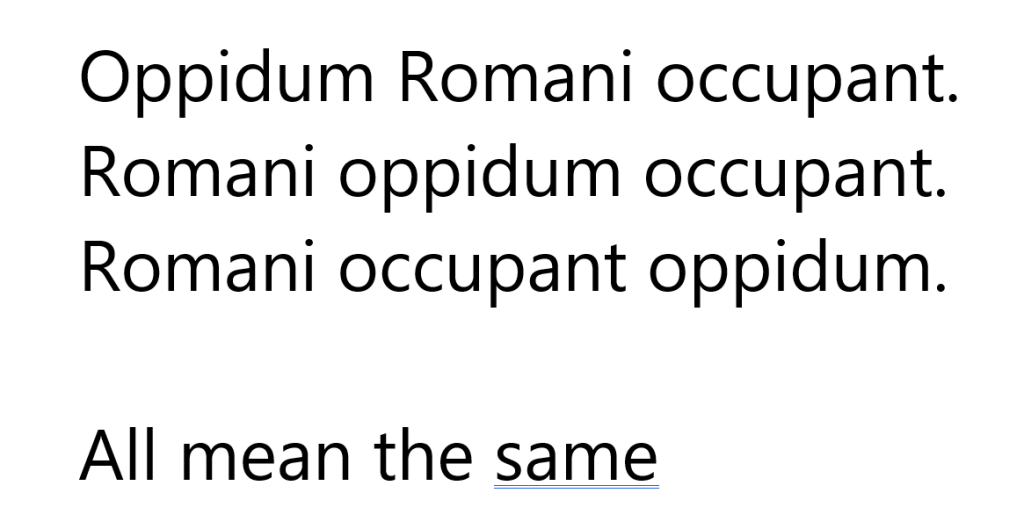
Authentic Caesar (Lightly Trimmed): Word Order in Action
These examples use Caesar’s vocabulary and syntactic habits, simplified to keep them beginner‑friendly.
⭐ Example 1 — Verb at the End
Romani oppidum occupant.
→ The Romans seize the town.
Caesar may also write:
Oppidum Romani occupant.
Same meaning; different emphasis.
⭐ Example 2 — Object First
Civem milites vident.
→ The soldiers see the citizen.
- civem comes first for emphasis
- Structure still comes from endings
⭐ Example 3 — Subject in the Middle
Hostes Romani oppidum occupant.
→ The Romans seize the town (not the enemies).
The nominative still matches the verb.
⭐ Example 4 — PPPs + Ablatives Scattered Around Core
Hoste capto Romani oppidum occupant.
→ After the enemy was captured, the Romans seize the town.
Even if written:
- Romani hoste capto oppidum occupant, or
- Oppidum Romani hoste capto occupant,
…the structure is unchanged.
⭐ Example 5 — Latin “Frame” Structure
Romani oppidum occupant militesque sequuntur.
Latin often “wraps” related words around the verb.
Endings keep everything clear.
Mini HSS Demonstration (Latin Word Order Explained Through Stripping)
Sentence:
Civem milites currentes vident.
Yellow Step — reveal the core
→ Milites civem vident.
Subject: milites
Verb: vident
Object: civem
Rebuild
→ currentes = “running” (describes milites)
Final Meaning:
“The running soldiers see the citizen.”
Word order never created ambiguity — endings prevented it.
⭐ FAQ — Lesson 11: Latin Word Order
Q. Is Latin word order really “free”?
Yes and no. Latin word order is free structurally because endings show grammar, but meaningful stylistically because authors use order to emphasise what matters.
Q. How do I know the subject if it’s not at the beginning?
Ignore position. Look at endings: a nominative form paired with a matching verb. That tells you the subject, wherever it appears.
Q. Why does Caesar put the object first so often?
To emphasise it. Latin often foregrounds important or surprising objects — but the endings still show you who is doing what to whom.
Q. Does word order ever change the core meaning?
Almost never. Core meaning comes from subject–verb–object endings, not order. Word order changes emphasis, not structure.
Q. How do I avoid reading Latin left‑to‑right?
Find the verb shape first (‑t or ‑nt), then locate the nominative and accusative. This stabilises the sentence wherever the words appear.
Q. How does understanding word order help with HSS?
HSS strips by function, not position. Knowing that Latin freely moves words means you won’t confuse movement with structure — exactly the clarity that HSS relies on.
Recent Comments