
How to Scan a Latin Word
Understanding how to scan a Latin word is one of the fastest ways to make real progress in Latin. Instead of guessing meanings or hunting for dictionary forms, scanning shows you the shape of the word first — and that shape tells you its job. This lesson demonstrates how to scan a Latin word quickly, calmly, and with confidence.
1. The Reader’s Problem (How to Scan a Latin Word Starts Here)
When most learners meet an unfamiliar Latin word, the mind jumps straight to meaning:
- “What does this mean?”
- “Is this a noun or a verb?”
- “Which case is it?”
- “I don’t know this word… so I can’t read the sentence.”
This direction makes reading harder.
The better question — the one behind how to scan a Latin word — is:
“What is this word shaped like?”
Meaning comes later.
Structure comes first.
2. The Pattern: How to Scan a Latin Word by Its Ending
Look only at the last 2–3 letters.
This single habit unlocks structure instantly.
Below are the shapes your Minimum Viable Toolkit already knows — now applied to real sentences.
A. Words ending in ‑t or ‑nt → VERBS (core action)
- videt → he/she sees
- currit → he/she runs
- audit → he/she hears
- venit → he/she comes
- tenent → they hold
- vident → they see
Whenever you see ‑t or ‑nt, the sentence just told you the action.
This is the foundation of how to scan a Latin word effectively.
B. Words ending in ‑it or ‑erunt → PERFECT VERBS (completed action)
- vidit → he/she saw
- vēnit → he/she came
- viderunt → they saw
Caesar’s narrative rhythm leans heavily on these.
C. Words ending in ‑um → Neuter Noun OR Masculine Object OR PPP (neuter)
One ending → three possibilities → enormous reading power.
- oppidum → town (neuter noun)
- servum → slave (object)
- corpus → “body” (special form but same structural behaviour)
- captum / inventum / defensum → PPP forms
When you see ‑um, think:
“Probably a noun, possibly a PPP — check the next word.”
This is real scanning.
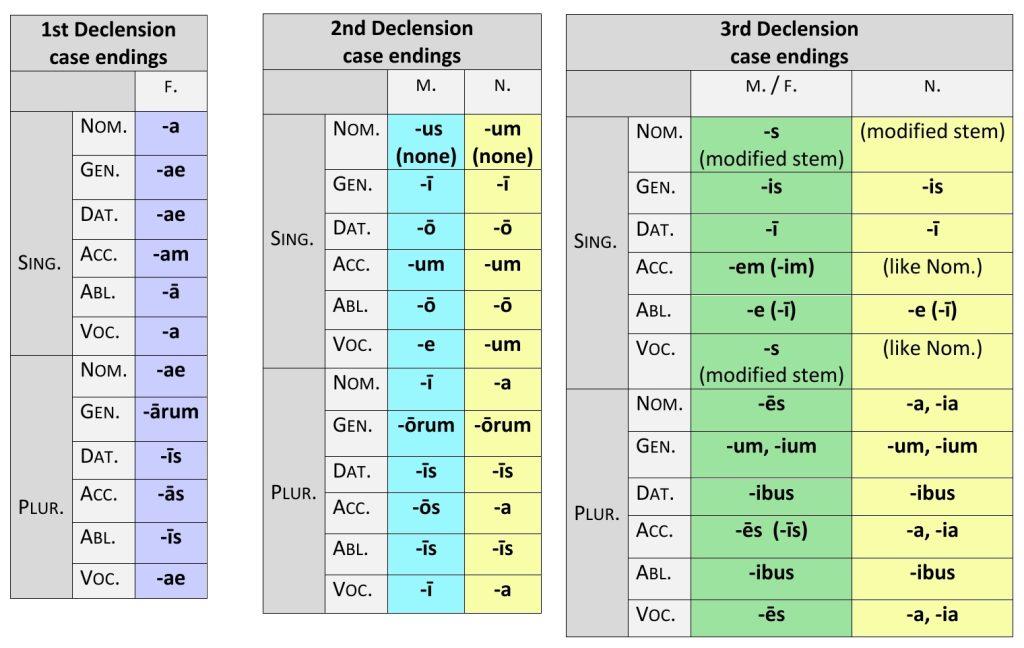
D. Words ending in ‑am, ‑as, ‑os, ‑es, ‑em → Very Often OBJECTS
Examples:
- puellam → the girl (object)
- servos → the slaves (object)
- civem → the citizen (object)
- reges → the kings (subject/object)
These endings very often indicate the target of the action — a key part of how to scan a Latin word in context.
E. Words ending in ‑us, ‑r, ‑a, ‑i, ‑ae → Very Often SUBJECTS
- servus → slave (subject)
- puer → boy (subject)
- puella → girl (subject)
- Romani → the Romans (subject)
Not always — but often enough to stabilise the structure quickly.
3. The Reader’s Decision (Core of How to Scan a Latin Word)
Each time you identify an ending, ask:
“Is this part of the core meaning or the supporting layer?”
- Verb‑shaped → core
- Subject‑shaped → core
- Object‑shaped → core
- PPP / participle / ablative phrase → supportive
This decision becomes automatic.
It is the mental foundation of the Highlighter Stripping System.
4. Authentic Caesar (Lightly Trimmed) — Scanning in Action
These examples use real Caesar vocabulary, simplified only to remove advanced clauses.
Everything is readable using your Minimum Viable Toolkit.
⭐ Example 1 — Pure Core Action
Oppidum tenent.
→ They hold the town.
- oppidum → noun (‑um)
- tenent → verb (‑nt)
Core claim: They hold the town.
This is the essence of how to scan a Latin word in context.
⭐ Example 2 — Add a Participial Description
Oppidum captum tenent.
→ They hold the captured town.
- oppidum → object
- captum → PPP (neuter)
- tenent → verb
Core: oppidum tenent
Support: captum
⭐ Example 3 — Noun + PPP + Verb
Corpus inventum ostendit.
→ He shows the discovered body.
- corpus → noun
- inventum → PPP
- ostendit → verb (‑t)
Structure becomes clear immediately.
⭐ Example 4 — Slightly Richer
Romani oppidum captum occupant.
→ The Romans seize the captured town.
- Romani → subject
- oppidum → object
- captum → PPP
- occupant → verb (‑nt)
Core: Romani occupant oppidum
Support: captum
5. Mini HSS Demonstration (How to Scan a Latin Word in Action)
Romani oppidum captum occupant.
Yellow Step
→ Romani oppidum occupant.
Core meaning: The Romans seize the town.
Rebuild
→ captum (“captured”)
Final: The Romans seize the captured town.
Scanning + structure → instant comprehension.
🌟 What You Realise in This Lesson
By this point, something important happens.
You realise that:
- You can already read authentic Latin, even from Caesar.
- You only needed a handful of endings to orient yourself.
- You don’t need full paradigms to understand the structure.
- You can spot the core meaning of a sentence quickly and reliably.
- You can separate essential meaning from descriptive detail, even without knowing every word.
- You are already thinking like a reader, not a decoder —
which is exactly how the Highlighter Stripping System works.
This is the early, confidence‑building moment most Latin courses never give their learners.
But it is central to Naked Latin.
You’re no longer intimidated by the sentence.
You’re shaping it.
And that changes everything.
Move on to Lesson 3: The Accusative to see scanning applied to objects.
❓ Beginner FAQ (Lesson 2)
Q. Do I really have to look at the ending first?
Yes — because the ending tells you the job the word is doing long before you look up its meaning. This is how experienced readers navigate Latin quickly and calmly.
Q. What if a word fits more than one category?
That’s normal. Latin endings often have more than one possibility. Just make the most likely guess (verb? subject? object?) and keep reading. The structure of the sentence will confirm or correct your first instinct.
Q. What if I don’t know the dictionary meaning of the word yet?
Once you know what role the word plays (verb / noun / participle / object / subject), the meaning becomes far easier to work out — and far harder to forget.
Q. How do I know which ‑um words are neuter nouns and which are participles?
If you see a noun + ‑um, the second word is probably a participle (e.g., oppidum captum).
If the ‑um word stands alone, or is the thing being acted on, it’s likely a noun.
Q. Is scanning the same thing as parsing?
No — scanning is quicker and lighter.
Parsing is detailed analysis.
Scanning is a first impression that guides your reading without slowing you down.
Q. What if the sentence is much longer than these examples?
The same scanning logic works no matter how long the sentence is.
You’ll always find:
- a verb (or two),
- a subject (or two),
- objects,
- supporting structures.
Scanning helps you separate these parts instead of drowning in words.
Q. Is it normal not to understand every word?
Yes. Reading Latin is not about instant translation — it’s about identifying structure. Once the structure is clear, the meaning follows naturally.
Q. How does scanning help with the Highlighter Stripping System later?
Scanning trains you to recognise:
- what belongs to the core, and
- what belongs to the supporting material.
HSS simply makes those decisions visible by colour and position.
You’re already learning the instinct now.
Recent Comments