
The Ablative: How Latin Shows Background, Setting, and Circumstance
Latin ablative case meaning explained in the clearest, reader‑first way.
Understanding Latin ablative case meaning is one of the biggest breakthroughs for early readers. Textbooks overwhelm beginners with lists of 20+ “uses,” but real Latin behaves more simply. In actual sentences — especially in Caesar — the ablative almost always gives background, setting, or circumstance, not core meaning.
If you’d like to revisit the core structure before diving in, return to Lesson 1: How Latin Sentences Work. And if you want to reinforce your scanning habits, Lesson 2 shows how endings reveal function instantly.
Not 20 uses — just what you actually meet when reading real sentences.
Textbooks famously give the ablative 20+ “uses”, each with a label:
- ablative of means
- ablative of manner
- ablative of description
- ablative of cause
- ablative of time
- ablative absolute
- ablative of comparison
- ablative of separation
- ablative of respect
- ablative of [insert another 10 categories here]
But when you read real Latin — especially Caesar — the ablative behaves in just one way:
It adds background or circumstance around the core action.
That’s it.
The ablative is not scary when you meet it “in the wild.”
This lesson shows you the reader’s version of the ablative — the way you actually meet it when reading.
Why Latin Ablative Case Meaning Matters
Traditional grammar divides the ablative into dozens of categories, which makes the case feel impossible. But structural reading simplifies everything:
The ablative supports the sentence.
It almost never carries the core claim.
Recognising Latin ablative case meaning lets you immediately separate background information from the sentence’s main action — which is exactly how the Highlighter Stripping System works.
Recognising the Ablative: Shapes You Will See Constantly
Here are the minimum‑viable ablative endings that appear everywhere in early reading:
Singular
- ‑o → servo, oppido
- ‑e → cive
- ‑a → puella (ablative form identical to nominative)
Plural
- ‑is → servis, puellis
- ‑ibus → civibus, militibus
You don’t need full paradigms.
You just need to recognise when a form looks ablative‑shaped and check whether it gives background or circumstance.
This is the essential insight behind Latin ablative case meaning.
The Reader’s Decision
Whenever you see an ablative shape, ask:
“Is this giving me background?”
If the phrase answers when, where, with whom, under what condition, or by what means, the ablative is doing its normal job:
✅ adding context
✅ adding setting
✅ adding circumstance
✅ living in the supporting layer
It rarely tells you the main action.
That’s the central idea of Latin ablative case meaning.
Authentic Caesar (Lightly Trimmed): Ablatives in Action
These examples use Caesar’s vocabulary and patterns — simplified to keep them beginner‑friendly.
⭐ Example 1 — Ablative of Place (Background)
In oppido manent.
→ They remain in the town.
- in oppido → background
- manent → core action
⭐ Example 2 — Ablative of Association
Cum militibus venit.
→ He comes with the soldiers.
- cum militibus → circumstance
- venit → action
⭐ Example 3 — Ablative of Means (No label needed)
Sagittis pugnant.
→ They fight with arrows.
Notice how Latin ablative case meaning works here:
- Not possession
- Not a category
- Just “with arrows” = how they fight
⭐ Example 4 — Ablative of Separation
Ex castris currunt.
→ They run out of the camp.
The ablative here sets the starting point — a type of background.
⭐ Example 5 — Ablative Absolute (Preview)
Hostibus captis Romani veniunt.
→ With the enemies captured, the Romans come.
- Ablative noun + ablative participle
- Pure background, outside the core claim
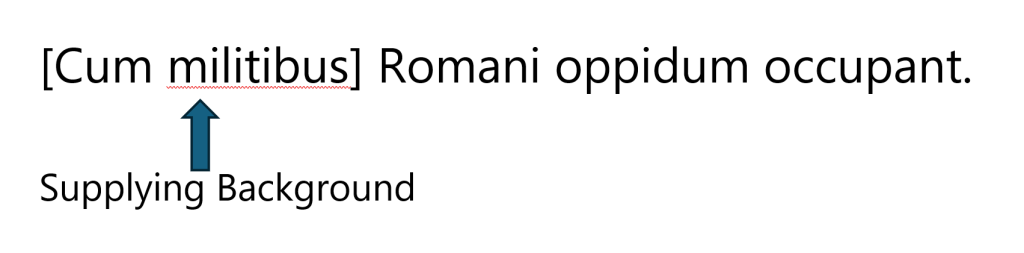
Mini HSS Demonstration (Latin Ablative Case Meaning in Action)
Sentence:
Cum militibus Romani oppidum occupant.
→ With the soldiers, the Romans seize the town.
Yellow Step — core only
→ Romani oppidum occupant.
Subject: Romani
Verb: occupant
Object: oppidum
Rebuild
→ add cum militibus = “with the soldiers”
Final meaning:
“With the soldiers, the Romans seize the town.”
This is exactly how the ablative behaves: always supportive, never core.
❓ Beginner FAQ (Lesson 5) The Ablative
Q. Do I need to memorise all the traditional “uses of the ablative”?
For real reading, the ablative simply adds background or circumstance around the core action.
Thinking structurally is far more effective than memorising lists.
Q. How do I recognise an ablative quickly?
At this stage, recognition is enough; precision comes later.
Q. Does the ablative ever form part of the core meaning?
The core meaning is almost always in subject + verb + accusative object.
The ablative tends to provide setting, method, companions, or circumstances — helpful, but not structural anchors.
Q. How do I know whether an ablative is telling me “where,” “how,” or “with whom”?
You don’t need to classify it.
Just ask:
“What background information is this ablative giving me?”
Often the preposition (in, cum, ex) makes the relationship obvious.
Q. What if the ablative appears without a preposition?
Try reading it as background detail: how, when, under what conditions.
You’ll see this especially with things like gladiis, sagittis, nocte, consilio.
Q. Is the ablative absolute the same thing as a normal ablative?
It still provides background, but in a more compact form:
noun (abl.) + participle (abl.).
You don’t need to master it yet — Lesson 10 will handle it fully.
Q. How do I avoid confusing ablatives and datives?
If the form ends in ‑o, ‑e, ‑is, ‑ibus and feels like “background,” treat it as ablative‑shaped support.
The dative will get its own focused lesson later.
Q. Why does Caesar use ablatives so often?
Ablatives keep sentences tight, efficient, and full of context — exactly Caesar’s style
Q. How does this help with the Highlighter Stripping System?
Ablatives almost always belong to the “supporting material” layer.
Seeing that now will make Yellow‑level stripping feel natural later.
Recent Comments