
Why You Can Parse Latin but Still Can’t Read It
If you’ve studied Latin for any length of time, this feeling will be familiar.
You look at a sentence and you:
- can identify the cases
- are able to parse the verb
- might even know every word
And yet — the sentence doesn’t mean anything.
This isn’t a failure of intelligence or effort. It’s a structural mismatch between how Latin works and how it’s usually taught.
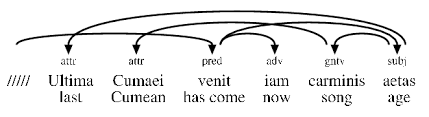
Parsing Is Not Reading
Parsing asks one question at a time:
- What case is this noun?
- What tense is this verb?
- What construction might this be?
Reading asks a very different question:
- What is the sentence doing?
Traditional Latin instruction often trains students to hover at word‑level, collecting facts about individual forms, rather than seeing how those forms cooperate to make a claim.
Latin, however, is not a language that reveals its meaning word by word.
It reveals meaning by structure.
Latin Meaning Lives in the Skeleton, Not the Vocabulary
In English, word order does much of the work.
In Latin, structure does.
A Latin sentence usually has:
- one governing verb
- a small number of core participants
- and a great deal of decorative or delaying material orbiting around them
If you don’t identify that core early, everything feels unstable. You end up rereading. Looking up words repeatedly. Translating fragments that never cohere.
This is why many learners can pass grammar tests but freeze when faced with real authors.
They were trained to name parts, not to locate the core.
Why Word‑by‑Word Translation Makes This Worse
Word‑by‑word translation feels diligent, but it locks you into the wrong mental posture.
It encourages you to treat Latin as:
- a cipher to be decoded
- a puzzle to be solved
- a foreign object to be rearranged into English
Real reading does the opposite.
It asks you to remain inside the Latin sentence long enough to see what holds it together — before you worry about how to say it in English.
The Shift That Changes Everything
Progress happens when learners move from asking:
“What is this word doing?”
to asking:
“What is the sentence saying, and which words matter for that?”
Once you start working sentence‑first, vocabulary lookup drops naturally. So does panic.
This is why modern reading‑first methods — and structured sentence analysis approaches — succeed (and why you can parse Latin but still can't read it.)
They train the eye to see shape, not noise.
If you’ve ever thought “I know Latin, but I can’t read Latin”, the problem is not your memory.
It’s that no one showed you where to look first.
Why You Can Parse Latin but Still Can’t Read It Next step:
If this disconnect describes your experience, the solution is not more memorisation — it’s learning how to strip a sentence down to its working core before rebuilding it. That’s the exact skill developed inside Naked Latin
Recent Comments