
rex - no more kings
The Latin word rex means ‘king’ and was a title used in early Roman history before the establishment of the Republic. However, the Romans developed a deep aversion to monarchy, leading to the abolition of kingship and the creation of a new political system.
The Roman Kings and Their Downfall
Rome was traditionally ruled by seven kings, beginning with Romulus, its legendary founder, in 753 BCE. These kings wielded absolute power, overseeing military, religious, and judicial matters. However, the last king, Lucius Tarquinius Superbus, ruled with tyranny, disregarding the Senate and the people's rights. His oppressive reign culminated in the infamous rape of Lucretia, a noblewoman whose tragic fate sparked outrage among the Roman elite.
In 509 BCE, a group of aristocrats, led by Lucius Junius Brutus, expelled Tarquinius Superbus, marking the end of the Roman monarchy. This event led to the establishment of the Roman Republic, a system designed to prevent the concentration of power in a single ruler.
The Republic and the Rejection of Kingship
After overthrowing the monarchy, Romans instituted a Republican government, where power was distributed among elected officials. The Senate became the dominant governing body, and two consuls were elected annually to prevent any individual from gaining excessive control.
The term rex became politically toxic, associated with tyranny and oppression. Even when Julius Caesar amassed significant power, he refused the title of king, knowing it would provoke public outrage. Instead, he adopted the title dictator perpetuus, meaning ‘dictator for life,’ though this ultimately led to his assassination.
Legacy and Influence
Despite Rome’s rejection of kingship, the title rex persisted in later European monarchies. Medieval rulers, including the Holy Roman Emperors, adopted the term, demonstrating its lasting influence. However, within Rome itself, the Republic remained deeply opposed to monarchical rule until the rise of the Roman Empire, when emperors effectively became kings in all but name.
Conclusion
The Romans abolished kingship to prevent tyranny, replacing it with a system of checks and balances. Their rejection of rex shaped their political identity, influencing governance for centuries.
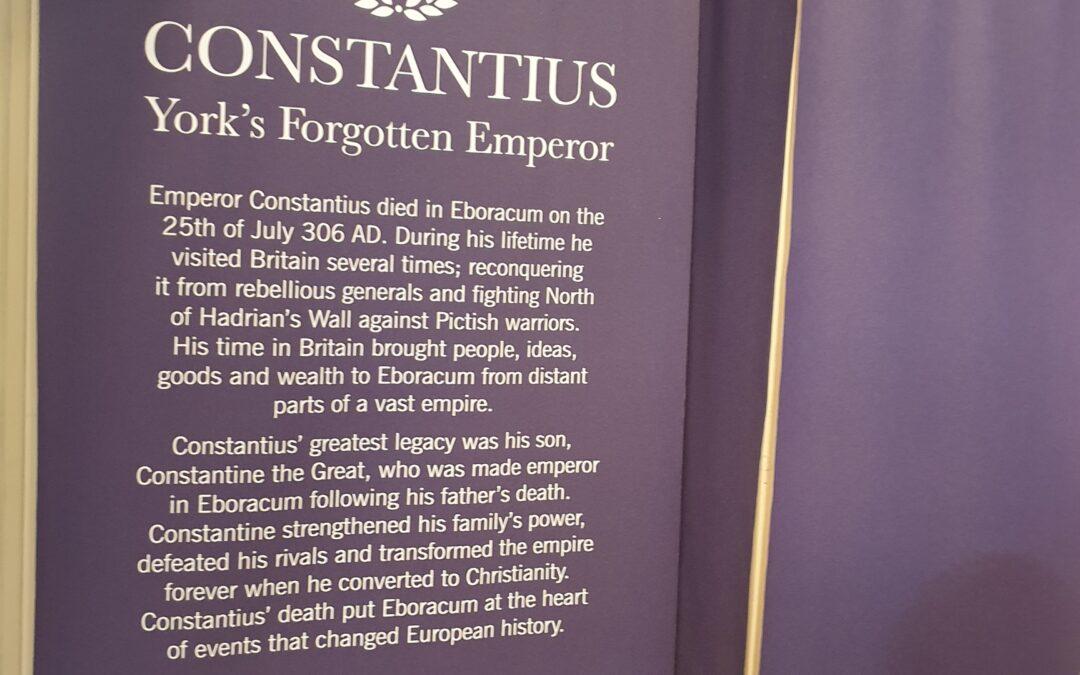
Today's Artwork: Photo showing the a display about Emperor Constantine's death in York in 306 AD.
Source: Yorkshire Museum
Here is a text only version. (See below for an interactive version)
12 At Medea, regis filia, Iasonem adamavit et ubi audivit eum tantum periculum subiturum esse rem aegre ferebat. Intellegebat enim patrem suum hunc laborem proposuisse eo ipso consilio, ut Iason moreretur. Quae cum ita essent, Medea, quae summam scientiam medicinae habebat, hoc consilium iniit.
Media nocte clam patre ex urbe evasit et postquam in montis finitimos venit herbas quasdam carpsit; tum suco expresso unguentum paravit quod vi sua corpus aleret nervosque confirmaret. Hoc facto Iasoni unguentum dedit, praecepit autem ut eo die quo isti labores conficiendi essent corpus suum et arma mane oblineret.
Iason, etsi paene omnis magnitudine et viribus corporis antecellebat, vita enim omnis in venationibus atque in studiis rei militaris constiterat, censebat tamen hoc consilium non neglegendum esse.
Red and Green Vocab
The words in red and green are found among the 3057 Most Common Words in the Classical Latin texts that we will explore on CentumVerba.com and are essential to your understanding of the texts of Caesar, Vergil and Cicero. The green words appear frequently (at least five times) among Vergil's Aeneid (books I-VI), Caesar de bello Gallico (books I-V) and in Cicero's works - in Catilinam (books I-IV), de lege Manilia (also known as de Imperio Cn. Pompei), and pro Achia. These works constituted the curriculum for Latin over 4 years in American High Schools at the start of the 20th Century. The bulk of my information is taken from The Vocabulary of High School Latin by Gonzalez Lodge. I have added to these 2000 words from varioius other sources to compile my own list of The 3057 Most Common Latin Words.
The black words do not appear frequently in Classical Latin.
The red words are the first occurrences of these words in this author and this word will appear as green the next time you encounter it.
If you are serious about building your vocabulary then you should learn the red words as they occur and you should already know the green ones!
I have provided a FLASHCARD set to help - see below.
How To Read the Interactive Text
To Read the Interactive Text Below Without a Dictionary-
On a Computer: you hover over a word and get all the possible parts of speech; declensions; and conjugations of every word.
Red and Green Vocab
The words in red and green are found among the 3057 Most Common Words in the Classical Latin texts that we will explore on CentumVerba.com and are essential to your understanding of the texts of Caesar, Vergil and Cicero. The green words appear frequently (at least five times) among Vergil's Aeneid (books I-VI), Caesar de bello Gallico (books I-V) and in Cicero's works - in Catilinam (books I-IV), de lege Manilia (also known as de Imperio Cn. Pompei), and pro Achia. These works constituted the curriculum for Latin over 4 years in American High Schools at the start of the 20th Century. The bulk of my information is taken from The Vocabulary of High School Latin by Gonzalez Lodge. I have added to these 2000 words from varioius other sources to compile my own list of The 3057 Most Common Latin Words.
The black words do not appear frequently in Classical Latin.
The red words are the first occurrences of these words in this author and this word will appear as green the next time you encounter it.
If you are serious about building your vocabulary then you should learn the red words as they occur and you should already know the green ones!
I have provided a FLASHCARD set to help - see below.
How To Read the Interactive Text
To Read the Interactive Text Below Without a Dictionary-
On a Phone or Tablet: don't 'hover' -'tap' the word. To remove the 'definition box' you 'tap' to the side of the text box.
INTERACTIVE DICTIONARY FREE TEXT
12 At Medea, regis filia, Iasonem adamavit et ubi audivit eum tantum periculum subiturum esse rem aegre ferebat.
You Need to be a Member to Access the Interactive Dictionary
Intellegebat enim patrem suum hunc laborem proposuisse eo ipso consilio, ut Iason moreretur.
Quae cum ita essent, Medea, quae summam scientiam medicinae habebat, hoc consilium iniit.
Media nocte clam patre ex urbe evasit et postquam in montis finitimos venit herbas quasdam carpsit; tum suco expresso unguentum paravit quod vi sua corpus aleret nervosque confirmaret.
Hoc facto Iasoni unguentum dedit, praecepit autem ut eo die quo isti labores conficiendi essent corpus suum et arma mane oblineret.
Iason, etsi paene omnis magnitudine et viribus corporis antecellebat, vita enim omnis in venationibus atque in studiis rei militaris constiterat, censebat tamen hoc consilium non neglegendum esse.
I have prepared online Flashcards at CRAM.com to make learning the vocabulary much easier. I have no financial gain from you using the app as it is FREE to use.
I have created a stack of the 20 new words in this passage.
YOU NEED TO SIGN UP AS A TRIAL MEMBER TO ACCESS THE FLASHCARDS
Here is the link to the FLASHCARDS
USING THE FLASHCARD APP:
To make the most of the online Flashcards use the "Click or use spacebar to begin" and the Latin word should appear. (The 'Shuffle' button will take the cards out of alphabetical order.) Type 'H' to get the conjugation / declension of the word if you want to see it. 'H' takes tyou back to the word. Click 'See Answer' or use the Spacebar to see the English.
If you were correct or close enough then select "I was right" or else "I was wrong". After you have completed the set it will start again but it will only display the ones you got wrong.
Continue through this process to learn all the words. I hope this is helpful!
Recent Comments