
spiritus - the breath of the Holy Spirit
The Latin word spiritus carries profound meanings, with its primary sense being ‘breath,’ ‘spirit,’ or ‘soul.’ Derived from spirare (‘to breathe’), spiritus signifies the life-giving force essential to existence. In both Classical Latin and later Vulgate Latin, its usage evolved to encompass physical, metaphysical, and religious dimensions.
In Classical Latin, spiritus was frequently employed by philosophers and poets. Cicero used it in discussions about the soul (anima), linking it to intellectual and moral qualities. Virgil and Lucretius referenced spiritus as the breath of life, emphasizing its connection to vitality and existence. It was also associated with air and movement, especially in Stoic philosophy, where spiritus was considered a vital force permeating the universe.
With the advent of Christianity and the translation of biblical texts into Latin, spiritus took on new theological significance. In Jerome’s Vulgate Bible, spiritus was frequently used to translate Greek pneuma, referring to the Holy Spirit (Spiritus Sanctus). This was a pivotal linguistic choice, reinforcing the spiritual and divine nature of the term. It played a crucial role in shaping Christian theology, signifying the presence and power of God in believers' lives.
Thus, spiritus evolved from a term describing breath and life force in Classical Latin to a deeply spiritual concept in Vulgate Latin. Its journey reflects the broader transformation of Roman thought and language under philosophical and religious influences, making it one of the most enduring Latin words still recognized today.
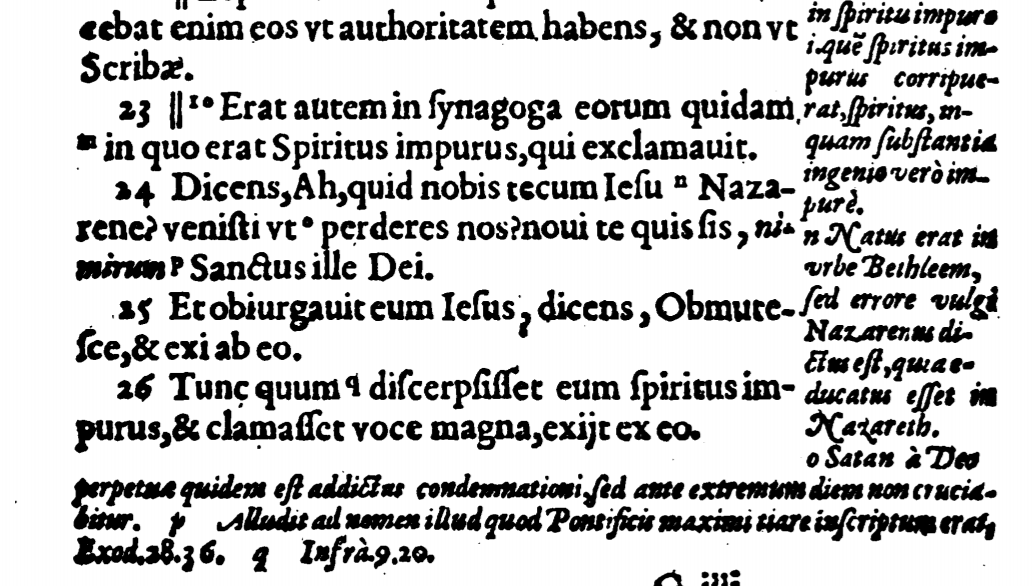
The images for these posts on Mark's gospel
Screenshots taken from the Nouum Testamentum of Théodore de Bèze, (1519-1605) ( Londini : Thomas Vautrollerius, typographus, 1587 )
Accessed from the Post Reformation Digital Library
The words in red and green are found among the 3057 Most Common Words in the Classical Latin texts that we will explore on CentumVerba.com and are essential to your understanding of the texts of Caesar, Vergil and Cicero. The green words appear frequently (at least five times) among Vergil's Aeneid (books I-VI), Caesar de bello Gallico (books I-V) and in Cicero's works - in Catilinam (books I-IV), de lege Manilia (also known as de Imperio Cn. Pompei), and pro Achia. These works constituted the curriculum for Latin over 4 years in American High Schools at the start of the 20th Century. The bulk of my information is taken from The Vocabulary of High School Latin by Gonzalez Lodge. I have added to these 2000 words from varioius other sources to compile my own list of The 3057 Most Common Latin Words.
The black words do not appear frequently in Classical Latin.
The red words are the first occurrences of these words in this author and this word will appear as green the next time you encounter it.
If you are serious about building your vocabulary then you should learn the red words as they occur and you should already know the green ones!
I have provided a FLASHCARD set to help - see below.
To Read the Interactive Text Below Without a Dictionary-
On a Computer:
Hover over a word to get all its possible parts of speech, declensions, or conjugations.
On a Tablet:
'TAP' the word to see the definition, and to remove the 'definition box' you simply 'TAP' anywhere to the side.
spiritus - the breath of the Holy Spirit
The Latin word spiritus carries profound meanings, with its primary sense being ‘breath,’ ‘spirit,’ or ‘soul.’ Derived from spirare (‘to breathe’), spiritus signifies the life-giving force essential to existence. In both Classical Latin and later Vulgate Latin, its usage evolved to encompass physical, metaphysical, and religious dimensions.
In Classical Latin, spiritus was frequently employed by philosophers and poets. Cicero used it in discussions about the soul (anima), linking it to intellectual and moral qualities. Virgil and Lucretius referenced spiritus as the breath of life, emphasizing its connection to vitality and existence. It was also associated with air and movement, especially in Stoic philosophy, where spiritus was considered a vital force permeating the universe.
With the advent of Christianity and the translation of biblical texts into Latin, spiritus took on new theological significance. In Jerome’s Vulgate Bible, spiritus was frequently used to translate Greek pneuma, referring to the Holy Spirit (Spiritus Sanctus). This was a pivotal linguistic choice, reinforcing the spiritual and divine nature of the term. It played a crucial role in shaping Christian theology, signifying the presence and power of God in believers' lives.
Thus, spiritus evolved from a term describing breath and life force in Classical Latin to a deeply spiritual concept in Vulgate Latin. Its journey reflects the broader transformation of Roman thought and language under philosophical and religious influences, making it one of the most enduring Latin words still recognized today.
The images for these posts on Mark's gospel
Screenshots taken from the Nouum Testamentum of Théodore de Bèze, (1519-1605) ( Londini : Thomas Vautrollerius, typographus, 1587 )
Accessed from the Post Reformation Digital Library
The words in red and green are found among the 3057 Most Common Words in the Classical Latin texts that we will explore on CentumVerba.com and are essential to your understanding of the texts of Caesar, Vergil and Cicero. The green words appear frequently (at least five times) among Vergil's Aeneid (books I-VI), Caesar de bello Gallico (books I-V) and in Cicero's works - in Catilinam (books I-IV), de lege Manilia (also known as de Imperio Cn. Pompei), and pro Achia. These works constituted the curriculum for Latin over 4 years in American High Schools at the start of the 20th Century. The bulk of my information is taken from The Vocabulary of High School Latin by Gonzalez Lodge. I have added to these 2000 words from varioius other sources to compile my own list of The 3057 Most Common Latin Words.
The black words do not appear frequently in Classical Latin.
The red words are the first occurrences of these words in this author and this word will appear as green the next time you encounter it.
If you are serious about building your vocabulary then you should learn the red words as they occur and you should already know the green ones!
I have provided a FLASHCARD set to help - see below.
To Read the Interactive Text Below Without a Dictionary-
On a Phone or Tablet: don't 'hover' -'tap' the word. To remove the 'definition box' you 'tap' to the side of the text box.
INTERACTIVE DICTIONARY FREE TEXT
23 Et erat in synagoga eorum homo in spiritu immundo et exclamavit,
24 dicens quid nobis et tibi Iesu Nazarene venisti perdere nos scio qui sis Sanctus Dei
You Need to be at least a Trial Member to Access the Interactive Dictionary
25 et comminatus est ei Iesus dicens obmutesce et exi de homine
26 et discerpens eum spiritus immundus et exclamans voce magna exiit ab eo
27 et mirati sunt omnes ita ut conquirerent inter se dicentes quidnam est hoc quaenam doctrina hæc nova quia in potestate etiam spiritibus immundis imperat et obediunt ei
28 et processit rumor eius statim in omnem regionem Galilææ.
29 Et protinus egredientes de synagoga venerunt in domum Simonis et Andreae cum Iacobo et Iohanne
I have prepared online Flashcards at CRAM.com to make learning the vocabulary much easier. I have no financial gain as the app is FREE to use.
I have created a stack of the 18 new words in this passage.
YOU NEED TO SIGN UP AS A TRIAL MEMBER TO ACCESS THE FLASHCARDS
Here is the link to the FLASHCARDS
USING THE FLASHCARD APP:
To make the most of the online Flashcards use the "Click or use spacebar to begin" and the Latin word should appear. (The 'Shuffle' button will take the cards out of alphabetical order.) Type 'H' to get the conjugation / declension of the word if you want to see it. 'H' takes tyou back to the word. Click 'See Answer' or use the Spacebar to see the English.
If you were correct or close enough then select "I was right" or else "I was wrong". After you have completed the set it will start again but it will only display the ones you got wrong.
Continue through this process to learn all the words. I hope this is helpful!
Recent Comments