
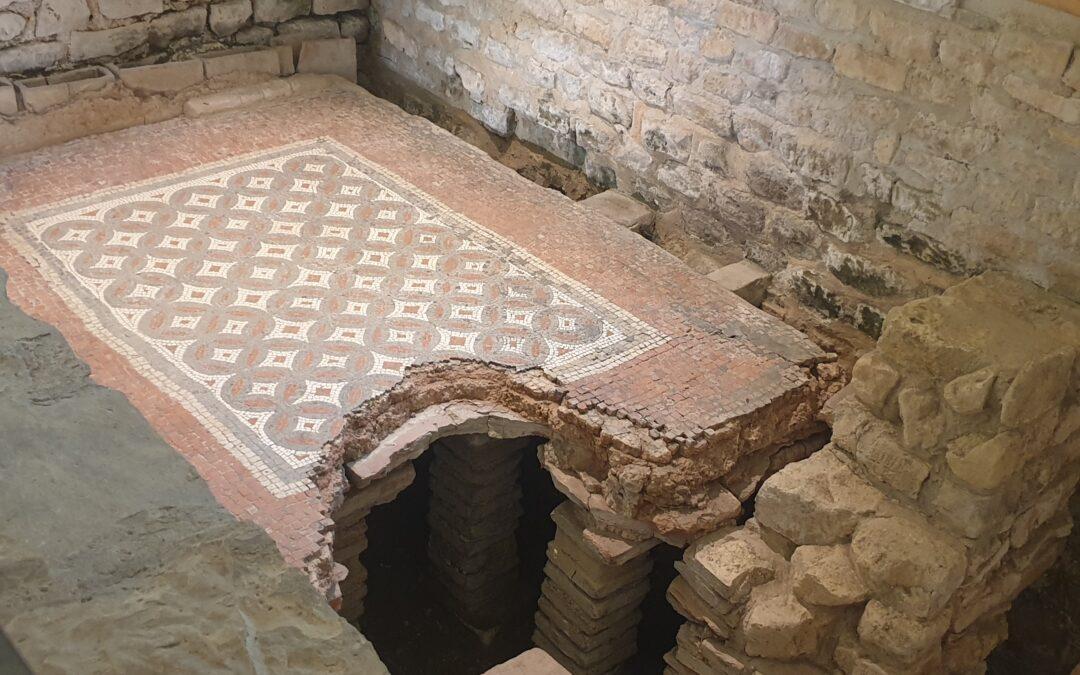
provincia- this one needs underfloor heating
The Latin noun provincia refers to a 'province or territory' and is a fundamental term in Roman administration and geography. Derived from the Latin words pro (for) and vincere (to conquer), provincia originally indicated a conquered territory governed by Rome. As the Roman Republic and Empire expanded, provincia became a key concept in managing and organizing their vast territories. Provincia is a first-declension noun.
In the Roman context, a provincia was not just a geographic area but also a political and administrative unit. Each province was governed by a Roman magistrate, such as a proconsul or propraetor, who was responsible for maintaining order, collecting taxes, and overseeing local affairs. These governors wielded significant power and were accountable to the Senate or Emperor, depending on the period.
The establishment of provinces allowed Rome to effectively manage its empire's diverse and far-reaching territories. Provinces varied widely in size, population, and importance. For example, the province of Sicilia (Sicily) was one of the first Roman provinces, acquired after the First Punic War, while the province of Britannia (Britain) was added much later during the reign of Emperor Claudius.
Provinces played a crucial role in the economic and military strength of Rome. They provided resources, such as grain, minerals, and manpower, which were vital for sustaining the Roman state and its military campaigns. Additionally, provinces served as centers of Romanization, where local populations were exposed to Roman culture, language, and legal systems, further integrating them into the empire.
Understanding provincia is essential for appreciating the administrative and geopolitical organization of the Roman world. It highlights the complexities of governing a vast empire and the mechanisms by which Rome maintained control over its diverse territories.
provincia appears only in Caesar and Cicero:
| AUTHOR | OCCURENCES |
| Caesar | 31 |
| Cicero | 24 |
| Vergil | 0 |
Today's Image: Mosaic floor with a hypocaust (Latin: hypocaustum) for underfloor heating.
Location: Chedworth Roman Villa
Red and Green Vocab
The words in red and green are found among the 3057 Most Common Words in the Classical Latin texts that we will explore on CentumVerba.com and are essential to your understanding of the texts of Caesar, Vergil and Cicero. The green words appear frequently (at least five times) among Vergil's Aeneid (books I-VI), Caesar de bello Gallico (books I-V) and in Cicero's works - in Catilinam (books I-IV), de lege Manilia (also known as de Imperio Cn. Pompei), and pro Achia. These works constituted the curriculum for Latin over 4 years in American High Schools at the start of the 20th Century. The bulk of my information is taken from The Vocabulary of High School Latin by Gonzalez Lodge. I have added to these 2000 words from varioius other sources to compile my own list of The 3057 Most Common Latin Words.
The black words do not appear frequently in Classical Latin.
The red words are the first occurrences of these words in this author and this word will appear as green the next time you encounter it.
If you are serious about building your vocabulary then you should learn the red words as they occur and you should already know the green ones!
I have provided a FLASHCARD set to help - see below.
How To Read the Interactive Text
To Read the Interactive Text Below Without a Dictionary-
On a Computer: you hover over a word and get all the possible parts of speech; declensions; and conjugations of every word.
Red and Green Vocab
The words in red and green are found among the 3057 Most Common Words in the Classical Latin texts that we will explore on CentumVerba.com and are essential to your understanding of the texts of Caesar, Vergil and Cicero. The green words appear frequently (at least five times) among Vergil's Aeneid (books I-VI), Caesar de bello Gallico (books I-V) and in Cicero's works - in Catilinam (books I-IV), de lege Manilia (also known as de Imperio Cn. Pompei), and pro Achia. These works constituted the curriculum for Latin over 4 years in American High Schools at the start of the 20th Century. The bulk of my information is taken from The Vocabulary of High School Latin by Gonzalez Lodge. I have added to these 2000 words from varioius other sources to compile my own list of The 3057 Most Common Latin Words.
The black words do not appear frequently in Classical Latin.
The red words are the first occurrences of these words in this author and this word will appear as green the next time you encounter it.
If you are serious about building your vocabulary then you should learn the red words as they occur and you should already know the green ones!
I have provided a FLASHCARD set to help - see below.
How To Read the Interactive Text
To Read the Interactive Text Below Without a Dictionary-
On a Phone or Tablet: don't 'hover' -'tap' the word. To remove the 'definition box' you 'tap' to the side of the text box.
INTERACTIVE DICTIONARY FREE TEXT
Caesari cum id nuntiatum esset, eos per provinciam nostram iter facere conari,
You Need to be a Member to Access the Interactive Dictionary
maturat ab urbe proficisci et quam maximis potest itineribus in Galliam ulteriorem contendit et ad Genavam pervenit.
Provinciae toti quam maximum potest militum numerum imperat (erat omnino in Gallia ulteriore legio una), pontem, qui erat ad Genavam, iubet rescindi.
Ubi de eius aventu Helvetii certiores facti sunt, legatos ad eum mittunt nobilissimos civitatis, cuius legationis Nammeius et Verucloetius principem locum obtinebant, qui dicerent sibi esse in animo sine ullo maleficio iter per provinciam facere, propterea quod aliud iter haberent nullum:
rogare ut eius voluntate id sibi facere liceat. Caesar, quod memoria tenebat L. Cassium consulem occisum exercitumque eius ab Helvetiis pulsum et sub iugum missum, concedendum non putabat;
neque homines inimico animo, data facultate per provinciam itineris faciundi, temperaturos ab iniuria et maleficio existimabat.
I have prepared online Flashcards at CRAM.com to make learning the vocabulary much easier. I have no financial gain from you using the app as it is FREE to use.
I have created a stack of the 25 new words in this passage.
Here is the link to the FLASHCARDS
USING THE FLASHCARD APP:
To make the most of the online Flashcards use the "Click or use spacebar to begin" and the Latin word should appear. (The 'Shuffle' button will take the cards out of alphabetical order.) Type 'H' to get the conjugation / declension of the word if you want to see it. 'H' takes tyou back to the word. Click 'See Answer' or use the Spacebar to see the English.
If you were correct or close enough then select "I was right" or else "I was wrong". After you have completed the set it will start again but it will only display the ones you got wrong.
Continue through this process to learn all the words. I hope this is helpful!
Recent Comments