
spatium - space the final frontier
The Latin noun spatium carries a breadth of meanings across various literary contexts, reflecting its significance in both the physical and metaphorical realms. Primarily, spatium denotes ‘space’ or ‘distance,’ referring to measured intervals in geography, motion, and time. Classical Latin authors utilize this term in diverse ways, shaping its meaning to fit their rhetorical and poetic needs.
In historical and military texts, spatium often conveys physical extent or distance between entities. Julius Caesar, in Commentarii de Bello Gallico, employs the term when describing battle formations, highlighting strategic distances between troops. The term also appears in Livy’s Ab Urbe Condita, where it denotes spatial separation between cities or within battlefield movements.
Poets, notably Virgil and Ovid, elevate spatium to a metaphorical plane. In the Aeneid, Virgil uses spatium to evoke temporal intervals, emphasizing fateful pauses before decisive action. Similarly, Ovid’s Metamorphoses adopts spatium in the context of transformation, marking transitional phases within metamorphic narratives. In these instances, spatium becomes a bridge between states, whether in the unfolding of fate or personal change.
Philosophical and scientific Latin texts also give spatium unique resonance. Lucretius, in De Rerum Natura, integrates the term into his exploration of atomism and cosmic structure, contemplating the void and the movement of particles. Spatium in such discussions reflects both tangible and theoretical distance, aligning with the poet’s broader vision of universal mechanics.
Legal and rhetorical works, including those by Cicero, exploit spatium in forensic arguments, particularly in reference to deadlines, terms, or measured delays. The term frequently appears in judicial discourse, articulating timeframes for legal proceedings.
Ultimately, spatium embodies more than mere physical measurement; it serves as a literary tool, enriching narratives and philosophical reflections. Whether marking physical expanse, temporal duration, or existential transitions, its multifaceted use in Latin literature underscores the nuanced and adaptable nature of the language. Across prose and poetry, spatium stands as a testament to the linguistic precision and expressive depth of Roman thought.
spatium appears most frequently in Caesar:
| AUTHOR | OCCURENCES |
| Caesar | 24 |
| Cicero | 3 |
| Vergil | 8 |
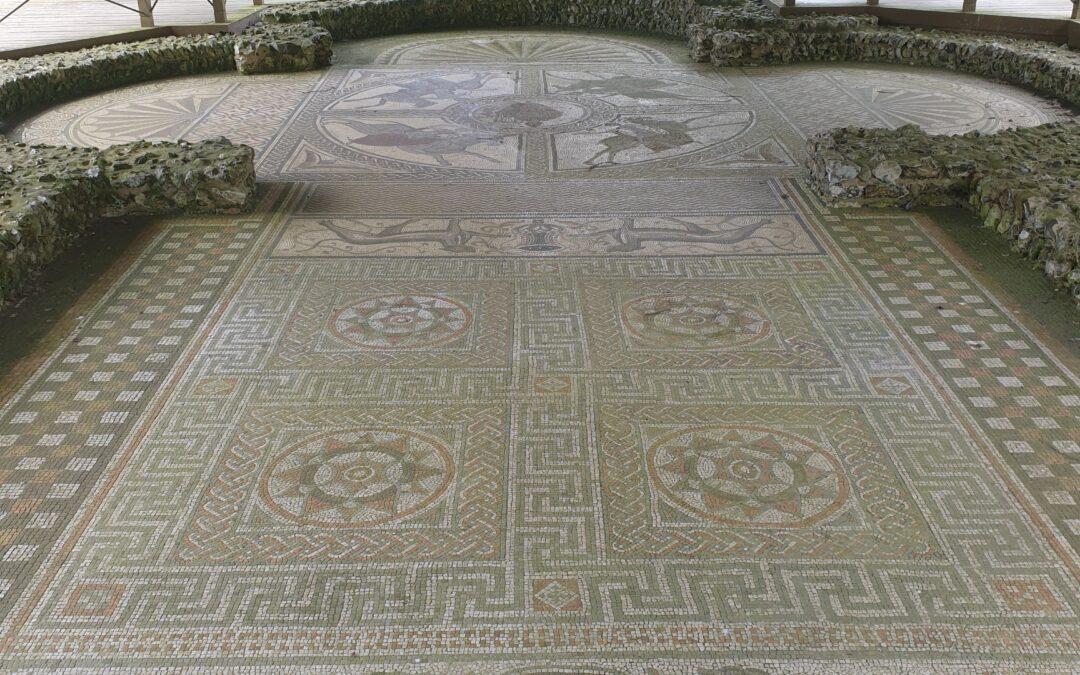
Today's Image: Mosaic floor
Location: Littlecote Roman Villa
Red and Green Vocab
The words in red and green are found among the 3057 Most Common Words in the Classical Latin texts that we will explore on CentumVerba.com and are essential to your understanding of the texts of Caesar, Vergil and Cicero. The green words appear frequently (at least five times) among Vergil's Aeneid (books I-VI), Caesar de bello Gallico (books I-V) and in Cicero's works - in Catilinam (books I-IV), de lege Manilia (also known as de Imperio Cn. Pompei), and pro Achia. These works constituted the curriculum for Latin over 4 years in American High Schools at the start of the 20th Century. The bulk of my information is taken from The Vocabulary of High School Latin by Gonzalez Lodge. I have added to these 2000 words from varioius other sources to compile my own list of The 3057 Most Common Latin Words.
The black words do not appear frequently in Classical Latin.
The red words are the first occurrences of these words in this author and this word will appear as green the next time you encounter it.
If you are serious about building your vocabulary then you should learn the red words as they occur and you should already know the green ones!
I have provided a FLASHCARD set to help - see below.
How To Read the Interactive Text
To Read the Interactive Text Below Without a Dictionary-
On a Computer: you hover over a word and get all the possible parts of speech; declensions; and conjugations of every word.
Red and Green Vocab
The words in red and green are found among the 3057 Most Common Words in the Classical Latin texts that we will explore on CentumVerba.com and are essential to your understanding of the texts of Caesar, Vergil and Cicero. The green words appear frequently (at least five times) among Vergil's Aeneid (books I-VI), Caesar de bello Gallico (books I-V) and in Cicero's works - in Catilinam (books I-IV), de lege Manilia (also known as de Imperio Cn. Pompei), and pro Achia. These works constituted the curriculum for Latin over 4 years in American High Schools at the start of the 20th Century. The bulk of my information is taken from The Vocabulary of High School Latin by Gonzalez Lodge. I have added to these 2000 words from varioius other sources to compile my own list of The 3057 Most Common Latin Words.
The black words do not appear frequently in Classical Latin.
The red words are the first occurrences of these words in this author and this word will appear as green the next time you encounter it.
If you are serious about building your vocabulary then you should learn the red words as they occur and you should already know the green ones!
I have provided a FLASHCARD set to help - see below.
How To Read the Interactive Text
To Read the Interactive Text Below Without a Dictionary-
On a Phone or Tablet: don't 'hover' -'tap' the word. To remove the 'definition box' you 'tap' to the side of the text box.
INTERACTIVE DICTIONARY FREE TEXT
Chapter 7.5
Tamen, ut spatium intercedere posset dum milites quos imperaverat convenirent,
You Need to be a Member to Access the Interactive Dictionary
legatis respondit diem se ad deliberandum sumpturum: si quid vellent, ad Id. April. reverterentur.
8 Interea ea legione quam secum habebat militibusque, qui ex provincia convenerant, a lacu Lemanno, qui in flumen Rhodanum influit, ad montem Iuram, qui fines Sequanorum ab Helvetiis dividit, milia passuum XVIIII murum in altitudinem pedum sedecim fossamque perducit.
Eo opere perfecto praesidia disponit, castella communit, quo facilius, si se invito transire conentur, prohibere possit.
Ubi ea dies quam constituerat cum legatis venit et legati ad eum reverterunt, negat se more et exemplo populi Romani posse iter ulli per provinciam dare et, si vim lacere conentur, prohibiturum ostendit.
I have prepared online Flashcards at CRAM.com to make learning the vocabulary much easier. I have no financial gain from you using the app as it is FREE to use.
I have created a stack of the 27 new words in this passage.
Here is the link to the FLASHCARDS
USING THE FLASHCARD APP:
To make the most of the online Flashcards use the "Click or use spacebar to begin" and the Latin word should appear. (The 'Shuffle' button will take the cards out of alphabetical order.) Type 'H' to get the conjugation / declension of the word if you want to see it. 'H' takes tyou back to the word. Click 'See Answer' or use the Spacebar to see the English.
If you were correct or close enough then select "I was right" or else "I was wrong". After you have completed the set it will start again but it will only display the ones you got wrong.
Continue through this process to learn all the words. I hope this is helpful!
Recent Comments