
auctoritas - credibility, authority and many other concepts
The Latin noun auctoritas translates to 'authority or influence' in English and holds significant cultural and political weight in Roman society. Derived from auctor (seller, vendor, author) auctoritas embodies the concept of one's ability to command respect, inspire trust, and wield power.
In ancient Rome, auctoritas was a critical aspect of an individual's social standing and political power. It wasn't just about formal authority or official positions, but also about the perceived legitimacy and moral influence one had over others. For example, a senator with great auctoritas would be highly respected and influential in the Senate, not merely due to his title but because of his personal qualities and achievements.
auctoritas was often associated with leaders, elders, and respected figures who had earned their standing through wisdom, experience, and service to the community. It was a quality that could not be easily granted or taken away, as it depended heavily on public perception and recognition.
In literature and historical texts, auctoritas frequently appears in discussions about governance, leadership, and the social dynamics of Rome. The historian Tacitus, for example, explores the concept of auctoritas in his works, examining how it influenced the actions and decisions of Roman emperors and other key figures.
Understanding auctoritas provides valuable insights into the values and structures of Roman society, where personal reputation and moral authority often carried as much weight as official power.
Today's Image: Altars of the First Cohort of Spaniards at Maryport 122-138 AD
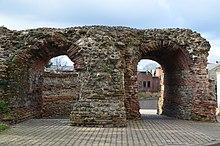
Location: Colchester Roman Wall
In the Roman period the wall had six gates located at regular intervals. Of these only two survive above ground today: Balkerne Gate and Duncan’s Gate. The Balkerne Gate was the original main entrance to Colchester. It was upgraded to a Triumphal Arch celebrating the conquest of Britannia by the Roman Emperor Claudius.
The words in red and green are found among the 3057 Most Common Words in the Classical Latin texts that we will explore on CentumVerba.com and are essential to your understanding of the texts of Caesar, Vergil and Cicero. The green words appear frequently (at least five times) among Vergil's Aeneid (books I-VI), Caesar de bello Gallico (books I-V) and in Cicero's works - in Catilinam (books I-IV), de lege Manilia (also known as de Imperio Cn. Pompei), and pro Achia. These works constituted the curriculum for Latin over 4 years in American High Schools at the start of the 20th Century. The bulk of my information is taken from The Vocabulary of High School Latin by Gonzalez Lodge. I have added to these 2000 words from varioius other sources to compile my own list of The 3057 Most Common Latin Words.
The black words do not appear frequently in Classical Latin.
The red words are the first occurrences of these words in this author and this word will appear as green the next time you encounter it.
If you are serious about building your vocabulary then you should learn the red words as they occur and you should already know the green ones!
I have provided a FLASHCARD set to help - see below.
To Read the Interactive Text Below Without a Dictionary-
On a Computer: you hover over a word and get all the possible parts of speech; declensions; and conjugations of every word.
auctoritas - credibility, authority and many other concepts
The Latin noun auctoritas translates to 'authority or influence' in English and holds significant cultural and political weight in Roman society. Derived from auctor (seller, vendor, author) auctoritas embodies the concept of one's ability to command respect, inspire trust, and wield power.
In ancient Rome, auctoritas was a critical aspect of an individual's social standing and political power. It wasn't just about formal authority or official positions, but also about the perceived legitimacy and moral influence one had over others. For example, a senator with great auctoritas would be highly respected and influential in the Senate, not merely due to his title but because of his personal qualities and achievements.
auctoritas was often associated with leaders, elders, and respected figures who had earned their standing through wisdom, experience, and service to the community. It was a quality that could not be easily granted or taken away, as it depended heavily on public perception and recognition.
In literature and historical texts, auctoritas frequently appears in discussions about governance, leadership, and the social dynamics of Rome. The historian Tacitus, for example, explores the concept of auctoritas in his works, examining how it influenced the actions and decisions of Roman emperors and other key figures.
Understanding auctoritas provides valuable insights into the values and structures of Roman society, where personal reputation and moral authority often carried as much weight as official power.
Today's Image: Altars of the First Cohort of Spaniards at Maryport 122-138 AD
Location: Colchester Roman Wall
In the Roman period the wall had six gates located at regular intervals. Of these only two survive above ground today: Balkerne Gate and Duncan’s Gate. The Balkerne Gate was the original main entrance to Colchester. It was upgraded to a Triumphal Arch celebrating the conquest of Britannia by the Roman Emperor Claudius.
The words in red and green are found among the 3057 Most Common Words in the Classical Latin texts that we will explore on CentumVerba.com and are essential to your understanding of the texts of Caesar, Vergil and Cicero. The green words appear frequently (at least five times) among Vergil's Aeneid (books I-VI), Caesar de bello Gallico (books I-V) and in Cicero's works - in Catilinam (books I-IV), de lege Manilia (also known as de Imperio Cn. Pompei), and pro Achia. These works constituted the curriculum for Latin over 4 years in American High Schools at the start of the 20th Century. The bulk of my information is taken from The Vocabulary of High School Latin by Gonzalez Lodge. I have added to these 2000 words from varioius other sources to compile my own list of The 3057 Most Common Latin Words.
The black words do not appear frequently in Classical Latin.
The red words are the first occurrences of these words in this author and this word will appear as green the next time you encounter it.
If you are serious about building your vocabulary then you should learn the red words as they occur and you should already know the green ones!
I have provided a FLASHCARD set to help - see below.
To Read the Interactive Text Below Without a Dictionary-
On a Phone or Tablet: don't 'hover' -'tap' the word. To remove the 'definition box' you 'tap' to the side of the text box.
INTERACTIVE DICTIONARY FREE TEXT
His rebus adducti et auctoritate Orgetorigis permoti constituerunt ea quae ad proficiscendum pertinerent comparare, iumentorum et carrorum
You Need to Sign Up as a Trial Member to Access the Interactive Dictionary
quam maximum numerum coemere, sementes quam maximas facere, ut in itinere copia frumenti suppeteret, cum proximis civitatibus pacem et amicitiam confirmare.
Ad eas res conficiendas biennium sibi satis esse duxerunt; in tertium annum profectionem lege confirmant. Ad eas res conficiendas Orgetorix deligitur.
Is sibi legationem ad civitates suscipit. In eo itinere persuadet Castico, Catamantaloedis filio, Sequano, cuius pater regnum in Sequanis multos annos obtinuerat et a senatu populi Romani amicus appellatus erat, ut regnum in civitate sua occuparet, quod pater ante habuerit;
itemque Dumnorigi Haeduo, fratri Diviciaci, qui eo tempore principatum in civitate obtinebat ac maxime plebi acceptus erat, ut idem conaretur persuadet eique filiam suam in matrimonium dat.
I have prepared online Flashcards at CRAM.com to make learning the vocabulary much easier. I have no financial gain from you using the app as it is FREE to use.
I have created a stack of the 38 new words in this passage.
Here is the link to the FLASHCARDS
USING THE FLASHCARD APP:
To make the most of the online Flashcards use the "Click or use spacebar to begin" and the Latin word should appear. (The 'Shuffle' button will take the cards out of alphabetical order.) Type 'H' to get the conjugation / declension of the word if you want to see it. 'H' takes tyou back to the word. Click 'See Answer' or use the Spacebar to see the English.
If you were correct or close enough then select "I was right" or else "I was wrong". After you have completed the set it will start again but it will only display the ones you got wrong.
Continue through this process to learn all the words. I hope this is helpful!
Recent Comments