
Present Participles: How Latin Shows “‑ing” Inside Sentences
Latin present participles made clear, simple, and readable.
Understanding Latin present participles is one of the fastest ways to recognise descriptive action inside sentences. These forms show what a noun is doing right now, giving Latin its fluid, compact way of expressing ongoing action. This lesson explains how Latin present participles work, how to scan them, and how they fit into the supporting layer of meaning.
To review core sentence structure, revisit Lesson 1.
To strengthen your scanning habit, see Lesson 2 before reading this lesson.
Why Latin Present Participles Matter
Latin has no separate “‑ing” words like English. Instead, it uses a participle built from the verb:
- currens → running
- clamans → shouting
- fugientes → fleeing
But the most important idea is this:
Latin present participles describe a noun’s ongoing action, not the sentence’s core action.
This is the heart of Latin present participles: they function as descriptive adjectives, never as the main verb.
Recognising Latin Present Participles Quickly
Latin present participles have only two shapes you need to recognise:
✅ 1. ‑ns → nominative singular
- currens (running)
- clamans (shouting)
- pugnans (fighting)
✅ 2. ‑nt‑ + ending → all other cases
- currentis → of the running…
- currentem → the running (object)
- currentes → running (plural)
You do not need to memorise the whole declension.
Recognition is enough — the key insight behind Latin present participles.
The Reader’s Decision: Which Noun Is Doing This “‑ing”?
Whenever you see ‑ns or ‑nt‑, ask:
“Which noun is this describing?”
“Who is doing this ongoing action?”
Latin present participles belong to the supporting layer, not the core.
They describe, enrich, or frame the sentence — but do not carry the main action.
This matches the stripping logic used in the Highlighter Stripping System.
Authentic Caesar (Lightly Trimmed): Latin Present Participles in Action
These examples use Caesar’s vocabulary and habits, simplified for early reading.
⭐ Example 1 — Simple and Clear
Puer currens venit.
→ The running boy comes.
- puer → subject
- currens → present participle
- venit → verb
Core: puer venit
Support: currens
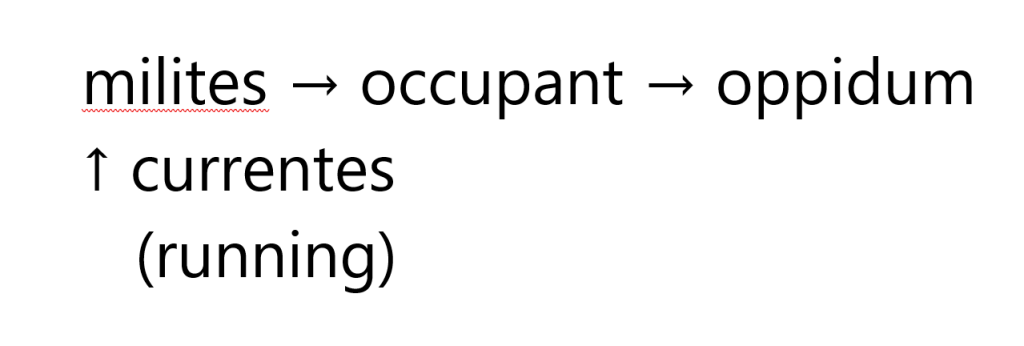 ⭐ Example 2 — Caesar‑Style Narrative
Milites currentes oppidum occupant.
→ The running soldiers seize the town.
Core: milites occupant oppidum
Support: currentes
⭐ Example 3 — With PPP (contrast of time)
Hostes fugientes corpus inventum relinquunt.
→ The fleeing enemies leave behind the discovered body.
Here you see both types:
- Present participle → fugientes (ongoing)
- PPP → inventum (completed)
⭐ Example 4 — Clear Ongoing Action
Civis clamans currit.
→ The shouting citizen runs.
Very common pattern.
⭐ Example 5 — Participles Inside Ablative Support
Cum militibus currentibus Romani veniunt.
→ With the running soldiers, the Romans come.
Two layers of support:
- Ablative: cum militibus
- Participle: currentibus
Core remains simply Romani veniunt.
Mini HSS Demonstration (Latin Present Participles in Context)
Sentence:
Milites currentes oppidum occupant.
Yellow Step — reveal the core
→ Milites oppidum occupant.
Subject: milites
Verb: occupant
Object: oppidum
Rebuild
→ add currentes (“running”)
Final Meaning:
“The running soldiers seize the town.”
Latin present participles always live in the supporting/description layer.
FAQ — Lesson 8: Present Participles
Q. How do I recognise a present participle?
Look for -ns (nominative singular) or -nt- followed by an ending. These always signal “‑ing” — running, shouting, fleeing.
Q. Does a present participle form part of the core meaning?
No. Present participles sit in the supporting layer. They describe a noun but don’t affect the core structure of the sentence.
Q. Do I need to memorise all the participle endings?
No. Recognition is enough. Treat -ns as “‑ing,” and -nt- as “‑ing + case ending.” That’s all you need for reading.
Q. How do I figure out which noun a participle belongs to?
Participles sit right next to the noun they describe, or very near it. If it reads naturally as “the X who is doing Y,” you’ve matched it correctly.
Q. Can present participles appear in the ablative absolute?
Yes — but you don’t need to master that yet. For now, just recognise them as another form of background description, not core meaning.
Q. How does this help with the Highlighter Stripping System?
HSS removes descriptive detail first. Present participles will almost always strip out at Yellow, revealing the core. Adding them back later becomes much easier when you recognise them quickly.
Recent Comments