
The Dative: The Case of Interest
Latin dative case meaning explained through structure, not memorisation.
Understanding Latin dative case meaning is one of the simplest ways to make Latin sentences feel more human and more readable. The dative marks the person who benefits from, receives, or is affected by the action.
This is why many readers call it the Case of Interest.
If you’d like to review how structure works before diving in, revisit Lesson 1. If you want to reinforce scanning habits, Lesson 2 (How to Scan a Latin Word) prepares your eye to spot dative endings instantly.
Why Latin Dative Case Meaning Matters
The dative is often taught as “the indirect object” with long lists:
- dative of purpose
- dative of reference
- double dative
- dative with special adjectives
- dative with certain verbs
…but readers of real Latin rarely think this way.
The Latin dative case meaning that matters for reading is simple:
“Whose interest is involved?”
“To whom or for whom is something done?”
“Who is affected?”
Once you ask these questions, the sentence begins to settle.
If you’d like to revisit the core structure before diving in, return to Lesson 1: How Latin Sentences Work. And if you want to reinforce your scanning habits, Lesson 2 shows how endings reveal function instantly.
Recognising the Dative: Minimal Shapes You Already Know
These endings appear constantly in Caesar and other prose:
Singular
- ‑o → servo, puero
- ‑ae → puellae
- ‑i → civi (3rd declension)
Plural
- ‑is → servis, puellis
- ‑ibus → civibus, militibus
You don’t need full paradigms — only the ability to spot when a form is dative‑shaped and ask the right question.
That’s the core of Latin dative case meaning.
The Reader’s Decision: Who Is Interested or Affected?
When a dative appears, check whether the verb expresses:
- giving (ostendere, dare, mittere)
- showing
- telling
- helping
- trusting
- pleasing
- harming (nocere)
If yes, the dative tells you who receives or who is affected.
Think structurally:
✅ Dative = recipient
✅ Dative = beneficiary
✅ Dative = affected party
This is the living meaning behind Latin dative case meaning.
Authentic Caesar (Lightly Trimmed): The Dative in Real Sentences
These examples use Caesar’s vocabulary and common sentence patterns, simplified to be beginner‑friendly.
⭐ Example 1 — Classic “Give/Show/Tell” Pattern
Militibus ostendit.
→ He shows (it) to the soldiers.
- militibus → dative plural (recipient)
- ostendit → verb (he shows)
⭐ Example 2 — Caesar’s Messaging Pattern
Romani legatos civibus mittunt.
→ The Romans send ambassadors to the citizens.
- legatos → object
- civibus → dative recipient
Clear and recognisable.
⭐ Example 3 — Dative of Possession (No label needed)
Equus militi est.
→ The horse is to the soldier.
→ i.e. The soldier has a horse.
Here the dative shows interest / connection, not ownership.
⭐ Example 4 — “Affected Party” Pattern
Hostes Romanis nocent.
→ The enemies harm the Romans.
- Romanis → dative affected
- nocent → they harm
Perfectly fits Latin dative case meaning.
⭐ Example 5 — Combined Support Layers
Cum militibus oppidum civibus servant.
→ With the soldiers, they protect the town for the citizens.
- civibus → dative (benefit)
- militibus → ablative support
- oppidum → accusative object
This mirrors real Caesar layering.
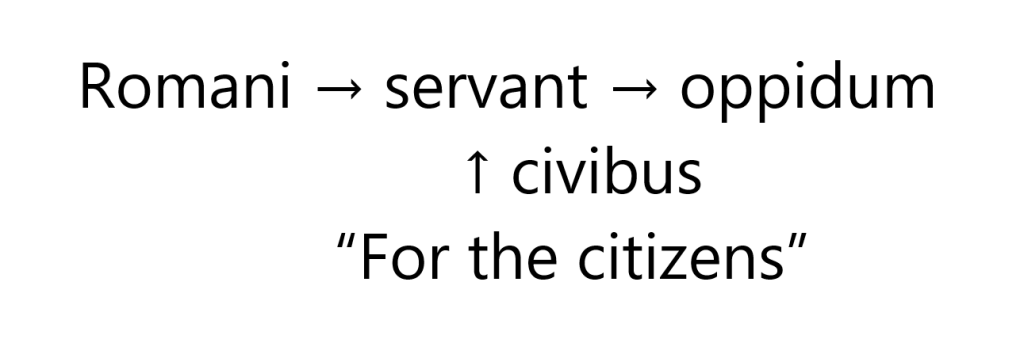 Mini HSS Demonstration (Latin Dative Case Meaning in Action)
Romani oppidum civibus servant.
→ The Romans protect the town for the citizens.
Yellow Step — reveal the core
→ Romani oppidum servant.
Subject: Romani
Verb: servant
Object: oppidum
Rebuild
→ add civibus = “for the citizens”
Final Meaning
“The Romans protect the town for the citizens.”
The dative clearly belongs in the relational layer, not the core.
❓ Beginner FAQ (Lesson 7)
Q. How do I recognise a dative quickly?
Look for the endings -o, -ae, -i, -is, -ibus. If the noun seems to mark the person affected by or receiving the action, you're looking at a dative.
Q. Is the dative always the “indirect object”?
No. The dative marks the person interested in, benefiting from, or affected by the action. That’s why we call it the Case of Interest.
Q. How do I know whether a dative goes with a verb or a noun?
Ask which interpretation makes structural sense. If the verb normally affects a person (*show, tell, send, harm, help, trust*), the dative belongs to the verb. If the noun naturally relates to another noun, attach it there.
Q. How do I tell dative and ablative apart? They sometimes look similar.
You don’t need perfect accuracy yet. At this stage, treat -o, -ae, -i as likely dative in simple sentences. -is and -ibus can be either, so use function as your guide: “background” → ablative, “person affected” → dative.
Q. What verbs tend to take a dative?
Many common verbs: ostendere (show), dare (give), mittere (send), nocere (harm), favere (support), credere (trust). You don’t need to memorise the list — you’ll recognise the pattern quickly.
Q. Can the dative express possession?
Yes, in patterns like equus militi est — “the horse is (of interest) to the soldier,” meaning “the soldier has a horse.” But we don’t treat this as a rule — it’s just another instance of “who the action or state concerns.”
Q. How does the dative help with the Highlighter Stripping System later?
Datives live in the relational support layer of the sentence. HSS strips to the core (subject–verb–object) first, then reintroduces the dative to show who the action affects or benefits.
Q. I still get unsure between accusative and dative — is that normal?
Completely normal. Make a sensible guess based on function: if the person is receiving/affected, think dative; if they are the object acted upon, think accusative. Context usually confirms your instinct immediately.
Recent Comments