
The Nominative: How Subjects Stick to the Verb
Latin nominative case basics for confident structural reading.
Understanding Latin nominative case basics is essential for stabilising Latin sentences. Once you know what a typical subject looks like, and how it links to the verb, the core structure becomes clear regardless of word order. If you’ve already studied Lesson 2: How to Scan a Latin Word, the recognisable endings in this lesson will feel familiar.
Whenever you want to revisit the big picture, Lesson 1 shows how Latin sentences work structurally — nominative recognition fits directly into that framework.
Why Latin Nominative Case Basics Matter
The nominative identifies the doer of the action — the person or thing performing the verb.
In Latin, the subject moves anywhere in the sentence, so relying on position (an English habit) will mislead you.
This is why Latin nominative case basics are simple but powerful:
the nominative gives you the anchor that tells the sentence who is acting.
Recognising the Nominative: Shapes You Already Know
These are the minimal, high‑frequency nominative endings you’ll meet constantly in real Latin:
Singular
- ‑a → puella
- ‑us / ‑r → servus, puer
- (no ending / stem only) → civis, miles
Plural
- ‑ae → puellae
- ‑i → Romani, pueri
- ‑es → cives, milites
No charts needed — just recognition.
When scanning, these are the shapes that answer the question:
“Who is doing the action?”
This forms the core of Latin nominative case basics.
How Latin Nominative Case Basics Help You Read
When you meet a subject‑shaped ending, match it to the verb:
- Verb ends in ‑t → subject is singular
- Verb ends in ‑nt → subject is plural
This simple check stabilises almost every Latin sentence, no matter how the author arranges the words.
Authentic Caesar (Lightly Trimmed): Nominatives in Real Sentences
These examples use real Caesar vocabulary and patterns, trimmed only to remove longer subordinate clauses.
⭐ Example 1 — Basic Subject + Verb
Puella currit.
→ The girl runs.
- puella → nominative
- currit → verb (‑t)
⭐ Example 2 — Common Caesar Pattern
Puer venit.
→ The boy comes.
- puer → nominative
- venit → verb
⭐ Example 3 — Plural Subject + Plural Verb
Romani veniunt.
→ The Romans come.
- Romani → nominative plural (‑i)
- veniunt → verb (‑nt)
⭐ Example 4 — Nominative with Object
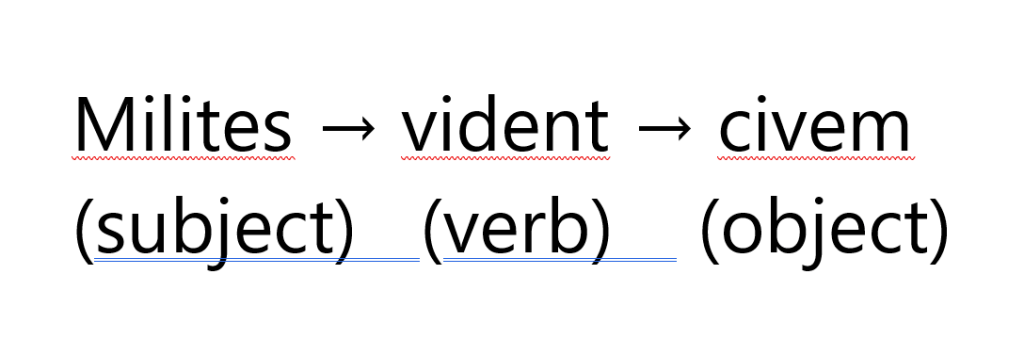
Milites civem vident.
→ The soldiers see the citizen.
- milites → nominative
- vident → verb (they)
- civem → accusative (object)
⭐ Example 5 — Nominative + PPP Phrase
Romani corpus inventum ostendunt.
→ The Romans show the discovered body.
Subject: Romani
Verb: ostendunt
Object: corpus
Support: inventum
Mini HSS Demonstration (Latin Nominative Case Basics Applied)
Sentence:
Milites civem vulneratum vident.
Yellow Step — Core Only
→ Milites civem vident.
- milites → nominative (subject)
- vident → verb
- civem → accusative (object)
Rebuild
→ Add vulneratum (“wounded”)
Final:
“The soldiers see the wounded citizen.”
The nominative anchors the entire sentence.
❓ Beginner FAQ (Lesson 4)
Q. How do I know if a noun is in the nominative?
These shapes frequently mark the doer of the action in simple sentences.
Q. Is every word ending in ‑us or ‑a automatically a subject?
Later we’ll see exceptions, but for now, treating them as “likely subjects” is the right instinct.
Q. How do I match a subject to its verb?
Check the number:
- ‑t on the verb → look for a singular nominative
- ‑nt on the verb → look for a plural nominative
The pairing is usually obvious.
Q. What if the subject comes at the end of the sentence?
Word order doesn’t decide the subject — the ending does.
A nominative at the end is still the subject.
Q. How do I know if a nominative is the real subject or just part of a descriptive phrase?
The noun that agrees is almost always the true subject.
Q. What about third‑declension nouns like miles or civis?
As long as they match the number of the verb, treat them as subjects.
Q. Can a sentence have more than one nominative?
Check which nouns agree with the verb’s number to locate the true subject(s).
Q. What if I’m unsure whether a noun is nominative or accusative?
Make the most likely structural choice, based on:
- verb ending (‑t or ‑nt),
- noun number,
- typical endings.
Latin usually “confirms” your instinct as you continue scanning.
Q. I still feel tempted to read from left to right — is that a problem?
But as soon as you see the verb, use it to stabilise the sentence.
Then the nominative → verb → object pattern becomes clear no matter where things appear.
Q. How does nominative recognition help me later with the HSS?
The core claim always includes the subject + main verb.
Recognising the nominative now means you’ll be ready for the “clean reveal” HSS produces later.
Recent Comments