
trans - one side or the other
The Latin preposition trans means ‘across’, ‘beyond’, or ‘through’, and is used to indicate movement or extension from one side to another. It governs the accusative case and appears frequently in classical Latin literature, both in literal and metaphorical contexts. Its compact form and clear directional sense make it a favourite among poets and prose writers alike.
In Virgil’s Aeneid, trans often marks heroic journeys and divine crossings. When Aeneas sails trans aequora, the phrase evokes not just physical travel but the emotional and spiritual passage through hardship. The preposition helps frame the epic’s geography, linking distant lands and peoples, and reinforcing the theme of destiny unfolding across space.
In Ovid’s Metamorphoses, trans is used with verbs of transformation and movement, such as transire and transfigurari. These compounds highlight the fluidity of identity and form, as characters pass trans boundaries of nature, gender, and mortality. The preposition thus becomes a marker of change, often subtle but profound, as when a nymph is turned into a tree or a mortal transit into myth.
Cicero uses trans in a more rhetorical and political register. In his speeches, trans may describe the crossing of legal or moral lines, as in transgredi ius, or the movement of ideas trans different domains of thought. It can also appear in spatial descriptions of Roman provinces or military campaigns, reinforcing the reach of Roman power trans flumen, trans mare, or trans Alpes.
Historians such as Livy and Tacitus employ trans to narrate military manoeuvres and territorial expansion. The preposition helps structure accounts of conquest and diplomacy, often appearing in phrases that describe armies moving trans rivers or borders. In these contexts, trans conveys both strategic intent and historical consequence.
Overall, trans in classical Latin is a preposition of passage and transformation. Whether used to describe physical movement, political ambition, or poetic metamorphosis, it signals a crossing—literal or figurative—that reshapes the narrative landscape.
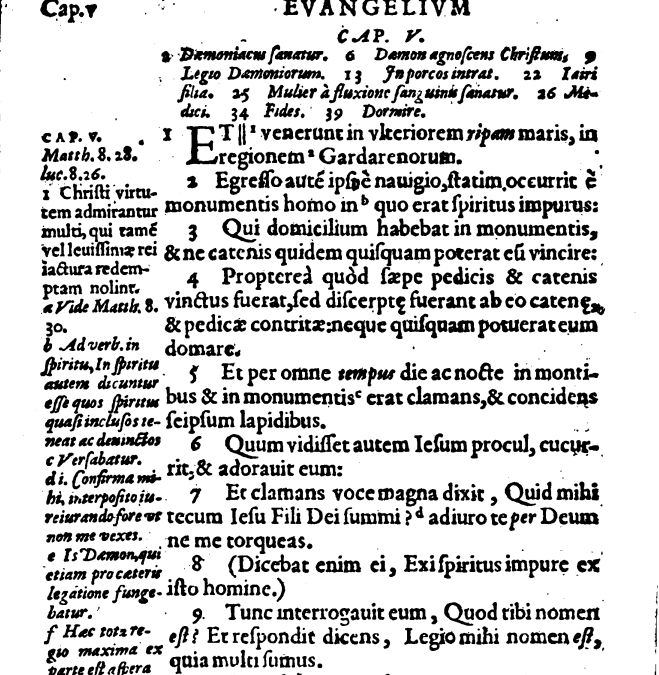
The images for these posts on Mark's gospel
Screenshots taken from the Nouum Testamentum of Théodore de Bèze, (1519-1605) ( Londini : Thomas Vautrollerius, typographus, 1587 )
Accessed from the Post Reformation Digital Library
Red and Green Vocab
The words in red and green are found among the 3057 Most Common Words in the Classical Latin texts that we will explore on CentumVerba.com and are essential to your understanding of the texts of Caesar, Vergil and Cicero. The green words appear frequently (at least five times) among Vergil's Aeneid (books I-VI), Caesar de bello Gallico (books I-V) and in Cicero's works - in Catilinam (books I-IV), de lege Manilia (also known as de Imperio Cn. Pompei), and pro Achia. These works constituted the curriculum for Latin over 4 years in American High Schools at the start of the 20th Century. The bulk of my information is taken from The Vocabulary of High School Latin by Gonzalez Lodge. I have added to these 2000 words from varioius other sources to compile my own list of The 3057 Most Common Latin Words.
The black words do not appear frequently in Classical Latin.
The red words are the first occurrences of these words in this author and this word will appear as green the next time you encounter it.
If you are serious about building your vocabulary then you should learn the red words as they occur and you should already know the green ones!
I have provided a FLASHCARD set to help - see below.
How To Read the Interactive Text
To Read the Interactive Text Below Without a Dictionary-
On a Computer: you hover over a word and get all its possible parts of speech; declensions; and conjugations.
On a Tablet: 'Tap' the word to see the definition, and to remove the 'definition box' you simply 'Tap' anywhere to the side.
Red and Green Vocab
The words in red and green are found among the 3057 Most Common Words in the Classical Latin texts that we will explore on CentumVerba.com and are essential to your understanding of the texts of Caesar, Vergil and Cicero. The green words appear frequently (at least five times) among Vergil's Aeneid (books I-VI), Caesar de bello Gallico (books I-V) and in Cicero's works - in Catilinam (books I-IV), de lege Manilia (also known as de Imperio Cn. Pompei), and pro Achia. These works constituted the curriculum for Latin over 4 years in American High Schools at the start of the 20th Century. The bulk of my information is taken from The Vocabulary of High School Latin by Gonzalez Lodge. I have added to these 2000 words from varioius other sources to compile my own list of The 3057 Most Common Latin Words.
The black words do not appear frequently in Classical Latin.
The red words are the first occurrences of these words in this author and this word will appear as green the next time you encounter it.
If you are serious about building your vocabulary then you should learn the red words as they occur and you should already know the green ones!
I have provided a FLASHCARD set to help - see below.
How To Read the Interactive Text
To Read the Interactive Text Below Without a Dictionary-
On a Phone or Tablet: ''TAP' the word to see the definition, and to remove the 'definition box' you simply 'TAP' anywhere to the side.
INTERACTIVE DICTIONARY FREE TEXT
Caput V
1 Et venerunt trans fretum maris in regionem Gerasenorum.
You Need to be at least a Trial Member to Access the Interactive Dictionary
2 Et exeunte eo de navi, statim occurrit ei de monumentis homo in spiritu immundo,
3 qui domicilium habebat in monumentis et neque catenis iam quisquam eum poterat ligare,
4 quoniam saepe compedibus et catenis vinctus dirupisset catenas et compedes comminuisset, et nemo poterat eum domare
5 et semper nocte ac die in monumentis et in montibus erat clamans et concidens se lapidibus.
6 Et videns Iesum a longe cucurrit et adoravit eum
7 et clamans voce magna dicit Quid mihi et tibi, Iesu, fili Dei Altissimi? Adiuro te per Deum, ne me torqueas.
8 Dicebat enim illi Exi, spiritus immunde, ab homine.
9 Et interrogabat eum Quod tibi nomen est? Et dicit ei Legio nomen mihi est, quia multi sumus.
I have prepared online Flashcards at CRAM.com to make learning the vocabulary much easier. I have no financial gain as the app is FREE to use.
I have created a stack of the 13 new words in this passage.
YOU NEED TO SIGN UP AS A TRIAL MEMBER TO ACCESS THE FLASHCARDS
Here is the link to the FLASHCARDS
USING THE FLASHCARD APP:
To make the most of the online Flashcards use the "Click or use spacebar to begin" and the Latin word should appear. (The 'Shuffle' button will take the cards out of alphabetical order.) Type 'H' to get the conjugation / declension of the word if you want to see it. 'H' takes tyou back to the word. Click 'See Answer' or use the Spacebar to see the English.
If you were correct or close enough then select "I was right" or else "I was wrong". After you have completed the set it will start again but it will only display the ones you got wrong.
Continue through this process to learn all the words. I hope this is helpful!
Recent Comments