
quam - more than...
The Latin word quam is remarkably versatile, functioning as an adverb, conjunction, and relative particle across a wide array of syntactic environments. Its core meaning—‘how’ or ‘than’—shifts depending on context, allowing authors to express comparison, degree, exclamation, and interrogation with precision and subtlety.
In comparative constructions, quam introduces the second term of comparison, as in maior quam speraveram. This usage is foundational in both prose and poetry, enabling nuanced evaluations of size, quality, or intensity. Cicero frequently employs quam in philosophical and rhetorical contexts to contrast ideas or moral values, as in nihil est melius quam virtus, where quam sharpens the ethical distinction.
As an interrogative adverb, quam appears in direct and indirect questions, typically modifying adjectives or adverbs: quam celeriter venit? or rogavit quam celeriter venisset. This interrogative function is common in narrative prose, especially in Livy and Tacitus, where it conveys uncertainty or inquiry without disrupting the flow of reported speech.
In exclamatory expressions, quam intensifies emotion or emphasis, often paired with adjectives: quam pulchra est! This usage is prominent in elegiac poetry, where quam helps convey heightened feeling or admiration. Propertius and Tibullus use it to underscore beauty, loss, or longing, drawing attention to subjective experience through syntactic emphasis.
Poets also exploit quam in similes and comparisons to create vivid imagery. In Virgil’s Aeneid, quam introduces analogies that enrich the epic’s descriptive power, as in velut quam si..., where the comparison deepens the reader’s understanding of character or action. The placement of quam within the verse often contributes to metrical balance and rhetorical force.
Grammatically, quam governs adjectives and adverbs in comparative degree, but it also appears with pronouns and conjunctions, as in quam ob rem, meaning ‘wherefore’. This idiomatic use is frequent in legal and philosophical texts, where logical clarity is essential.
In sum, quam is a syntactic linchpin in Latin, enabling authors to articulate comparison, inquiry, and emotion with economy and elegance. Its adaptability across genres and registers reflects the linguistic precision and expressive range that characterize classical Latin literature.
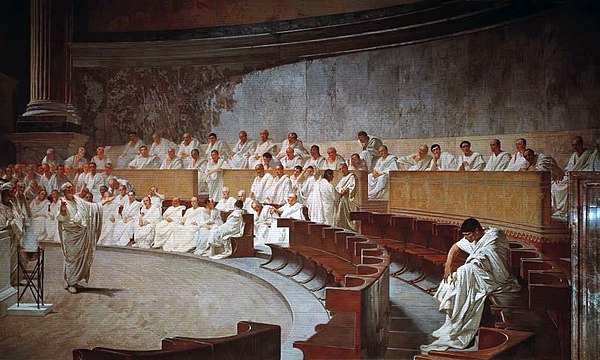
Today's Image: Roman senator Cicero (106-43 BCE) denouncing Catiline's conspiracy to overthrow the Republic in the Roman senate
Source: A fresco by Cesare Maccari (1840-1919) (Public Domain)
Site: Worldhistory.org
Here is a text only version. (See below for an interactive version)
23 Post haec Iason et Medea e Thessalia expulsi ad urbem Corinthum venerunt, cuius urbis Creon quidam regnum tum obtinebat. Erat autem Creonti filia una, nomine Glauce. Quam cum vidisset, Iason constituit Medeam uxorem suam repudiare eo consilio, ut Glaucen in matrimonium duceret.
At Medea, ubi intellexit quae ille in animo haberet, ira graviter commota, iure iurando confirmavit se tantam iniuriam ulturam. Hoc igitur consilium cepit. Vestem paravit summa arte contextam et variis coloribus tinctam. Hanc diro quodam infecit veneno, cuius vis talis erat ut si quis eam vestem induisset corpus eius quasi igni ureretur. Hoc facto vestem ad Glaucen misit: illa autem nihil mali suspicans donum libenter accepit et vestem novam more feminarum statim induit.
Red and Green Vocab
The words in red and green are found among the 3057 Most Common Words in the Classical Latin texts that we will explore on CentumVerba.com and are essential to your understanding of the texts of Caesar, Vergil and Cicero. The green words appear frequently (at least five times) among Vergil's Aeneid (books I-VI), Caesar de bello Gallico (books I-V) and in Cicero's works - in Catilinam (books I-IV), de lege Manilia (also known as de Imperio Cn. Pompei), and pro Achia. These works constituted the curriculum for Latin over 4 years in American High Schools at the start of the 20th Century. The bulk of my information is taken from The Vocabulary of High School Latin by Gonzalez Lodge. I have added to these 2000 words from varioius other sources to compile my own list of The 3057 Most Common Latin Words.
The black words do not appear frequently in Classical Latin.
The red words are the first occurrences of these words in this author and this word will appear as green the next time you encounter it.
If you are serious about building your vocabulary then you should learn the red words as they occur and you should already know the green ones!
I have provided a FLASHCARD set to help - see below.
How To Read the Interactive Text
To Read the Interactive Text Below Without a Dictionary-
On a Computer: you hover over a word and get all the possible parts of speech; declensions; and conjugations of every word.
Red and Green Vocab
The words in red and green are found among the 3057 Most Common Words in the Classical Latin texts that we will explore on CentumVerba.com and are essential to your understanding of the texts of Caesar, Vergil and Cicero. The green words appear frequently (at least five times) among Vergil's Aeneid (books I-VI), Caesar de bello Gallico (books I-V) and in Cicero's works - in Catilinam (books I-IV), de lege Manilia (also known as de Imperio Cn. Pompei), and pro Achia. These works constituted the curriculum for Latin over 4 years in American High Schools at the start of the 20th Century. The bulk of my information is taken from The Vocabulary of High School Latin by Gonzalez Lodge. I have added to these 2000 words from varioius other sources to compile my own list of The 3057 Most Common Latin Words.
The black words do not appear frequently in Classical Latin.
The red words are the first occurrences of these words in this author and this word will appear as green the next time you encounter it.
If you are serious about building your vocabulary then you should learn the red words as they occur and you should already know the green ones!
I have provided a FLASHCARD set to help - see below.
How To Read the Interactive Text
To Read the Interactive Text Below Without a Dictionary-
On a Phone or Tablet: don't 'hover' -'tap' the word. To remove the 'definition box' you 'tap' to the side of the text box.
INTERACTIVE DICTIONARY FREE TEXT
23 Post haec Iason et Medea e Thessalia expulsi ad urbem Corinthum venerunt, cuius urbis Creon quidam regnum tum obtinebat. You Need to be a Member to Access the Interactive Dictionary
Erat autem Creonti filia una, nomine Glauce. Quam cum vidisset, Iason constituit Medeam uxorem suam repudiare eo consilio, ut Glaucen in matrimonium duceret.
At Medea, ubi intellexit quae ille in animo haberet, ira graviter commota, iure iurando confirmavit se tantam iniuriam ulturam.
Hoc igitur consilium cepit. Vestem paravit summa arte contextam et variis coloribus tinctam.
Hanc diro quodam infecit veneno, cuius vis talis erat ut si quis eam vestem induisset corpus eius quasi igni ureretur.
Hoc facto vestem ad Glaucen misit: illa autem nihil mali suspicans donum libenter accepit et vestem novam more feminarum statim induit.
I have prepared online Flashcards at CRAM.com to make learning the vocabulary much easier. I have no financial gain from you using the app as it is FREE to use.
I have created a stack of the 15 new words in this passage.
YOU NEED TO SIGN UP AS A TRIAL MEMBER TO ACCESS THE FLASHCARDS
Here is the link to the FLASHCARDS
USING THE FLASHCARD APP:
To make the most of the online Flashcards use the "Click or use spacebar to begin" and the Latin word should appear. (The 'Shuffle' button will take the cards out of alphabetical order.) Type 'H' to get the conjugation / declension of the word if you want to see it. 'H' takes tyou back to the word. Click 'See Answer' or use the Spacebar to see the English.
If you were correct or close enough then select "I was right" or else "I was wrong". After you have completed the set it will start again but it will only display the ones you got wrong.
Continue through this process to learn all the words. I hope this is helpful!
Recent Comments