
consilium - when a plan comes together
The Latin noun consilium, a neuter second-declension word, encompasses meanings such as 'plan', 'advice', 'counsel', and 'deliberation'. Its semantic range allows it to function in both abstract and concrete contexts, making it a versatile term in classical Latin literature.
In Cicero’s oratory and philosophical works, consilium is frequently employed to denote strategic thinking or prudent judgment. He uses it to distinguish between rash action and thoughtful deliberation, often contrasting impetus with consilium. In De Officiis, for instance, consilium is associated with moral reasoning and the careful weighing of duties. It also appears in political contexts, referring to advisory bodies or the collective wisdom of the Senate.
Caesar’s Commentarii de Bello Gallico uses consilium to describe military planning and tactical decisions. Phrases like consilium capere or consilium mutare reflect the dynamic nature of command decisions. Here, consilium is not merely abstract advice but a decisive act that shapes the course of campaigns. The term also appears in descriptions of enemy actions, underscoring its role in strategic narrative.
In Livy’s historiography, consilium often marks the turning point in political or military episodes. It may refer to the deliberations of generals or magistrates, or to the wisdom—or folly—of collective decision-making. Livy sometimes juxtaposes consilium with fortuna, suggesting a tension between human planning and divine or chance outcomes.
Ovid uses consilium more sparingly, but when it appears, it tends to carry a rhetorical or ironic tone. In Metamorphoses, consilium may be invoked in dialogues between gods or mortals, often to highlight the futility or cleverness of a plan. Its presence in poetic contexts adds a layer of reflection or critique to the narrative.
In Roman comedy, consilium is frequently part of the plot machinery. Characters devise schemes—often misguided or humorous—and the term is used to signal the planning stage of deception or resolution. This usage reflects everyday speech and the practical concerns of domestic life.
Across genres, consilium serves as a linguistic marker of deliberation, strategy, and judgment, adapting fluidly to the rhetorical and thematic needs of each author.
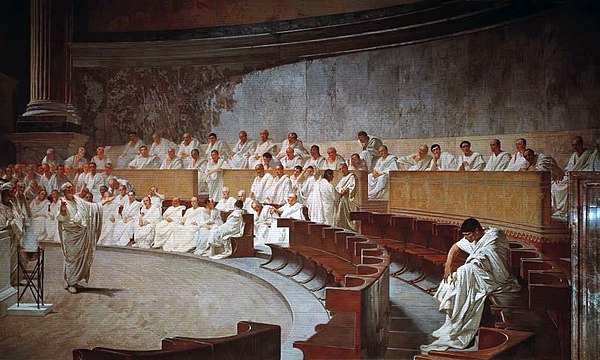
Today's Image: Roman senator Cicero (106-43 BCE) denouncing Catiline's conspiracy to overthrow the Republic in the Roman senate
Source: A fresco by Cesare Maccari (1840-1919) (Public Domain)
Site: Worldhistory.org
Here is a text only version. (See below for an interactive version)
23 Post haec Iason et Medea e Thessalia expulsi ad urbem Corinthum venerunt, cuius urbis Creon quidam regnum tum obtinebat. Erat autem Creonti filia una, nomine Glauce. Quam cum vidisset, Iason constituit Medeam uxorem suam repudiare eo consilio, ut Glaucen in matrimonium duceret. At Medea, ubi intellexit quae ille in animo haberet, ira graviter commota, iure iurando confirmavit se tantam iniuriam ulturam.
Hoc igitur consilium cepit. Vestem paravit summa arte contextam et variis coloribus tinctam. Hanc diro quodam infecit veneno, cuius vis talis erat ut si quis eam vestem induisset corpus eius quasi igni ureretur. Hoc facto vestem ad Glaucen misit: illa autem nihil mali suspicans donum libenter accepit et vestem novam more feminarum statim induit.
How To Read the Interactive Text
To Read the Interactive Text Below Without a Dictionary-
On a Computer: you hover over a word and get all the possible parts of speech; declensions; and conjugations of every word.
How To Read the Interactive Text
To Read the Interactive Text Below Without a Dictionary-
On a Phone or Tablet: don't 'hover' -'tap' the word. To remove the 'definition box' you 'tap' to the side of the text box.
INTERACTIVE DICTIONARY FREE TEXT
23 Post haec Iason et Medea e Thessalia expulsi ad urbem Corinthum venerunt, cuius urbis Creon quidam regnum tum obtinebat.
You Need to be a Member to Access the Interactive Dictionary
Erat autem Creonti filia una, nomine Glauce.
Quam cum vidisset, Iason constituit Medeam uxorem suam repudiare eo consilio, ut Glaucen in matrimonium duceret.
At Medea, ubi intellexit quae ille in animo haberet, ira graviter commota, iure iurando confirmavit se tantam iniuriam ulturam.
Hoc igitur consilium cepit. Vestem paravit summa arte contextam et variis coloribus tinctam.
Hanc diro quodam infecit veneno, cuius vis talis erat ut si quis eam vestem induisset corpus eius quasi igni ureretur.
Hoc facto vestem ad Glaucen misit: illa autem nihil mali suspicans donum libenter accepit et vestem novam more feminarum statim induit.
20 Tandem post multa pericula Iason in eundem locum pervenit unde olim profectus erat.
You Need to be a Member to Access the Interactive Dictionary
Tum e navi egressus ad regem Peliam, qui regnum adhuc obtinebat, statim se contulit et vellere aureo monstrato ab eo postulavit ut regnum sibi traderetur;
Pelias enim pollicitus erat, si Iason vellus rettulisset, se regnum ei traditurum.
Postquam Iason ostendit quid fieri vellet Pelias primum nihil respondit, sed diu in eadem tristitia tacitus permansit; tandem ita locutus est. “Vides me aetate iam esse confectum neque dubium est quin dies supremus mihi adsit.
Liceat igitur mihi dum vivam hoc regnum obtinere; tum, postquam ego e vita discesserd, tu in meum locum venies.”
Hac oratione adductus Iason respondit se id facturum quod ille rogasset.
Recent Comments