
tempestas - in a teacup?
In Latin, tempestas primarily means ‘storm’ or ‘weather,’ but its semantic range extends to include ‘season,’ ‘period of time,’ or even metaphorical ‘turmoil.’ As a feminine third-declension noun, tempestas is both a natural and narrative force throughout Roman literature, frequently invoked to signal danger, change, or divine intervention.
In Vergil’s Aeneid, tempestas plays a pivotal role. The first book opens with Aeneas caught in a violent storm sent by Juno: intonuere poli, et crebris micat ignibus aether; praesentemque viris intentant omnia mortem, a moment of elemental chaos summoned to disrupt destiny. The tempestas here is not just weather—it is the embodied wrath of gods and the harbinger of heroic trial. Later, Neptune calms the tempestas, a motif reinforcing divine hierarchy and the restored order.
Cicero uses tempestas metaphorically in oratory and philosophy. In Pro Sestio, he describes political upheaval as tempestas rei publicae, ‘a storm of the republic,’ suggesting civic danger as elemental and destructive. Likewise, in Tusculanae Disputationes, he contrasts internal peace with emotional tempestates animi—‘storms of the soul’—linking Stoic equanimity with meteorological imagery.
Livy, chronicling the early Roman Republic, often presents literal tempestates as omens or portents. A sudden tempestas might interrupt battle or temple rites, prompting religious interpretation. In these moments, tempestas serves as a narrative pivot, indicating divine displeasure or the fragility of human plans.
Ovid employs tempestas lyrically and symbolically. In Metamorphoses, storms drive transformation, destruction, or divine punishment. In the flood narrative of Deucalion and Pyrrha, the tempestas becomes a total reset of humanity, a cleansing chaos: tempestasque illas et inundantia caeli lumina flammarumque ruinas evoke the fusion of elements undone.
Even in Horace’s odes, tempestas becomes metaphor: moral confusion, social upheaval, or the unpredictability of fate. In Odes 1.5, he compares a jilted lover to a sailor caught in a past tempestas, metaphorizing emotional trauma.
Thus, across Roman genres, tempestas is not merely meteorological—it embodies disruption, trial, or divine will. Whether battering ships, republics, or souls, it marks the threshold of chaos and test of character. In every storm, Roman authors find not just weather—but meaning.
Today's Artwork:
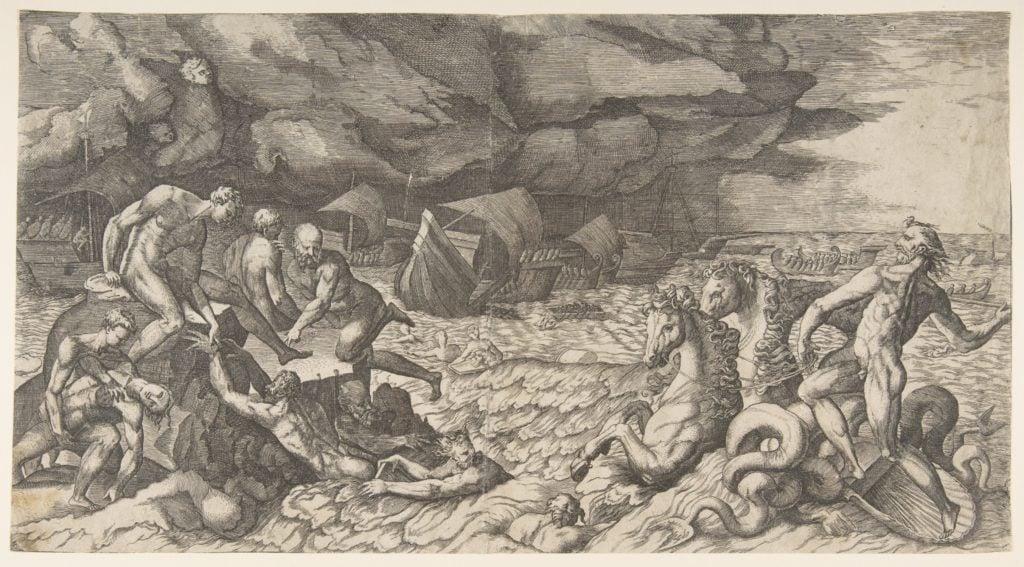
Image: Neptune calming the Tempest Aeolus raised against the Fleet of Aeneas
Artist: Giulio Bonasone (Italian, active Rome and Bologna, 1531–after 1576)
Date: 1531–76 (unknown)
Medium: Engraving
Source: Met Museum (New York)
Here is a text only version. (See below for an interactive version)
Olli subridens hominum sator atque deorum,
voltu, quo caelum tempestatesque serenat,
oscula libavit natae, dehinc talia fatur:
“Parce metu, Cytherea: manent immota tuorum
fata tibi; cernes urbem et promissa Lavini
moenia, sublimemque feres ad sidera caeli
magnanimum Aenean; neque me sententia vertit.
Hic tibi (fabor enim, quando haec te cura remordet,
longius et volvens fatorum arcana movebo)
bellum ingens geret Italia, populosque feroces
contundet, moresque viris et moenia ponet,
tertia dum Latio regnantem viderit aestas,
ternaque transierint Rutulis hiberna subactis.
At puer Ascanius, cui nunc cognomen Iulo
additur,—Ilus erat, dum res stetit Ilia regno,—
triginta magnos volvendis mensibus orbis
imperio explebit, regnumque ab sede Lavini
transferet, et longam multa vi muniet Albam.
Need Help Understanding the Latin?
You might find it helpful to start with the Side-by-Side Version which allows you to see my own very literal translation of the text which is almost a word-for-word translation - in an attempt to make it easier to understand the Latin!
Finally come back to this page - Classical Text and you should be able to better understand and competently read the original Latin text.
Vocabulary Version
I have prepared a Vocabulary Version of the passage (link at bottom of the page) which highlights the 3057 Most Common Words in the texts of Vergil, Caesar and Cicero that we will explore on CentumVerba.com
If you are serious about building your vocabulary, the FLASHCARD set should help you learn them.
How To Read the Interactive Text
To Read the Interactive Text Below Without a Dictionary-
On a Computer: you hover over a word and get all the possible parts of speech; declensions; and conjugations of every word.
Need Help Understanding the Latin?
You might find it helpful to start with the Side-by-Side Version which allows you to see my own very literal translation of the text which is almost a word-for-word translation - in an attempt to make it easier to understand the Latin!
Finally come back to this page - Classical Text and you should be able to better understand and competently read the original Latin text.
Vocabulary Version
I have prepared a Vocabulary Version of the passage (link at bottom of the page) which highlights the 3057 Most Common Words in the texts of Vergil, Caesar and Cicero that we will explore on CentumVerba.com
If you are serious about building your vocabulary, the FLASHCARD set should help you learn them.
How To Read the Interactive Text
To Read the Interactive Text Below Without a Dictionary-
On a Phone or Tablet: don't 'hover' -'tap' the word. To remove the 'definition box' you 'tap' to the side of the text box.
INTERACTIVE DICTIONARY FREE TEXT
Olli subridens hominum sator atque deorum, voltu,
You Need to be a Member to Access the Interactive Dictionary
quo caelum tempestatesque serenat, oscula libavit natae, dehinc talia fatur:
“Parce metu, Cytherea: manent immota tuorum fata tibi; cernes urbem et promissa Lavini moenia, sublimemque feres ad sidera caeli magnanimum Aenean; neque me sententia vertit.
Hic tibi (fabor enim, quando haec te cura remordet, longius et volvens fatorum arcana movebo) bellum ingens geret Italia,
populosque feroces contundet, moresque viris et moenia ponet, tertia dum Latio regnantem viderit aestas, ternaque transierint Rutulis hiberna subactis.
At puer Ascanius, cui nunc cognomen Iulo additur, —Ilus erat, dum res stetit Ilia regno,—
triginta magnos volvendis mensibus orbis imperio explebit, regnumque ab sede Lavini transferet, et longam multa vi muniet Albam.
Recent Comments