
etiam - even still
The Latin adverb etiam, commonly translated as ‘also’, ‘even’, or ‘still’, carries flexible emphasis across authors and genres. Rather than simply adding elements, it shades meaning, modifies tone, and calibrates rhetorical weight.
In Cicero’s speeches, etiam is a powerful tool of argumentation. He uses it to introduce additional evidence or to stress an already compelling point. In Pro Archia, when arguing for poetic value in Roman civic life, Cicero adds etiam before less expected virtues—suggesting not mere accumulation, but a deliberate escalation. Often, etiam leads into clauses that heighten emotional or ethical appeal, as when Cicero urges the Senate to consider not only justice but etiam clemency. It sharpens the edge of persuasion without resorting to verbosity.
Caesar, in the Commentarii, uses etiam to mark logistical details and strategic priorities. While narrating campaigns, he often includes etiam when listing preparations or alliances, signaling additions that carry tactical weight. When stating that troops secured grain, weapons, and etiam reinforcements, he implies that the last element completes or strengthens the position. Etiam here is not casual; it reflects calculated thoroughness.
Livy deploys etiam to layer historical consequence. In Ab Urbe Condita, it often appears when expanding on social or political causes. When narrating unrest, Livy includes etiam to suggest systemic depth: not only were citizens angry, but etiam neglected by leadership. This usage encourages readers to consider multiplicity rather than isolated causes.
Poets use etiam sparingly but meaningfully. In Ovid’s Metamorphoses, etiam heightens the emotional stakes of transformations. When characters plead for mercy, their suffering is made more vivid through phrases like etiam nunc doleo—‘even now I grieve’. Virgil uses etiam to reinforce divine intent or mortal cost, often sliding it between verbs to suggest continuity or excess.
In classical Latin, etiam does more than connect ideas—it orchestrates emphasis, adjusting the semantic gravity of a clause. Whether in oratory, history, or poetry, its function is precise: guiding the reader toward recognition, addition, or emotional depth without overstating the case. It is a word of quiet insistence and deliberate pacing.
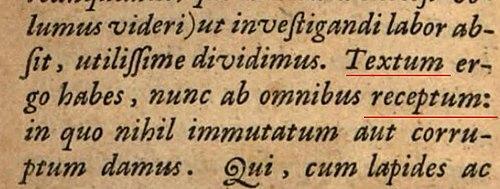
Today's Image: Elzevier 1633 edition
"A text therefore you have, that has now by everyone been received" (emphasis added): the words from the Elzevier 1633 edition, in Latin, from which the term "Textus receptus" was derived
Source: wikipedia.org
etiam - even still
he Latin adverb etiam, commonly translated as ‘also’, ‘even’, or ‘still’, carries flexible emphasis across authors and genres. Rather than simply adding elements, it shades meaning, modifies tone, and calibrates rhetorical weight.
In Cicero’s speeches, etiam is a powerful tool of argumentation. He uses it to introduce additional evidence or to stress an already compelling point. In Pro Archia, when arguing for poetic value in Roman civic life, Cicero adds etiam before less expected virtues—suggesting not mere accumulation, but a deliberate escalation. Often, etiam leads into clauses that heighten emotional or ethical appeal, as when Cicero urges the Senate to consider not only justice but etiam clemency. It sharpens the edge of persuasion without resorting to verbosity.
Caesar, in the Commentarii, uses etiam to mark logistical details and strategic priorities. While narrating campaigns, he often includes etiam when listing preparations or alliances, signaling additions that carry tactical weight. When stating that troops secured grain, weapons, and etiam reinforcements, he implies that the last element completes or strengthens the position. Etiam here is not casual; it reflects calculated thoroughness.
Livy deploys etiam to layer historical consequence. In Ab Urbe Condita, it often appears when expanding on social or political causes. When narrating unrest, Livy includes etiam to suggest systemic depth: not only were citizens angry, but etiam neglected by leadership. This usage encourages readers to consider multiplicity rather than isolated causes.
Poets use etiam sparingly but meaningfully. In Ovid’s Metamorphoses, etiam heightens the emotional stakes of transformations. When characters plead for mercy, their suffering is made more vivid through phrases like etiam nunc doleo—‘even now I grieve’. Virgil uses etiam to reinforce divine intent or mortal cost, often sliding it between verbs to suggest continuity or excess.
In classical Latin, etiam does more than connect ideas—it orchestrates emphasis, adjusting the semantic gravity of a clause. Whether in oratory, history, or poetry, its function is precise: guiding the reader toward recognition, addition, or emotional depth without overstating the case. It is a word of quiet insistence and deliberate pacing.
Today's Image: Elzevier 1633 edition
"A text therefore you have, that has now by everyone been received" (emphasis added): the words from the Elzevier 1633 edition, in Latin, from which the term "Textus receptus" was derived
Source: wikipedia.org
Red and Green Vocab
The words in red and green are found among the 3057 Most Common Words in the Classical Latin texts that we will explore on CentumVerba.com and are essential to your understanding of the texts of Caesar, Vergil and Cicero. The green words appear frequently (at least five times) among Vergil's Aeneid (books I-VI), Caesar de bello Gallico (books I-V) and in Cicero's works - in Catilinam (books I-IV), de lege Manilia (also known as de Imperio Cn. Pompei), and pro Achia. These works constituted the curriculum for Latin over 4 years in American High Schools at the start of the 20th Century. The bulk of my information is taken from The Vocabulary of High School Latin by Gonzalez Lodge. I have added to these 2000 words from varioius other sources to compile my own list of The 3057 Most Common Latin Words.
The black words do not appear frequently in Classical Latin.
The red words are the first occurrences of these words in this author and this word will appear as green the next time you encounter it.
If you are serious about building your vocabulary then you should learn the red words as they occur and you should already know the green ones!
I have provided a FLASHCARD set to help - see below.
How To Read the Interactive Text
To Read the Interactive Text Below Without a Dictionary-
On a Computer: you hover over a word and get all the possible parts of speech; declensions; and conjugations of every word.
Red and Green Vocab
The words in red and green are found among the 3057 Most Common Words in the Classical Latin texts that we will explore on CentumVerba.com and are essential to your understanding of the texts of Caesar, Vergil and Cicero. The green words appear frequently (at least five times) among Vergil's Aeneid (books I-VI), Caesar de bello Gallico (books I-V) and in Cicero's works - in Catilinam (books I-IV), de lege Manilia (also known as de Imperio Cn. Pompei), and pro Achia. These works constituted the curriculum for Latin over 4 years in American High Schools at the start of the 20th Century. The bulk of my information is taken from The Vocabulary of High School Latin by Gonzalez Lodge. I have added to these 2000 words from varioius other sources to compile my own list of The 3057 Most Common Latin Words.
The black words do not appear frequently in Classical Latin.
The red words are the first occurrences of these words in this author and this word will appear as green the next time you encounter it.
If you are serious about building your vocabulary then you should learn the red words as they occur and you should already know the green ones!
I have provided a FLASHCARD set to help - see below.
How To Read the Interactive Text
To Read the Interactive Text Below Without a Dictionary-
On a Phone or Tablet: don't 'hover' -'tap' the word. To remove the 'definition box' you 'tap' to the side of the text box.
INTERACTIVE DICTIONARY FREE TEXT
A quo non receptus etiam ad me venire ausus es, atque ut domi meae te adservarem rogasti.
You Need to be a Member to Access the Interactive Dictionary
cum a me quoque id responsum tulisses, me nullo modo posse isdem parietibus tuto esse tecum, quia magno in periculo essem quod isdem moenibus contineremur, ad Q. Metellum praetorem venisti.
A quo repudiatus ad sodalem tuum, virum optimum, M. Metellum demigrasti, quem tu videlicet et ad custodiendum te diligentissimum et ad suspicandum sagacissimum et ad vindicandum fortissimum fore putasti.
sed quam longe videtur a carcere atque a vinculis abesse debere qui se ipse iam dignum custodia iudicarit?
[20] quae cum ita sint, Catilina, dubitas, si emori aequo animo non potes, abire in aliquas terras et vitam istam multis suppliciis iustis debitisque ereptam fugae solitudinique mandare?
I have prepared online Flashcards at CRAM.com to make learning the vocabulary much easier. I have no financial gain from you using the app as it is FREE to use.
I have created a stack of the 16 new words in this passage.
Here is the link to the FLASHCARDS
USING THE FLASHCARD APP:
To make the most of the online Flashcards use the "Click or use spacebar to begin" and the Latin word should appear. (The 'Shuffle' button will take the cards out of alphabetical order.) Type 'H' to get the conjugation / declension of the word if you want to see it. 'H' takes tyou back to the word. Click 'See Answer' or use the Spacebar to see the English.
If you were correct or close enough then select "I was right" or else "I was wrong". After you have completed the set it will start again but it will only display the ones you got wrong.
Continue through this process to learn all the words. I hope this is helpful!
Recent Comments