
Pater
In Roman classical literature, the concept of 'pater'—Latin for father—embodied far more than biological parenthood. It was a symbol of authority, duty, and moral leadership, deeply woven into the Roman understanding of family, society, and even the cosmos. The paterfamilias, or male head of household, held patria potestas—legal power over his children, wife, slaves, and property. This role was not merely administrative; it was ideological, representing the Roman ideals of auctoritas, disciplina, and pietas.
In epic literature, the figure of the father often serves as a moral compass. In Virgil's Aeneid, Aeneas is frequently referred to as pater Aeneas, emphasizing his role not only as the biological father of Ascanius but as the figurative father of the Roman people. His decisions, often painful and self-denying, are guided by duty to his lineage and destiny. The term pater thus becomes synonymous with sacrifice, leadership, and the burden of legacy.
Cicero, in his philosophical and rhetorical works, uses the image of the father to articulate civic responsibility. In De Re Publica and De Officiis, he likens the ideal statesman to a father guiding his household, suggesting that the Roman state itself is a kind of extended family. The Senate was known as the patres conscripti, reinforcing the idea that governance was a paternal duty.
Religious texts and rituals also reflect this paternal framework. Gods such as Jupiter and Mars were addressed as pater, linking divine authority to the human father figure. This usage sanctified the father's role, aligning it with cosmic order and divine will.
In comedy, playwrights like Plautus and Terence often depict fathers as overbearing or out of touch, creating tension with younger characters. These portrayals reflect social anxieties about generational change and the limits of paternal control.
Ultimately, the Roman 'pater' in literature is not just a familial figure but a cultural archetype—protector, disciplinarian, and moral guide. His presence anchors Roman ideals of hierarchy, responsibility, and continuity, making him a central figure in both private life and public imagination.
Today's Image
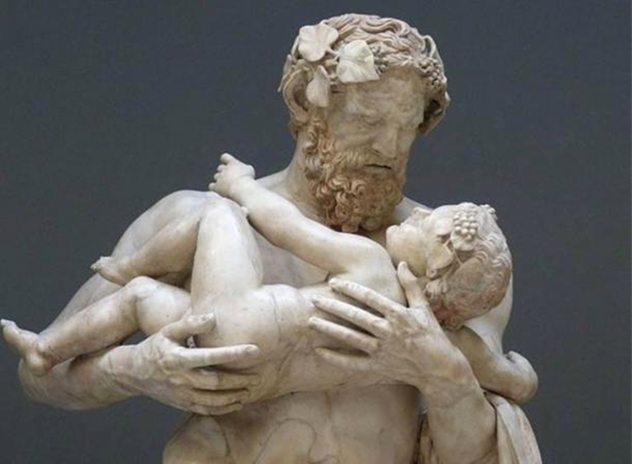
Father and child sculpture
Artist: unknown
Here is a text only version. (See below for an interactive version)
[13.5] Se ita a patribus maioribusque suis didicisse, ut magis virtute contenderent quam dolo aut insidiis niterentur. Quare ne committeret ut is locus ubi constitissent ex calamitate populi Romani et internecione exercitus nomen caperet aut memoriam proderet.
CAPUT XIV
His Caesar ita respondit: eo sibi minus dubitationis dari, quod eas res quas legati Helvetii commemorassent memoria teneret, atque eo gravius ferre quo minus merito populi Romani accidissent; qui si alicuius iniuriae sibi conscius fuisset, non fuisse difficile cavere; sed eo deceptum, quod neque commissum a se intellegeret quare timeret neque sine causa timendum putaret.
Quod si veteris contumeliae oblivisci vellet, num etiam recentium iniuriarum, quod eo invito iter per provinciam per vim temptassent, quod Haeduos, quod Ambarros, quod Allobrogas vexassent, memoriam deponere posse?
Here is a text only version. (See below for an interactive version)
[13.5] Se ita a patribus maioribusque suis didicisse, ut magis virtute contenderent quam dolo aut insidiis niterentur. Quare ne committeret ut is locus ubi constitissent ex calamitate populi Romani et internecione exercitus nomen caperet aut memoriam proderet.
CAPUT XIV
His Caesar ita respondit: eo sibi minus dubitationis dari, quod eas res quas legati Helvetii commemorassent memoria teneret, atque eo gravius ferre quo minus merito populi Romani accidissent; qui si alicuius iniuriae sibi conscius fuisset, non fuisse difficile cavere; sed eo deceptum, quod neque commissum a se intellegeret quare timeret neque sine causa timendum putaret.
Quod si veteris contumeliae oblivisci vellet, num etiam recentium iniuriarum, quod eo invito iter per provinciam per vim temptassent, quod Haeduos, quod Ambarros, quod Allobrogas vexassent, memoriam deponere posse
Need Help Understanding the Latin?
You might find it helpful to start with the Side-by-Side Version which allows you to see my own very literal translation of the text which is almost a word-for-word translation - in an attempt to make it easier to understand the Latin!
Finally come back to this page - Classical Text and you should be able to better understand and competently read the original Latin text.
Vocabulary Version
I have prepared a Vocabulary Version of the passage (link at bottom of the page) which highlights the 3057 Most Common Words in the texts of Vergil, Caesar and Cicero that we will explore on CentumVerba.com
If you are serious about building your vocabulary, the FLASHCARD set should help you learn them.
How To Read the Interactive Text
To Read the Interactive Text Below Without a Dictionary-
On a Computer: you hover over a word and get all the possible parts of speech; declensions; and conjugations of every word.
Need Help Understanding the Latin?
You might find it helpful to start with the Side-by-Side Version which allows you to see my own very literal translation of the text which is almost a word-for-word translation - in an attempt to make it easier to understand the Latin!
Finally come back to this page - Classical Text and you should be able to better understand and competently read the original Latin text.
Vocabulary Version
I have prepared a Vocabulary Version of the passage (link at bottom of the page) which highlights the 3057 Most Common Words in the texts of Vergil, Caesar and Cicero that we will explore on CentumVerba.com
If you are serious about building your vocabulary, the FLASHCARD set should help you learn them.
How To Read the Interactive Text
To Read the Interactive Text Below Without a Dictionary-
On a Phone or Tablet: don't 'hover' -'tap' the word. To remove the 'definition box' you 'tap' to the side of the text box.
Dictionary-Free Interactive Text
[13.5] Se ita a patribus maioribusque suis didicisse, ut magis virtute contenderent quam dolo aut insidiis niterentur.
You Need to be a Member to Access the Interactive Dictionary
Quare ne committeret ut is locus ubi constitissent ex calamitate populi Romani et internecione exercitus nomen caperet aut memoriam proderet.
CAPUT XIV
His Caesar ita respondit: eo sibi minus dubitationis dari, quod eas res quas legati Helvetii commemorassent memoria teneret, atque eo gravius ferre quo minus merito populi Romani accidissent;
qui si alicuius iniuriae sibi conscius fuisset, non fuisse difficile cavere; sed eo deceptum, quod neque commissum a se intellegeret quare timeret neque sine causa timendum putaret.
Quod si veteris contumeliae oblivisci vellet, num etiam recentium iniuriarum, quod eo invito iter per provinciam per vim temptassent, quod Haeduos, quod Ambarros, quod Allobrogas vexassent, memoriam deponere posse?
INTERACTIVE DICTIONARY-FREE TEXT
[13.5] Se ita a patribus maioribusque suis didicisse, ut magis virtute contenderent quam dolo aut insidiis niterentur.
You Need to be a Member to Access the Interactive Dictionary
Quare ne committeret ut is locus ubi constitissent ex calamitate populi Romani et internecione exercitus nomen caperet aut memoriam proderet.
CAPUT XIV
His Caesar ita respondit: eo sibi minus dubitationis dari, quod eas res quas legati Helvetii commemorassent memoria teneret, atque eo gravius ferre quo minus merito populi Romani accidissent;
qui si alicuius iniuriae sibi conscius fuisset, non fuisse difficile cavere; sed eo deceptum, quod neque commissum a se intellegeret quare timeret neque sine causa timendum putaret.
Quod si veteris contumeliae oblivisci vellet, num etiam recentium iniuriarum, quod eo invito iter per provinciam per vim temptassent, quod Haeduos, quod Ambarros, quod Allobrogas vexassent, memoriam deponere posse?
Recent Comments