
se - time for reflection
In classical Latin, the reflexive pronoun se is a third-person form used to indicate that the subject of a clause is also the object of the action. It has no nominative case, as it cannot serve as the subject. Its forms include se (accusative and ablative), sui (genitive), and sibi (dative). These forms are invariant with respect to number and gender, and always refer back to the subject of the clause in which they appear.
The use of se is essential for clarity in Latin, especially in indirect statements and complex sentences. For example, in Caesar dixit se venturum esse, se refers to Caesar himself, not someone else. This reflexive structure allows Latin to maintain syntactic precision without repeating names or using ambiguous pronouns.
In narrative prose, especially in Caesar’s Commentarii de Bello Gallico, se appears frequently to maintain a tight narrative focus. It is also common in indirect discourse, where it helps distinguish between the speaker and the subject of the reported speech. In poetry, se often carries emotional or dramatic weight. In Virgil’s Aeneid, Dido’s tragic end is marked by the line se ferro conicit, emphasising her self-directed action and despair.
In poetry, se often carries emotional or dramatic weight. In Virgil’s Aeneid, characters use se in moments of despair or resolve, such as when Dido prepares to take her own life: se ferro conicit. The reflexive here intensifies the action, emphasising that the subject is both agent and recipient of the deed.
Latin also uses se in idiomatic expressions and reflexive verb constructions. Phrases like se conferre (to betake oneself), se recipere (to retreat), and se praebere (to show oneself) are common in both prose and verse. These expressions often convey motion, transformation, or self-presentation.
In philosophical and rhetorical texts, se is used to express introspection or moral agency. Cicero, for instance, uses se to explore ethical self-awareness and the relationship between the individual and the state.
Importantly, se is distinct from the intensive pronoun ipse, which emphasises identity rather than reflexivity. While se refers back to the subject, ipse highlights or contrasts it.
Overall, the reflexive pronoun se is a subtle yet powerful feature of Latin grammar. It enables elegant expression of self-directed action, psychological nuance, and syntactic clarity across genres and registers.
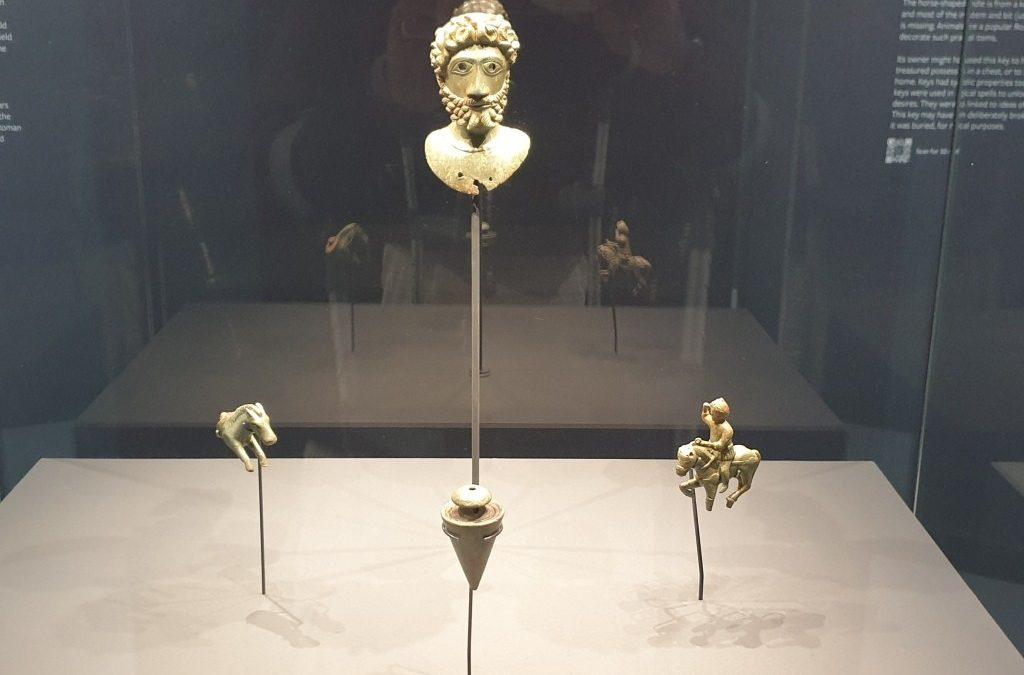
Today's Image: The Ryedale Hoard
Location: Yorkshire Museum
Source: My own photo
Red and Green Vocab
The words in red and green are found among the 3057 Most Common Words in the Classical Latin texts that we will explore on CentumVerba.com and are essential to your understanding of the texts of Caesar, Vergil and Cicero. The green words appear frequently (at least five times) among Vergil's Aeneid (books I-VI), Caesar de bello Gallico (books I-V) and in Cicero's works - in Catilinam (books I-IV), de lege Manilia (also known as de Imperio Cn. Pompei), and pro Achia. These works constituted the curriculum for Latin over 4 years in American High Schools at the start of the 20th Century. The bulk of my information is taken from The Vocabulary of High School Latin by Gonzalez Lodge. I have added to these 2000 words from varioius other sources to compile my own list of The 3057 Most Common Latin Words.
The black words do not appear frequently in Classical Latin.
The red words are the first occurrences of these words in this author and this word will appear as green the next time you encounter it.
If you are serious about building your vocabulary then you should learn the red words as they occur and you should already know the green ones!
I have provided a FLASHCARD set to help - see below.
How To Read the Interactive Text
To Read the Interactive Text Below Without a Dictionary-
On a Computer: you hover over a word and get all the possible parts of speech; declensions; and conjugations of every word.
Red and Green Vocab
The words in red and green are found among the 3057 Most Common Words in the Classical Latin texts that we will explore on CentumVerba.com and are essential to your understanding of the texts of Caesar, Vergil and Cicero. The green words appear frequently (at least five times) among Vergil's Aeneid (books I-VI), Caesar de bello Gallico (books I-V) and in Cicero's works - in Catilinam (books I-IV), de lege Manilia (also known as de Imperio Cn. Pompei), and pro Achia. These works constituted the curriculum for Latin over 4 years in American High Schools at the start of the 20th Century. The bulk of my information is taken from The Vocabulary of High School Latin by Gonzalez Lodge. I have added to these 2000 words from varioius other sources to compile my own list of The 3057 Most Common Latin Words.
The black words do not appear frequently in Classical Latin.
The red words are the first occurrences of these words in this author and this word will appear as green the next time you encounter it.
If you are serious about building your vocabulary then you should learn the red words as they occur and you should already know the green ones!
I have provided a FLASHCARD set to help - see below.
How To Read the Interactive Text
To Read the Interactive Text Below Without a Dictionary-
On a Phone or Tablet: don't 'hover' -'tap' the word. To remove the 'definition box' you 'tap' to the side of the text box.
INTERACTIVE DICTIONARY FREE TEXT
Se ita a patribus maioribusque suis didicisse, ut magis virtute contenderent quam dolo aut insidiis niterentur.
You Need to be a Member to Access the Interactive Dictionary
Quare ne committeret ut is locus ubi constitissent ex calamitate populi Romani et internecione exercitus nomen caperet aut memoriam proderet.
CAPUT XIV
His Caesar ita respondit: eo sibi minus dubitationis dari, quod eas res quas legati Helvetii commemorassent memoria teneret, atque eo gravius ferre quo minus merito populi Romani accidissent;
qui si alicuius iniuriae sibi conscius fuisset, non fuisse difficile cavere; sed eo deceptum, quod neque commissum a se intellegeret quare timeret neque sine causa timendum putaret.
Quod si veteris contumeliae oblivisci vellet, num etiam recentium iniuriarum, quod eo invito iter per provinciam per vim temptassent, quod Haeduos, quod Ambarros, quod Allobrogas vexassent, memoriam deponere posse?
You Need to be a Member to Access the Interactive Dictionary
I have prepared online Flashcards at CRAM.com to make learning the vocabulary much easier. I have no financial gain from you using the app as it is FREE to use.
I have created a stack of the 22 new words in this passage.
Here is the link to the FLASHCARDS
USING THE FLASHCARD APP:
To make the most of the online Flashcards use the "Click or use spacebar to begin" and the Latin word should appear. (The 'Shuffle' button will take the cards out of alphabetical order.) Type 'H' to get the conjugation / declension of the word if you want to see it. 'H' takes tyou back to the word. Click 'See Answer' or use the Spacebar to see the English.
If you were correct or close enough then select "I was right" or else "I was wrong". After you have completed the set it will start again but it will only display the ones you got wrong.
Continue through this process to learn all the words. I hope this is helpful!
Recent Comments