
regnum- a spiritual kingdom
In Vulgate Latin, the noun regnum—meaning ‘kingdom,’ ‘reign,’ or ‘rule’—takes on profound theological and eschatological significance, far beyond its classical usage. While in classical Latin regnum often referred to a political territory or the authority of a monarch, in the Vulgate it becomes a central term in expressing divine sovereignty and the spiritual realm.
One of the most frequent and theologically rich uses of regnum in the Vulgate is in the phrase regnum Dei (‘the kingdom of God’) or regnum caelorum (‘the kingdom of heaven’), which appear throughout the Gospels. These expressions translate the Greek basileia tou theou and basileia tōn ouranōn, and they encapsulate the core message of Christ’s ministry. For example, in Matthew 6:33, the Vulgate reads: ‘Quaerite autem primum regnum Dei et iustitiam eius’ (‘But seek first the kingdom of God and His righteousness’), emphasizing the primacy of divine rule over worldly concerns.
Regnum also appears in eschatological contexts, referring to the final establishment of God’s reign at the end of time. In Revelation 11:15, the Vulgate declares: ‘Factum est regnum huius mundi Domini nostri et Christi eius’ (‘The kingdom of this world has become the kingdom of our Lord and of His Christ’), signalling the ultimate triumph of divine authority.
Beyond the Gospels and Revelation, regnum is used in the Psalms and prophetic books to describe both earthly kingdoms and the eternal dominion of God. Its repetition throughout the Vulgate reinforces a theological worldview in which all temporal power is subordinate to divine kingship.
Thus, in the Vulgate, regnum is not merely a political term but a spiritual one, symbolizing the reign of God in the hearts of believers, the Church, and the world to come. Its usage reflects the Christian transformation of Roman political language into a vocabulary of faith, hope, and divine order. This shift marks one of the many ways the Vulgate shaped the theological imagination of medieval and early modern Europe.
The images for these posts on Mark's gospel
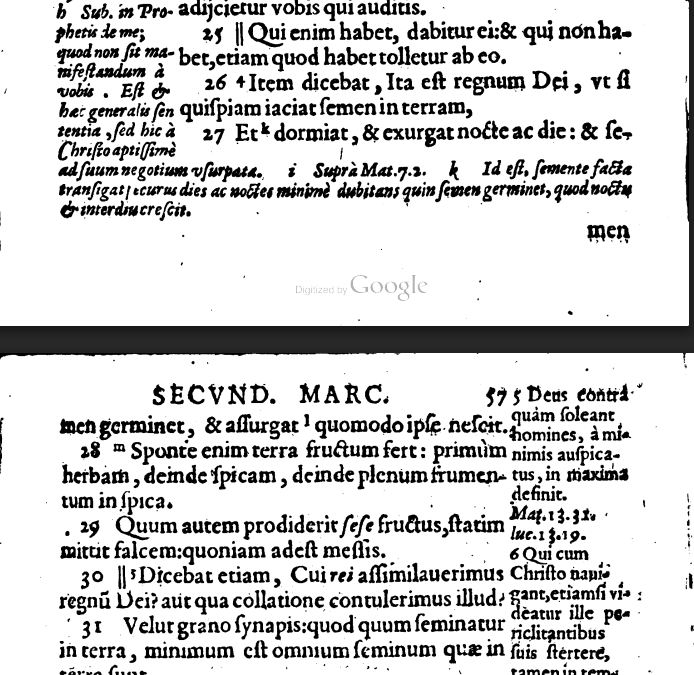
Screenshots taken from the Nouum Testamentum of Théodore de Bèze, (1519-1605) ( Londini : Thomas Vautrollerius, typographus, 1587 )
Accessed from the Post Reformation Digital Library
JUMP To Dictionary Free Interactive Text
Here is a text only version.
EVANGELIUM MARCUM
CAPUT 3
24 et si regnum in se dividatur non potest stare regnum illud
25 et si domus super semet ipsam dispertiatur non poterit domus illa stare
26 et si Satanas consurrexit in semet ipsum dispertitus est et non potest stare sed finem habet
27 nemo potest vasa fortis ingressus in domum diripere nisi prius fortem alliget et tunc domum eius diripiet
28 amen dico vobis quoniam omnia dimittentur filiis hominum peccata et blasphemiae quibus blasphemaverint
29 qui autem blasphemaverit in Spiritum Sanctum non habet remissionem in aeternum sed reus erit aeterni delicti
30 quoniam dicebant spiritum inmundum habet
31 et veniunt mater eius et fratres et foris stantes miserunt ad eum vocantes eum
32 et sedebat circa eum turba et dicunt ei ecce mater tua et fratres tui foris quaerunt te
How To Read the Interactive Text Without a Dictionary
On a Computer:
Hover over a word to get all its possible parts of speech, declensions, or conjugations.
On a Tablet:
'TAP' the word to see the definition, and to remove the 'definition box' you simply 'TAP' anywhere to the side.
How To Read the Interactive Text
'Tap' the word to see the definition and to remove the 'definition box' you simply 'tap' antwhere to the side.
EVANGELIUM MARCUM
CAPUT 3
24 Et si regnum in se dividatur, non potest stare regnum illud
You Need to be at least a Trial Member to Access the Interactive Dictionary
25 et si domus in semet ipsam dispertiatur, non poterit domus illa stare.
26 Et si Satanas consurrexit in semet ipsam et dispertitus est, non potest stare, sed finem habet.
27 Nemo autem potest in domum fortis ingressus vasa eius diripere, nisi prius fortem alliget et tunc domum eius diripiet.
28 Amen dico vobis Omnia dimittentur filiis hominum peccata et blasphemiae, quibus blasphemaverint
29 qui autem blasphemaverit in Spiritum Sanctum, non habet remissionem in aeternum, sed reus est aeterni delicti.
30 Quoniam dicebant Spiritum immundum habet.
31 Et venit mater eius et fratres eius, et foris stantes miserunt ad eum vocantes eum.
32 Et sedebat circa eum turba, et dicunt ei Ecce mater tua et fratres tui et sorores tuae foris quaerunt te.
Recent Comments