
Allobroges
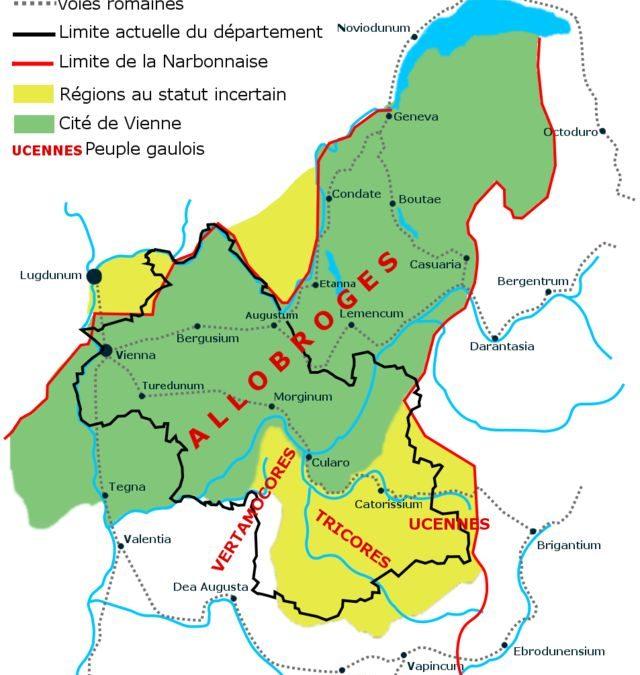
The Allobroges were a Gallic tribe that lived in the Rhône Valley, between the Rhône and Isère rivers, and around present-day Geneva. They were first mentioned in historical records in connection with Hannibal's crossing of the Alps in 218 BCE.
The Allobroges were known for their warlike nature and played a significant role in regional conflicts. In 122 BCE, they attacked the Aedui, prompting Rome to intervene. They were defeated by Roman forces and incorporated into the province of Transalpine Gaul. Their territory was officially annexed by Rome in 121 BCE by Gnaeus Domitius Ahenobarbus and Quintus Fabius Maximus Allobrogicus.
Despite their subjugation, the Allobroges occasionally resisted Roman rule. In 63 BCE, they provided crucial evidence against the Catilinarian Conspiracy, helping to convict Catiline and his associates. However, they later rebelled against Roman extortion and were defeated once again.
By the time of Julius Caesar’s Gallic Wars, the Allobroges were firmly under Roman control. They did not join Vercingetorix in his resistance against Rome at the Battle of Alesia in 52 BCE. Under Augustus, they were fully incorporated into the province of Narbonese Gaul, administered from the Latin colony of Vienna.
Their name, Allobroges, is believed to mean "foreigners" or "those from another country," suggesting they may have migrated into the region relatively late compared to other Gallic tribes. Their strategic location made them an important part of Roman military and trade networks.
Today's Image
Map of the territory held by the Allobroges
Source: unknown
Here is a text only version. (See below for an interactive version)
[11.3] Item Allobroges, qui trans Rhodanum vicos possessionesque habebant, fuga se ad Caesarem recipiunt et demonstrant sibi praeter agri solum nihil esse reliqui. Quibus rebus adductus Caesar non expectandum sibi statuit dum, omnibus, fortunis sociorum consumptis, in Santonos Helvetii pervenirent.
CHAPTER 12
Flumen est Arar, quod per fines Haeduorum et Sequanorum in Rhodanum influit, incredibili lenitate, ita ut oculis in utram partem fluat iudicari non possit. Id Helvetii ratibus ac lintribus iunctis transibant. Ubi per exploratores Caesar certior factus est tres iam partes copiarum Helvetios id flumen traduxisse, quartam vero partem citra flumen Ararim reliquam esse, de tertia vigilia cum legionibus tribus e castris profectus ad eam partem pervenit quae nondum flumen transierat. Eos impeditos et inopinantes adgressus magnam partem eorum concidit; reliqui sese fugae mandarunt atque in proximas silvas abdiderunt.
Need Help Understanding the Latin?
You might find it helpful to start with the Side-by-Side Version which allows you to see my own very literal translation of the text which is almost a word-for-word translation - in an attempt to make it easier to understand the Latin!
Finally come back to this page - Classical Text and you should be able to better understand and competently read the original Latin text.
Vocabulary Version
I have prepared a Vocabulary Version of the passage (link at bottom of the page) which highlights the 3057 Most Common Words in the texts of Vergil, Caesar and Cicero that we will explore on CentumVerba.com
If you are serious about building your vocabulary, the FLASHCARD set should help you learn them.
How To Read the Interactive Text
To Read the Interactive Text Below Without a Dictionary-
On a Computer: you hover over a word and get all the possible parts of speech; declensions; and conjugations of every word.
Need Help Understanding the Latin?
You might find it helpful to start with the Side-by-Side Version which allows you to see my own very literal translation of the text which is almost a word-for-word translation - in an attempt to make it easier to understand the Latin!
Finally come back to this page - Classical Text and you should be able to better understand and competently read the original Latin text.
Vocabulary Version
I have prepared a Vocabulary Version of the passage (link at bottom of the page) which highlights the 3057 Most Common Words in the texts of Vergil, Caesar and Cicero that we will explore on CentumVerba.com
If you are serious about building your vocabulary, the FLASHCARD set should help you learn them.
How To Read the Interactive Text
To Read the Interactive Text Below Without a Dictionary-
On a Phone or Tablet: don't 'hover' -'tap' the word. To remove the 'definition box' you 'tap' to the side of the text box.
Dictionary-Free Interactive Text
[11.3] Item Allobroges, qui trans Rhodanum vicos possessionesque habebant, fuga se ad Caesarem recipiunt et demonstrant sibi praeter agri solum nihil esse reliqui.
INTERACTIVE DICTIONARY-FREE TEXT
[11.3] Item Allobroges, qui trans Rhodanum vicos possessionesque habebant, fuga se ad Caesarem recipiunt et demonstrant sibi praeter agri solum nihil esse reliqui.
Recent Comments