
acer - are you sharp enough?
The Latin adjective acer, acris, acre is a third-declension adjective meaning 'sharp', 'fierce', 'keen', or 'vigorous'. It is often associated with intensity, whether in physical sharpness, mental acuity, or emotional fervor. In Virgil’s Aeneid, acer appears frequently, carrying a sense of forcefulness and urgency that complements the epic’s themes of war, struggle, and destiny.
One of the most prominent uses of acer in the Aeneid occurs in descriptions of warriors, particularly Aeneas and his rivals. The adjective conveys battle-readiness and aggression, often appearing in contexts that emphasize martial prowess. Aeneas himself is described as 'acer in proeliis' ('fierce in battles'), a phrase that reinforces his role as both a heroic fighter and a relentless executor of fate.
Beyond individual warriors, acer is employed to characterize weapons and actions. Virgil uses it to describe spears, swords, and swift movements in combat. For instance, the phrase 'acri telo' ('with a sharp weapon') appears in the heat of battle, reinforcing the brutal precision of war. This sharpness is not merely physical but symbolic—it represents determination, urgency, and the inescapable nature of fate.
The adjective also finds its way into psychological descriptions, adding depth to characters' emotions. Turnus, Aeneas' primary antagonist, is often depicted as acer, particularly in moments of passionate defiance or reckless fury. His relentless drive against fate, his refusal to yield, and his desperation in the climactic duel all echo acer’s meaning in both mind and action.
Additionally, acer can describe non-human elements such as winds or flames, contributing to Virgil’s vivid atmospheric effects. A storm raging with acer ventus ('fierce wind') mirrors the turmoil of human conflict, binding natural violence with human destiny.
Virgil’s use of acer throughout the Aeneid is deliberate—it shapes not just descriptions but the tone of the epic itself. Whether applied to warriors, weapons, emotions, or nature, acer embodies the relentless force driving the poem forward. It is the sharp edge of fate, the intensity of battle, and the fire of ambition. In Virgil’s world, nothing soft endures—only the fierce, the keen, and the unyielding. And acer is the perfect word to capture that spirit.
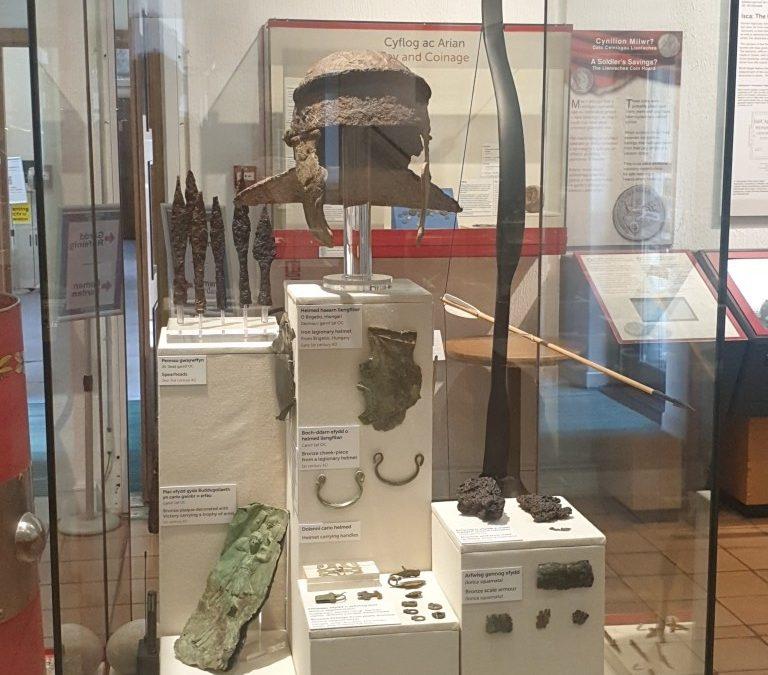
Todays image is:
Arms and Armour at Caerleon Roman Museum
Source: My own photograph
Red and Green Vocab
The words in red and green are found among the 3057 Most Common Words in the Classical Latin texts that we will explore on CentumVerba.com and are essential to your understanding of the texts of Caesar, Vergil and Cicero. The green words appear frequently (at least five times) among Vergil's Aeneid (books I-VI), Caesar de bello Gallico (books I-V) and in Cicero's works - in Catilinam (books I-IV), de lege Manilia (also known as de Imperio Cn. Pompei), and pro Achia. These works constituted the curriculum for Latin over 4 years in American High Schools at the start of the 20th Century. The bulk of my information is taken from The Vocabulary of High School Latin by Gonzalez Lodge. I have added to these 2000 words from varioius other sources to compile my own list of The 3057 Most Common Latin Words.
The black words do not appear frequently in Classical Latin.
The red words are the first occurrences of these words in this author and this word will appear as green the next time you encounter it.
If you are serious about building your vocabulary then you should learn the red words as they occur and you should already know the green ones!
I have provided a FLASHCARD set to help - see below.
How To Read the Interactive Text
To Read the Interactive Text Below Without a Dictionary-
On a Computer: you hover over a word and get all the possible parts of speech; declensions; and conjugations of every word.
Red and Green Vocab
The words in red and green are found among the 3057 Most Common Words in the Classical Latin texts that we will explore on CentumVerba.com and are essential to your understanding of the texts of Caesar, Vergil and Cicero. The green words appear frequently (at least five times) among Vergil's Aeneid (books I-VI), Caesar de bello Gallico (books I-V) and in Cicero's works - in Catilinam (books I-IV), de lege Manilia (also known as de Imperio Cn. Pompei), and pro Achia. These works constituted the curriculum for Latin over 4 years in American High Schools at the start of the 20th Century. The bulk of my information is taken from The Vocabulary of High School Latin by Gonzalez Lodge. I have added to these 2000 words from varioius other sources to compile my own list of The 3057 Most Common Latin Words.
The black words do not appear frequently in Classical Latin.
The red words are the first occurrences of these words in this author and this word will appear as green the next time you encounter it.
If you are serious about building your vocabulary then you should learn the red words as they occur and you should already know the green ones!
I have provided a FLASHCARD set to help - see below.
How To Read the Interactive Text
To Read the Interactive Text Below Without a Dictionary-
On a Phone or Tablet: don't 'hover' -'tap' the word. To remove the 'definition box' you 'tap' to the side of the text box.
INTERACTIVE DICTIONARY FREE TEXT
Praecipue pius Aeneas nunc acris Oronti, nunc Amyci casum gemit et crudelia secum fata Lyci, fortemque Gyan, fortemque Cloanthum.
You Need to be a Member to Access the Interactive Dictionary
Et iam finis erat, cum Iuppiter aethere summo despiciens mare velivolum terrasque iacentis litoraque et latos populos, sic vertice caeli constitit, et Libyae defixit lumina regnis.
Atque illum talis iactantem pectore curas tristior et lacrimis oculos suffusa nitentis adloquitur Venus:
“O qui res hominumque deumque aeternis regis imperiis, et fulmine terres, quid meus Aeneas in te committere tantum, quid Troes potuere, quibus, tot funera passis, cunctus ob Italiam terrarum clauditur orbis?
Certe hinc Romanos olim, volventibus annis, hinc fore ductores, revocato a sanguine Teucri, qui mare, qui terras omni dicione tenerent, pollicitus, quae te, genitor, sententia vertit?
I have prepared online Flashcards at CRAM.com to make learning the vocabulary much easier. I have no financial gain from you using the app as it is FREE to use.
I have created a stack of the 18 new words in this passage.
Here is the link to the FLASHCARDS
USING THE FLASHCARD APP:
To make the most of the online Flashcards use the "Click or use spacebar to begin" and the Latin word should appear. (The 'Shuffle' button will take the cards out of alphabetical order.) Type 'H' to get the conjugation / declension of the word if you want to see it. 'H' takes tyou back to the word. Click 'See Answer' or use the Spacebar to see the English.
If you were correct or close enough then select "I was right" or else "I was wrong". After you have completed the set it will start again but it will only display the ones you got wrong.
Continue through this process to learn all the words. I hope this is helpful!
Recent Comments