
What Struggle Looks Like When You’re Reading Latin Correctly
One of the most damaging ideas new Latin learners absorb — often without realising it — is this:
If reading feels hard, I must be doing something wrong.
That belief causes more frustration, more abandonment, and more unnecessary self‑doubt than almost anything else in Latin learning.
The Naked Latin Toolkit exists partly to dismantle that idea.
Because once you are reading latin correctly, struggle does not disappear —
but it changes shape.
This post explains what that new shape looks like, and how to recognise the difference between productive difficulty and genuine confusion.
The Old Kind of Struggle
Before learners develop a reading process, struggle usually looks like this:
- staring at a sentence without knowing where to start
- translating word by word and losing the sense halfway through
- looking up multiple dictionary entries for the same word
- rereading the sentence repeatedly with no increase in clarity
- feeling anxious, tired, or irritated very quickly
This kind of struggle feels personal.
It leads to thoughts like:
I don’t get Latin.
Everyone else understands this faster than I do.
I must be missing something important.
Very often, nothing important is missing at all — except structure.
What Changes Once You’re Reading Properly
When you begin to read with structure first, something subtle but crucial happens.
You still pause.
You still think.
You still reread.
But the quality of the struggle changes.
Instead of chaos, you experience friction.
And friction is useful.
Productive Struggle Has Clear Features
Here is what struggle tends to look like when you are actually reading latin correctly.
You Know Where the Difficulty Is
The sentence may still be hard — but you can usually say why.
For example:
- “I see the core, but this participle is doing something odd.”
- “The structure is clear, but the background is dense.”
- “The verb is obvious, but the relationships are layered.”
That is not confusion. That is diagnosis.
You Don’t Panic at Length
Long sentences no longer feel automatically impossible.
You may not understand everything immediately, but you can say:
- “The main action is clear.”
- “Most of this is supporting material.”
The sentence feels big, but not hostile.
You Can Pause Without Collapsing
One of the strongest signs of progress is this:
You can stop reading a sentence without feeling defeated.
You might:
- move on and return later,
- accept partial understanding,
- or simply mark a section for further attention.
That is not avoidance. That is control.
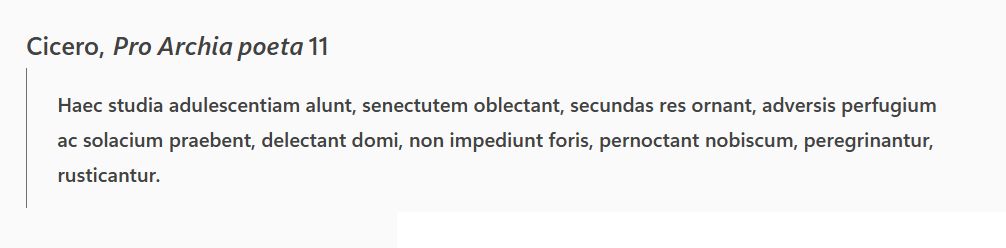
You Can Pause Without Collapsing
One of the strongest signs of progress is this:
You can stop reading a sentence without feeling defeated.
You might:
- move on and return later,
- accept partial understanding,
- or simply mark a section for further attention.
That is not avoidance. That is control.
Partial Understanding Is Real Understanding
This is one of the hardest ideas for learners to accept — but also one of the most liberating.
You do not need to understand everything for reading to be genuine.
In real reading:
- the core matters first,
- background fills in gradually,
- and perfect clarity is rare.
If you can say:
“I know who is doing what, and roughly in what situation,”
you are reading.
Everything else is refinement.
What “Easy” Is Not a Useful Target
Many learners assume that “progress” will feel like:
- instant comprehension,
- smooth English translation,
- or total certainty.
That almost never happens — even for advanced readers.
Reading latin corectly feels more like:
- steady orientation,
- reduced anxiety,
- and fewer dead ends.
The work is still there — but it no longer feels like guesswork.
Confusion Has a New Meaning Now
Before, confusion felt like:
I can’t do this.
Now, confusion usually means:
There’s a structural question I haven’t answered yet.
That’s an invitation, not a verdict.
Sometimes the answer is:
- reread,
- strip back to the core,
- or simply move on and let context accumulate.
None of those responses are failures.
A Reassurance Worth Repeating
If reading Latin now feels:
- slow,
- thoughtful,
- effortful but not panicked,
then something important has gone right, not wrong.
You are no longer relying on luck or memorisation. You are using a method — even if it feels quiet and understated.
That’s how real reading develops.
What to Watch For Instead of “Ease”
As you continue reading, look for these signs of progress instead:
- You recover from confusion faster.
- You recognise familiar structures more often.
- You trust yourself to keep going.
- You stop blaming yourself for difficult sentences.
Those are far better indicators than speed or fluency.
The Point of This Lesson
Struggle is not the enemy.
Unstructured struggle is.
Once structure is visible, difficulty becomes manageable — even useful.
So if Latin feels slow but no longer scary,
if hard sentences frustrate you less than they used to,
if you know what to do next even when answers are incomplete —
then you are reading correctly.
That is exactly where you’re meant to be.
Recent Comments