
cura- concerned about care
The Latin word cura (genitive: curae), meaning care, concern, attention, or anxiety, is a first-declension feminine noun with significant versatility and depth. Its usage in classical Roman literature reflects a range of human experiences, from practical responsibilities to deep emotional states.
In Roman literature, cura frequently appears to signify concern or worry, often associated with emotional struggles. For example, in Virgil’s Aeneid, cura is used to express the weight of care and responsibility that burdens Aeneas as he undertakes his divinely ordained journey. This reflects both personal and societal obligations, emphasizing the Roman values of duty and perseverance.
Cura also represents love and devotion. In poetry, such as that of Ovid or Propertius, cura often conveys the cares of love, including both its joys and torments. In this sense, it captures the emotional intensity of human relationships, illustrating its dual role as a source of both solace and distress.
Philosophically, cura holds a broader meaning as the concept of mindfulness or attention. Cicero and Seneca employ the term when discussing the moral and intellectual duties of individuals, emphasizing care in decision-making and self-improvement.
In modern terminology, cura has left its mark through derivatives like curate (to take care of or organize) and curator (one who cares for a collection or institution). It also influences medical terms, such as cure and curative, which stem from its association with tending and healing. Additionally, the term secure derives from the Latin securus (without care or anxiety), showcasing cura's relevance in linguistic evolution.
Overall, cura serves as a rich and multifaceted term in both classical and modern contexts, embodying a spectrum of meanings tied to care, responsibility, and emotional depth. Its enduring legacy highlights the universality of its central themes across time and culture.
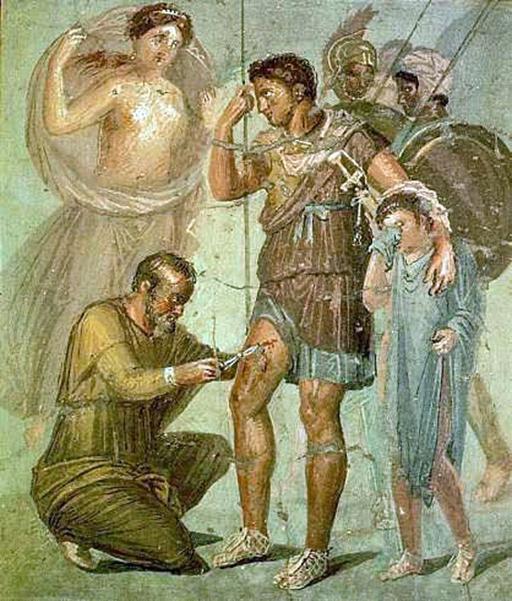
Todays image is:
A fresco found on a wall of a house in Pompeii, depicting the Roman hero Aeneas having a spear head removed from his thigh by the doctor, Iapyx. Aeneas is leaning on his son, Ascanius, and his mother, the goddess Venus, is helping from behind.
Red and Green Vocab
The words in red and green are found among the 3057 Most Common Words in the Classical Latin texts that we will explore on CentumVerba.com and are essential to your understanding of the texts of Caesar, Vergil and Cicero. The green words appear frequently (at least five times) among Vergil's Aeneid (books I-VI), Caesar de bello Gallico (books I-V) and in Cicero's works - in Catilinam (books I-IV), de lege Manilia (also known as de Imperio Cn. Pompei), and pro Achia. These works constituted the curriculum for Latin over 4 years in American High Schools at the start of the 20th Century. The bulk of my information is taken from The Vocabulary of High School Latin by Gonzalez Lodge. I have added to these 2000 words from varioius other sources to compile my own list of The 3057 Most Common Latin Words.
The black words do not appear frequently in Classical Latin.
The red words are the first occurrences of these words in this author and this word will appear as green the next time you encounter it.
If you are serious about building your vocabulary then you should learn the red words as they occur and you should already know the green ones!
I have provided a FLASHCARD set to help - see below.
How To Read the Interactive Text
To Read the Interactive Text Below Without a Dictionary-
On a Computer: you hover over a word and get all the possible parts of speech; declensions; and conjugations of every word.
Red and Green Vocab
The words in red and green are found among the 3057 Most Common Words in the Classical Latin texts that we will explore on CentumVerba.com and are essential to your understanding of the texts of Caesar, Vergil and Cicero. The green words appear frequently (at least five times) among Vergil's Aeneid (books I-VI), Caesar de bello Gallico (books I-V) and in Cicero's works - in Catilinam (books I-IV), de lege Manilia (also known as de Imperio Cn. Pompei), and pro Achia. These works constituted the curriculum for Latin over 4 years in American High Schools at the start of the 20th Century. The bulk of my information is taken from The Vocabulary of High School Latin by Gonzalez Lodge. I have added to these 2000 words from varioius other sources to compile my own list of The 3057 Most Common Latin Words.
The black words do not appear frequently in Classical Latin.
The red words are the first occurrences of these words in this author and this word will appear as green the next time you encounter it.
If you are serious about building your vocabulary then you should learn the red words as they occur and you should already know the green ones!
I have provided a FLASHCARD set to help - see below.
How To Read the Interactive Text
To Read the Interactive Text Below Without a Dictionary-
On a Phone or Tablet: don't 'hover' -'tap' the word. To remove the 'definition box' you 'tap' to the side of the text box.
INTERACTIVE DICTIONARY FREE TEXT
reperti sunt duo equites Romani qui te ista cura liberarent et se illa ipsa nocte paulo ante lucem me in meo lecto interfecturos esse pollicerentur.
You Need to be a Member to Access the Interactive Dictionary
[10] haec ego omnia vixdum etiam coetu vestro dimisso comperi; domum meam maioribus praesidiis munivi atque firmavi, exclusi eos quos tu ad me salutatum mane miseras, cum illi ipsi venissent quos ego iam multis ac summis viris ad me id temporis venturos esse praedixeram.
Chapter 5
quae cum ita sint, Catilina, perge quo coepisti: egredere aliquando ex urbe; patent portae; proficiscere. nimium diu te imperatorem tua illa Manliana castra desiderant.
Educ tecum etiam omnis tuos, si minus, quam plurimos; purga urbem. Magno me metu liberaveris, modo inter me atque te murus intersit.
I have prepared online Flashcards at CRAM.com to make learning the vocabulary much easier. I have no financial gain from you using the app as it is FREE to use.
I have created a stack of the 20 new words in this passage.
Here is the link to the FLASHCARDS
USING THE FLASHCARD APP:
To make the most of the online Flashcards use the "Click or use spacebar to begin" and the Latin word should appear. (The 'Shuffle' button will take the cards out of alphabetical order.) Type 'H' to get the conjugation / declension of the word if you want to see it. 'H' takes tyou back to the word. Click 'See Answer' or use the Spacebar to see the English.
If you were correct or close enough then select "I was right" or else "I was wrong". After you have completed the set it will start again but it will only display the ones you got wrong.
Continue through this process to learn all the words. I hope this is helpful!
Recent Comments