
Perfect Passive Participles (PPP): How Latin Shows “Having Been…”
Latin perfect passive participles explained clearly and structurally.
Understanding Latin perfect passive participles unlocks a huge amount of real Latin. These forms take a completed action (“having been captured”, “having been praised”) and attach it to a noun as a description. They are everywhere in Caesar, and once you recognise them, you’ll see how Latin compresses actions into compact, readable structures.
If you want the contrast between ongoing and completed action, review Lesson 8: Present Participles, or perhaps you may want to revisit core sentence structure, if so, return to Lesson 1: How Latin Sentences Work..
Why Latin Perfect Passive Participles Matter
Textbooks overwhelm learners with full paradigms, howwever, real reading requires something simpler:
A perfect passive participle is just a completed-action adjective.
It describes a noun with “having been…” meaning.
This is the essence of Latin perfect passive participles: they show an action that happened before the main verb, yet still affects the meaning of the noun today.
Examples:
- captus → having been captured
- laudata → having been praised
- inventum → having been found
PPP add depth, not complexity.
Recognising Latin Perfect Passive Participles
PPP follow the same endings you already know:
✅ Masculine: ‑us
- captus, laudatus, inventus
✅ Feminine: ‑a
- capta, laudata, inventa
✅ Neuter: ‑um
- captum, laudatum, inventum
They behave exactly like 1st/2nd declension adjectives, not like verbs.
This is the most important part of Latin perfect passive participles:
you already know the shapes.
The Reader’s Decision: What Completed Action Is Describing This Noun?
Whenever you see a word ending in ‑tus, ‑ta, or ‑tum, ask:
“Which noun has already undergone this action?”
PPP belong to the supporting layer, not the core.
They are descriptive, not structural.
This matches the way HSS will eventually colour and position them.
Authentic Caesar (Lightly Trimmed): PPP in Real Sentences
Below are real Caesar vocabulary patterns, simplified for early readability.
⭐ Example 1 — Classic Caesar Form
Oppidum captum tenent.
→ They hold the captured town.
Core: oppidum tenent
Support: captum
⭐ Example 2 — PPP + Core Action
Corpus inventum ostendit.
→ He shows the discovered body.
- corpus → object
- inventum → PPP
- ostendit → verb
⭐ Example 3 — Narrative PPP
Hostes fugati veniunt.
→ The routed enemies come.
PPP often summarise a prior event.
⭐ Example 4 — PPP as Description
Civem vulneratum vident.
→ They see the wounded citizen.
The completed action (having been wounded) describes civem.
⭐ Example 5 — PPP + Ablative Support (Foreshadowing Lesson 10)
Cum militibus captis Romani veniunt.
→ With the captured soldiers, the Romans come.
You now see how PPP integrate with ablative phrasing.
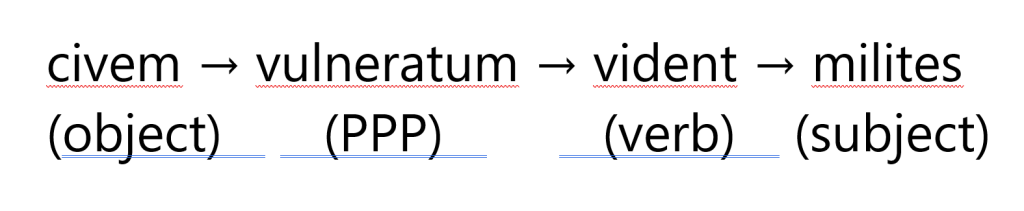 Mini HSS Demonstration (Latin Perfect Passive Participles in Action)
Sentence:
Civem vulneratum milites vident.
Yellow Step — reveal core
→ Milites civem vident.
Subject: milites
Verb: vident
Object: civem
Rebuild
→ vulneratum (“wounded”)
Final:
“The soldiers see the wounded citizen.”
PPP never carry the main verb — they enrich the noun.
⭐ FAQ — Lesson 9: Perfect Passive Participles
Q. How do I recognise a Perfect Passive Participle?
Look for -tus, -ta, -tum. These always signal “having been …” and behave like 1st/2nd declension adjectives.
Q. Do PPP belong to the core of the sentence?
No. PPP sit firmly in the supporting layer. They describe nouns but never carry the main action — that job belongs to the verb.
Q. Why do PPP use -us, -a, -um endings?
Because they decline like adjectives, not like verbs. They match the noun they describe in gender, number, and case.
Q. How do PPP differ from present participles?
Present participles describe an ongoing action (“running”). PPP describe a completed action (“having been captured”). Together, they give you time‑sense inside the sentence.
Q. How do I attach a PPP to the right noun?
Match the gender/number/case of the participle to the noun that makes sense. If “captured” obviously describes the town (*oppidum captum*), you’ve found the right connection.
Q. Will PPP appear in ablative absolutes later?
Yes — PPP are a core part of the ablative absolute. But for now, just recognise them as descriptive; the full structure comes later in the course.
Q. How does recognising PPP help with the HSS?
PPP almost always strip out at Yellow because they’re descriptive. Knowing them now makes HSS feel natural and predictable later.
Recent Comments