
Literary Insights Await
“Grammar Spotlight: Mastering the Double Accusative”
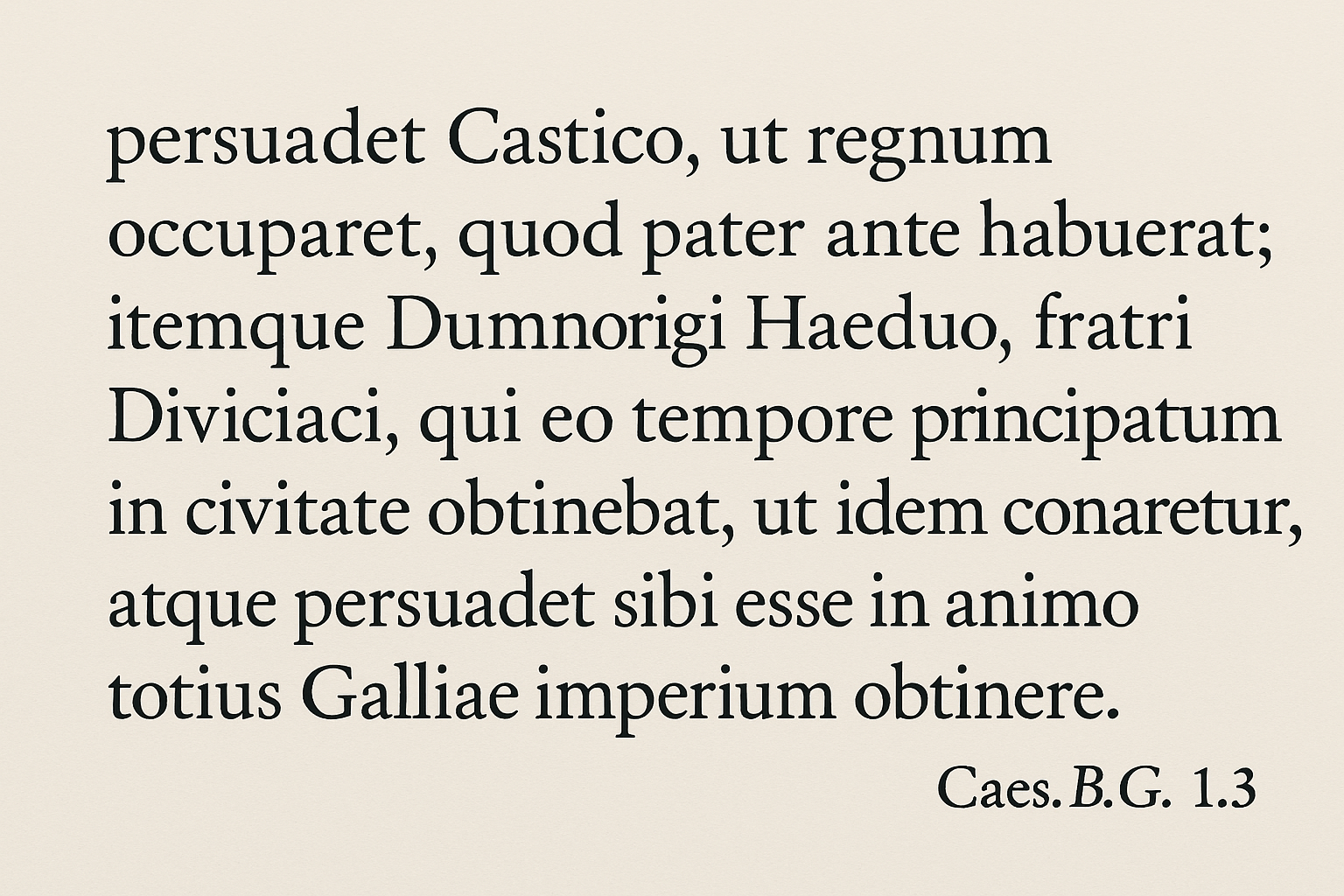
“Caesar’s phrase persuadet Castico ut regnum occuparet illustrates the double accusative: one verb governing a person and a thing. A hallmark of Latin syntax, it appears in epic and oratory too.”
The Power of Words
What is a Double Accusative?
A double accusative occurs when a single verb governs two accusative elements in the same clause. This construction is common in Latin and reflects the flexibility of its syntax. The two accusatives usually have different syntactic roles:
Types of Double Accusative Constructions
-
Person + Thing (Object of Action)
- Verbs of teaching, asking, hiding, reminding, persuading often take two accusatives:
- Example: docet pueros grammaticam — “He teaches the boys grammar.”
- pueros = person taught
- grammaticam = thing taught
- Example: docet pueros grammaticam — “He teaches the boys grammar.”
- Verbs of teaching, asking, hiding, reminding, persuading often take two accusatives:
-
Direct Object + Predicate Accusative (Factitive Verbs)
- Verbs like facere, vocare, appellare, creare take an object and a second accusative describing its new state or identity:
- Example: facit me potentem — “She makes me powerful.”
- me = direct object
- potentem = predicate accusative
- Example: facit me potentem — “She makes me powerful.”
- Verbs like facere, vocare, appellare, creare take an object and a second accusative describing its new state or identity:
-
Person + Penalty or Price
- Verbs of punishing, costing, valuing can take two accusatives:
- Example: mactare hostem supplicium — “To punish the enemy with death.”
- hostem = person punished
- supplicium = penalty
- Example: mactare hostem supplicium — “To punish the enemy with death.”
- Verbs of punishing, costing, valuing can take two accusatives:
Ad eas res conficiendas Orgetorix deligitur. Is sibi legationem ad civitates suscipit. In eo itinere persuadet Castico, Catamantaloedis filio, Sequano, cuius pater regnum in Sequanis multos annos obtinuerat et a senatu populi Romani amicus appellatus erat, ut regnum in civitate sua occuparet,
DBG 1.3.
Key double accusative: persuadet Castico ut regnum occuparet. Here, persuadet governs Castico (person) and regnum (thing) in the accusative.

Key double accusative: facis me potentem nimborum tempestatumque. Verb facis takes me (person) and potentem (predicate accusative) as its two accusatives.

Aeolus haec contra: “Tuus, O regina, quid optes explorare labor; mihi iussa capessere fas est. Tu mihi, quodcumque hoc regni, tu sceptra Iovemque concilias, tu das epulis accumbere divom, nimborumque facis tempestatumque potentem.”
Aen. 1.76–77.
nonne hunc in vincla duci, non ad mortem rapi, non summo supplicio mactari imperabis?
In Cat. 1.3.
Key double accusative: mactari supplicio. Here, mactari (passive infinitive of macto) implies an active construction like mactare Catilinam supplicium, where Catilinam (person) and supplicium (thing) would both be accusative. Cicero uses this idiomatically in rhetorical questions.
Exploring Language and Learning
Why It Matters
- The double accusative illustrates Latin’s ability to express nuanced relationships without prepositions.
- It often signals semantic roles: who is affected and what is involved.
- Recognizing it helps avoid mistranslation and deepens understanding of Latin syntax.
Insights from Literary Quotes
The quotes presented above delve into the profound impact of language and the journey of learning. Wittgenstein's insight reminds us that language shapes our perception and understanding of the world, emphasising the beauty and power of words. Socrates' reflection on wisdom highlights the importance of acknowledging our limitations as a stepping stone to mastery. Together, these quotes underscore the transformative nature of language and the continuous pursuit of knowledge. They resonate with our mission at CentumVerba.com, where we facilitate a seamless and enriching Latin learning experience, allowing readers to expand their linguistic horizons and deepen their comprehension.
Explore Further: Related Questions
1. What other verbs in Latin regularly take two accusatives?
Verbs like docere (teach), rogare (ask), celare (hide), poscere (demand), and factitive verbs (facere, vocare, appellare) often require two accusatives.
2. How does the double accusative differ from the accusative with infinitive?
The double accusative involves two objects of the same verb, while the accusative with infinitive uses one accusative as the subject of an infinitive clause.
3. Can a double accusative occur with passive verbs?
Yes, but usually only the person becomes nominative in the passive; the second accusative often remains (e.g., vocatur rex from vocant eum regem).
4. Which Latin authors use double accusatives most frequently?
Caesar, Cicero, and Livy in prose; Vergil and Ovid in poetry—especially with factitive verbs and rhetorical constructions.
5. How do factitive verbs create a double accusative structure?
They take a direct object and a predicate accusative describing its new state: facit me potentem (“makes me powerful”).
6. Is there an equivalent of the double accusative in English or other languages?
Yes, English uses object + object complement: “They made him king.” Many Indo-European languages share this pattern.
7. What is the difference between double accusative and double dative?
Double accusative = two objects of one verb; double dative = two datives expressing purpose and reference (e.g., auxilio mihi est).
8. Why does Latin allow two accusatives without prepositions?
Latin relies on case endings for meaning, so prepositions are unnecessary when roles are clear from morphology and context.
9. Can a double accusative appear in poetry differently than in prose?
Yes, poets often separate the two accusatives for metrical or stylistic effect, sometimes placing the predicate accusative far from the verb.
10. What role does word order play in interpreting double accusatives?
Word order is flexible, but context and endings clarify roles. Predicate accusatives often follow the direct object or appear near the verb.
Recent Comments