
lacrima - tears of grief or joy
The Latin noun lacrima, meaning ‘tear’, is a word rich in emotional and poetic resonance throughout classical Latin literature. As a feminine first-declension noun, lacrima appears in contexts ranging from grief and mourning to joy and tenderness, often serving as a marker of deeply felt human experience.
In epic poetry, lacrima frequently accompanies scenes of farewell, death, or divine pity. Virgil’s Aeneid uses lacrimae to underscore the cost of war and exile. In sunt lacrimae rerum, the word evokes a universal sorrow embedded in the fabric of existence. Here, lacrima is not merely a physical manifestation of emotion but a symbol of shared suffering and memory.
Elegiac poets such as Propertius and Tibullus deploy lacrima to express romantic anguish and longing. In these verses, tears often flow in response to absence, betrayal, or unfulfilled desire. The recurrence of lacrima in love poetry reflects its role as a conduit between inner feeling and outward expression. Ovid, in particular, manipulates the image of lacrima to elicit sympathy or to dramatise emotional vulnerability, as in lacrimae non sunt mentitae, where tears serve as evidence of sincerity.
In rhetorical prose, lacrima may appear in appeals to pathos. Cicero occasionally references tears in courtroom speeches to heighten emotional stakes or to portray a client’s suffering. While less frequent than in poetry, such usage demonstrates the word’s capacity to influence audience sentiment and moral judgement.
Grammatically, lacrima is straightforward, but its placement within a sentence or verse often carries weight. Poets may position it at the beginning or end of a line for emphasis, or pair it with verbs like fundere, cadere, or tenere to evoke motion or restraint.
Whether literal or metaphorical, lacrima functions as a bridge between body and soul, grounding abstract emotion in tangible imagery. Its recurrence across genres attests to its expressive power and its capacity to articulate the complexities of human feeling in Latin literary tradition.
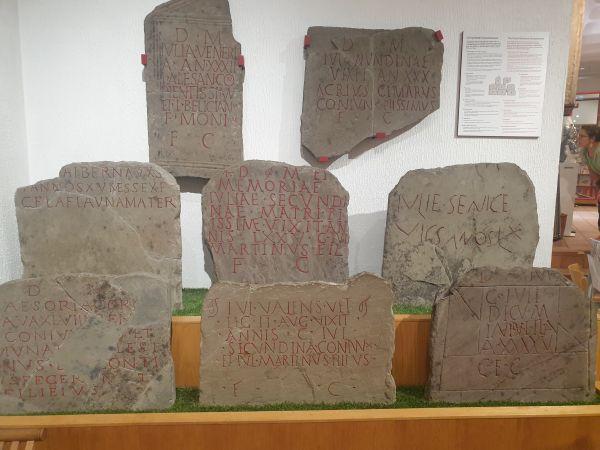
Today's Image: The great Bulmore Gravestones Caerleon Museum
Here is a text only version. (See below for an interactive version)
Caput XX Diviciacus multis cum lacrimis Caesarem complexus obsecrare coepit ne quid gravius in fratrem statueret: scire se illa esse vera, nec quemquam ex eo plus quam se doloris capere, propterea quod, cum ipse gratia plurimum domi atque in reliqua Gallia, ille minimum propter adulescentiam posset, per se crevisset; quibus opibus ac nervis non solum ad minuendam gratiam, sed paene ad perniciem suam uteretur.
Sese tamen et amore fraterno et existimatione vulgi commoveri. Quod si quid ei a Caesare gravius accidisset, cum ipse eum locum amicitiae apud eum teneret, neminem existimaturum non sua voluntate factum; qua ex re futurum uti totius Galliae animi a se averterentur.
Need Help Understanding the Latin?
You might find it helpful to start with the Side-by-Side Version which allows you to see my own very literal translation of the text which is almost a word-for-word translation - in an attempt to make it easier to understand the Latin!
Finally come back to this page - Classical Text and you should be able to better understand and competently read the original Latin text.
Vocabulary Version
I have prepared a Vocabulary Version of the passage (link at bottom of the page) which highlights the 3057 Most Common Words in the texts of Vergil, Caesar and Cicero that we will explore on CentumVerba.com
If you are serious about building your vocabulary, the FLASHCARD set should help you learn them.
How To Read the Interactive Text
To Read the Interactive Text Below Without a Dictionary-
On a Computer: you hover over a word and get all the possible parts of speech; declensions; and conjugations of every word.
Need Help Understanding the Latin?
You might find it helpful to start with the Side-by-Side Version which allows you to see my own very literal translation of the text which is almost a word-for-word translation - in an attempt to make it easier to understand the Latin!
Finally come back to this page - Classical Text and you should be able to better understand and competently read the original Latin text.
Vocabulary Version
I have prepared a Vocabulary Version of the passage (link at bottom of the page) which highlights the 3057 Most Common Words in the texts of Vergil, Caesar and Cicero that we will explore on CentumVerba.com
If you are serious about building your vocabulary, the FLASHCARD set should help you learn them.
How To Read the Interactive Text
To Read the Interactive Text Below Without a Dictionary-
On a Phone or Tablet: don't 'hover' -'tap' the word. To remove the 'definition box' you 'tap' to the side of the text box.
Dictionary-Free Interactive Text
Caput XX
Diviciacus multis cum lacrimis Caesarem complexus obsecrare coepit ne quid gravius in fratrem statueret:
You Need to be a Member to Access the Interactive Dictionary
scire se illa esse vera, nec quemquam ex eo plus quam se doloris capere, propterea quod, cum ipse gratia plurimum domi atque in reliqua Gallia, ille minimum propter adulescentiam posset, per se crevisset;
quibus opibus ac nervis non solum ad minuendam gratiam, sed paene ad perniciem suam uteretur.
Sese tamen et amore fraterno et existimatione vulgi commoveri.
Quod si quid ei a Caesare gravius accidisset, cum ipse eum locum amicitiae apud eum teneret, neminem existimaturum non sua voluntate factum;
qua ex re futurum uti totius Galliae animi a se averterentur.
INTERACTIVE DICTIONARY-FREE TEXT
Caput XX
Diviciacus multis cum lacrimis Caesarem complexus obsecrare coepit ne quid gravius in fratrem statueret:
You Need to be a Member to Access the Interactive Dictionary
scire se illa esse vera, nec quemquam ex eo plus quam se doloris capere, propterea quod, cum ipse gratia plurimum domi atque in reliqua Gallia, ille minimum propter adulescentiam posset, per se crevisset;
quibus opibus ac nervis non solum ad minuendam gratiam, sed paene ad perniciem suam uteretur.
Sese tamen et amore fraterno et existimatione vulgi commoveri.
Quod si quid ei a Caesare gravius accidisset, cum ipse eum locum amicitiae apud eum teneret, neminem existimaturum non sua voluntate factum;
qua ex re futurum uti totius Galliae animi a se averterentur.
Recent Comments