
brevis - I'll be brief
The Latin adjective brevis, meaning ‘short’ or ‘brief’, is a term of both physical and metaphorical significance in classical literature. Its use spans poetry, prose, and philosophical discourse, often marking limits of time, space, or expression. The word’s flexibility allows authors to comment on duration, stature, style, and even life itself.
In poetry, brevis is frequently employed to describe metrical units, particularly in discussions of prosody. A brevis syllable is one that is short in quantity, forming part of the technical vocabulary of Latin verse. Poets such as Horace and Virgil, though not always overtly metrical in their references, rely on the concept of brevis to shape rhythm and cadence. The term thus underpins the structure of Latin poetry, even when not explicitly stated.
Beyond metrics, brevis appears in lyric and elegiac contexts to evoke fleeting moments or transient emotions. Horace’s Odes often reflect on the brevity of youth or pleasure, urging the reader to seize the day while time permits. Here, brevis becomes a philosophical marker, not just a temporal one, suggesting the limits of human experience. In Propertius and Tibullus, brevis is used to describe short-lived love affairs or the passing nature of beauty, reinforcing the elegiac mood of impermanence.
In prose, brevis is valued as a stylistic ideal. Cicero, while known for elaborate periods, occasionally praises brevitas in rhetorical instruction, especially when clarity and impact are required. The term is associated with precision and restraint, qualities admired in both oratory and philosophical writing. Seneca, in particular, champions brevis expression as a sign of intellectual discipline, contrasting it with verbose indulgence.
In historiography, brevis may denote concise summaries or abridged accounts, as seen in Livy’s transitions between episodes. It signals a shift in narrative pace, allowing the historian to compress or highlight events selectively.
Thus, brevis in classical Latin literature is more than a descriptor—it is a tool of form, thought, and tone, shaping how authors present and interpret the world.
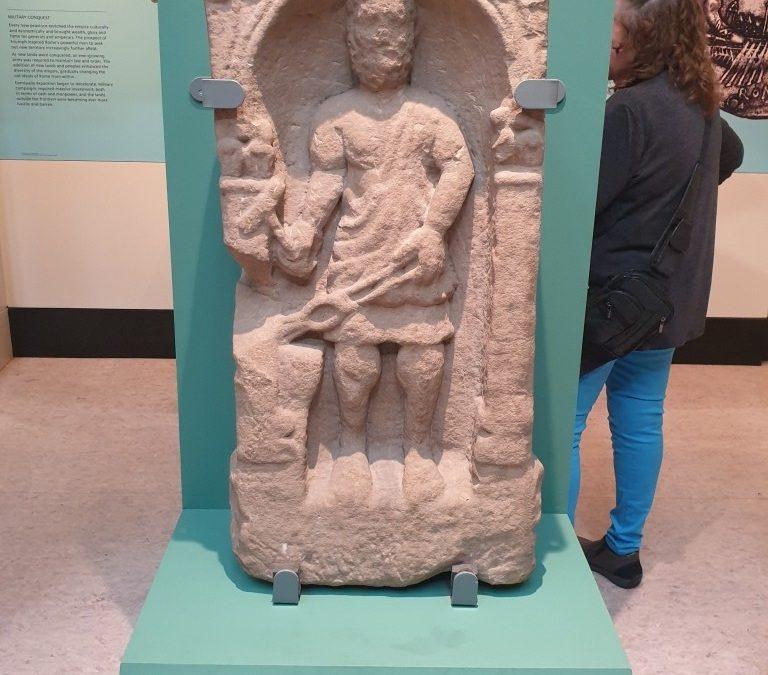
Today's Image: A blacksmith at work
Source: My Own Photo
Site: York Roman Museum
Here is a text only version. (See below for an interactive version)
Post breve tempus a piscatore quodam reperta est, et ad domum regis Polydectis adducta est. Ille matrem et puerum benigne excepit, et sedem tutam in finibus suis dedit. Danae hoc donum libenter accepit, et pro tanto beneficio regi gratias egit.
3 Perseus igitur multos annos ibi habitavit, et cum matre sua vitam egit beatam. At Polydectes Danaen magnopere amabat atque eam in matrimonium ducere volebat. Hoc tamen consilium Perseo minime gratum erat. Polydectes Igitur Perseum dimittere constituit. Tum juvenem ad se vocavit et haec dixit: "Turpe est vitam hanc ignavam agere; jam dudum tu adulescens es; quousque hic manebis? Tempus est arma capere et virtutem praestare. Hinc abi, et caput Medusae mihi refer."
Red and Green Vocab
The words in red and green are found among the 3057 Most Common Words in the Classical Latin texts that we will explore on CentumVerba.com and are essential to your understanding of the texts of Caesar, Vergil and Cicero. The green words appear frequently (at least five times) among Vergil's Aeneid (books I-VI), Caesar de bello Gallico (books I-V) and in Cicero's works - in Catilinam (books I-IV), de lege Manilia (also known as de Imperio Cn. Pompei), and pro Achia. These works constituted the curriculum for Latin over 4 years in American High Schools at the start of the 20th Century. The bulk of my information is taken from The Vocabulary of High School Latin by Gonzalez Lodge. I have added to these 2000 words from varioius other sources to compile my own list of The 3057 Most Common Latin Words.
The black words do not appear frequently in Classical Latin.
The red words are the first occurrences of these words in this author and this word will appear as green the next time you encounter it.
If you are serious about building your vocabulary then you should learn the red words as they occur and you should already know the green ones!
I have provided a FLASHCARD set to help - see below.
How To Read the Interactive Text
To Read the Interactive Text Below Without a Dictionary-
On a Computer: you hover over a word and get all the possible parts of speech; declensions; and conjugations of every word.
Red and Green Vocab
The words in red and green are found among the 3057 Most Common Words in the Classical Latin texts that we will explore on CentumVerba.com and are essential to your understanding of the texts of Caesar, Vergil and Cicero. The green words appear frequently (at least five times) among Vergil's Aeneid (books I-VI), Caesar de bello Gallico (books I-V) and in Cicero's works - in Catilinam (books I-IV), de lege Manilia (also known as de Imperio Cn. Pompei), and pro Achia. These works constituted the curriculum for Latin over 4 years in American High Schools at the start of the 20th Century. The bulk of my information is taken from The Vocabulary of High School Latin by Gonzalez Lodge. I have added to these 2000 words from varioius other sources to compile my own list of The 3057 Most Common Latin Words.
The black words do not appear frequently in Classical Latin.
The red words are the first occurrences of these words in this author and this word will appear as green the next time you encounter it.
If you are serious about building your vocabulary then you should learn the red words as they occur and you should already know the green ones!
I have provided a FLASHCARD set to help - see below.
How To Read the Interactive Text
To Read the Interactive Text Below Without a Dictionary-
On a Phone or Tablet: don't 'hover' -'tap' the word. To remove the 'definition box' you 'tap' to the side of the text box.
INTERACTIVE DICTIONARY FREE TEXT
Post breve tempus a piscatore quodam reperta est, You Need to be a Member to Access the Interactive Dictionary
Ille matrem et puerum benigne excepit, et sedem tutam in finibus suis dedit.
Danae hoc donum libenter accepit, et pro tanto beneficio regi gratias egit.
3 Perseus igitur multos annos ibi habitavit, et cum matre sua vitam egit beatam.
At Polydectes Danaen magnopere amabat atque eam in matrimonium ducere volebat.
Hoc tamen consilium Perseo minime gratum erat. Polydectes Igitur Perseum dimittere constituit. Tum juvenem ad se vocavit et haec dixit:
"Turpe est vitam hanc ignavam agere; jam dudum tu adulescens es; quousque hic manebis? Tempus est arma capere et virtutem praestare. Hinc abi, et caput Medusae mihi refer."
I have prepared online Flashcards at CRAM.com to make learning the vocabulary much easier. I have no financial gain from you using the app as it is FREE to use.
I have created a stack of the 49 new words from The 3057 Essential Latin Words in this passage.
YOU NEED TO SIGN UP AS A TRIAL MEMBER TO ACCESS THE FLASHCARDS
Here is the link to the FLASHCARDS
USING THE FLASHCARD APP:
To make the most of the online Flashcards use the "Click or use spacebar to begin" and the Latin word should appear. (The 'Shuffle' button will take the cards out of alphabetical order.) Type 'H' to get the conjugation / declension of the word if you want to see it. 'H' takes tyou back to the word. Click 'See Answer' or use the Spacebar to see the English.
If you were correct or close enough then select "I was right" or else "I was wrong". After you have completed the set it will start again but it will only display the ones you got wrong.
Continue through this process to learn all the words. I hope this is helpful!
Recent Comments