
poeta - masculine first declension noun
The Latin masculine first declension noun poeta, meaning ‘poet’, is a loanword from Greek, and its adoption into Latin reflects both linguistic borrowing and cultural aspiration. In classical literature, poeta denotes not merely a writer of verse but a figure of creative authority, often positioned between tradition and innovation.
In early Latin poetry, poeta was not yet a fully established role. Ennius, often called the father of Roman poetry, refers to himself as a poeta who brings Greek forms into Latin, suggesting a conscious shaping of Roman literary identity. His use of poeta implies both imitation and transformation, as he adapts Homeric models to Roman themes.
By the time of Catullus, poeta had acquired a more personal and artistic resonance. Catullus uses the term to assert his place within a literary elite, distinguishing the poeta from mere versifiers. His poems often reflect on the role of the poeta as a craftsman of language and emotion, capable of both invective and tenderness. The word thus becomes a marker of aesthetic self-awareness.
Virgil’s use of poeta in the Eclogues and Georgics is more formalised. He presents the poeta as a mediator between nature, myth, and civic life. In the Aeneid, although the term itself is rare, the poet’s voice is omnipresent, shaping epic memory and imperial ideology. The poeta here is a cultural architect, not just a narrator.
Ovid, in contrast, foregrounds the identity of the poeta in his exile poetry. In Tristia and Epistulae ex Ponto, he laments the fate of the poeta banished from Rome, arguing that poetic talent should transcend political punishment. His reflections elevate the poeta to a figure of resistance and remembrance.
Thus, in classical Latin literature, poeta evolves from a borrowed term into a richly layered concept, encompassing artistry, identity, and cultural power.
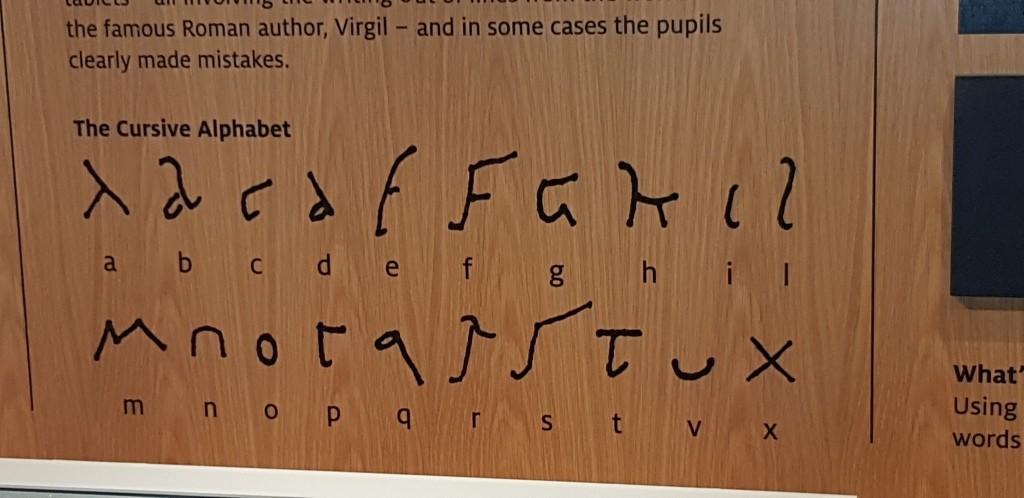
Today's Image: A display of writing of the Latin alphabet
Source: My Own Photo
Site: Vindolanda Museum
Here is a text only version. (See below for an interactive version)
1 Haec narrantur a poetis de Perseo. Perseus filius erat Jovis, maximi deorum. Avus ejus Acrisius appellabatur. Acrisius volebat Perseum, nepotem suum, necare; nam propter oraculum puerum timebat. Comprehendit igitur Perseum, adhuc infantem, et cum matre in arca lignea inclusit. Tum arcam ipsam in mare conjecit. Danae, Persei mater, magnopere territa est; tempestas enim magna mare turbabat. Perseus autem in sinu matris dormiebat.
2 Juppiter tamen haec omnia vidit, et filium suum servare constituit. Fecit igitur mare tranquillum, et arcam ad insulam Seriphum perduxit. Hujus insulae Polydectes tum rex erat. Postquam arca ad litus appulsa est, Danae in harena quietem capiebat.
Red and Green Vocab
The words in red and green are found among the 3057 Most Common Words in the Classical Latin texts that we will explore on CentumVerba.com and are essential to your understanding of the texts of Caesar, Vergil and Cicero. The green words appear frequently (at least five times) among Vergil's Aeneid (books I-VI), Caesar de bello Gallico (books I-V) and in Cicero's works - in Catilinam (books I-IV), de lege Manilia (also known as de Imperio Cn. Pompei), and pro Achia. These works constituted the curriculum for Latin over 4 years in American High Schools at the start of the 20th Century. The bulk of my information is taken from The Vocabulary of High School Latin by Gonzalez Lodge. I have added to these 2000 words from varioius other sources to compile my own list of The 3057 Most Common Latin Words.
The black words do not appear frequently in Classical Latin.
The red words are the first occurrences of these words in this author and this word will appear as green the next time you encounter it.
If you are serious about building your vocabulary then you should learn the red words as they occur and you should already know the green ones!
I have provided a FLASHCARD set to help - see below.
How To Read the Interactive Text
To Read the Interactive Text Below Without a Dictionary-
On a Computer: you hover over a word and get all the possible parts of speech; declensions; and conjugations of every word.
Red and Green Vocab
The words in red and green are found among the 3057 Most Common Words in the Classical Latin texts that we will explore on CentumVerba.com and are essential to your understanding of the texts of Caesar, Vergil and Cicero. The green words appear frequently (at least five times) among Vergil's Aeneid (books I-VI), Caesar de bello Gallico (books I-V) and in Cicero's works - in Catilinam (books I-IV), de lege Manilia (also known as de Imperio Cn. Pompei), and pro Achia. These works constituted the curriculum for Latin over 4 years in American High Schools at the start of the 20th Century. The bulk of my information is taken from The Vocabulary of High School Latin by Gonzalez Lodge. I have added to these 2000 words from varioius other sources to compile my own list of The 3057 Most Common Latin Words.
The black words do not appear frequently in Classical Latin.
The red words are the first occurrences of these words in this author and this word will appear as green the next time you encounter it.
If you are serious about building your vocabulary then you should learn the red words as they occur and you should already know the green ones!
I have provided a FLASHCARD set to help - see below.
How To Read the Interactive Text
To Read the Interactive Text Below Without a Dictionary-
On a Phone or Tablet: don't 'hover' -'tap' the word. To remove the 'definition box' you 'tap' to the side of the text box.
INTERACTIVE DICTIONARY FREE TEXT
1 Haec narrantur a poetis de Perseo. Perseus filius erat Jovis, maximi deorum. You Need to be a Member to Access the Interactive Dictionary
Avus ejus Acrisius appellabatur. Acrisius volebat Perseum, nepotem suum, necare; nam propter oraculum puerum timebat.
Comprehendit igitur Perseum, adhuc infantem, et cum matre in arca lignea inclusit.
Tum arcam ipsam in mare conjecit. Danae, Persei mater, magnopere territa est; tempestas enim magna mare turbabat. Perseus autem in sinu matris dormiebat.
2 Juppiter tamen haec omnia vidit, et filium suum servare constituit.
Fecit igitur mare tranquillum, et arcam ad insulam Seriphum perduxit. Hujus insulae Polydectes tum rex erat.
Postquam arca ad litus appulsa est, Danae in harena quietem capiebat.
I have prepared online Flashcards at CRAM.com to make learning the vocabulary much easier. I have no financial gain from you using the app as it is FREE to use.
I have created a stack of the 53 new words of the 3057 Essential Latin Words in this passage.
YOU NEED TO SIGN UP AS A TRIAL MEMBER TO ACCESS THE FLASHCARDS
Here is the link to the FLASHCARDS
USING THE FLASHCARD APP:
To make the most of the online Flashcards use the "Click or use spacebar to begin" and the Latin word should appear. (The 'Shuffle' button will take the cards out of alphabetical order.) Type 'H' to get the conjugation / declension of the word if you want to see it. 'H' takes tyou back to the word. Click 'See Answer' or use the Spacebar to see the English.
If you were correct or close enough then select "I was right" or else "I was wrong". After you have completed the set it will start again but it will only display the ones you got wrong.
Continue through this process to learn all the words. I hope this is helpful!
Recent Comments