
puer - not only boy but child
The Latin noun puer, meaning ‘boy’ or ‘child’, is a frequent and versatile term in classical literature, often carrying social, emotional, and symbolic weight beyond its basic definition. While its primary sense denotes a young male, its usage varies widely depending on context, genre, and authorial intent.
In Roman comedy, particularly in Plautus and Terence, puer often refers to a household slave or servant, typically young and clever. These pueri are central to the comic plot, acting as intermediaries, tricksters, or confidants. Their youth is not merely biological but functional, representing agility, wit, and subordination within the domestic sphere.
In epic and elegiac poetry, puer can evoke tenderness, vulnerability, or idealised beauty. Virgil’s Aeneid uses puer to describe Ascanius, Aeneas’ son, whose presence symbolises continuity and future hope. The term here is both literal and emblematic, linking familial duty to national destiny. In contrast, Ovid’s elegiac poems often use puer in amorous contexts, referring to Cupid or to young lovers. The word becomes a vehicle for exploring desire, playfulness, and emotional instability.
In philosophical and rhetorical prose, puer may appear in moral exempla or educational discourse. Seneca, for instance, discusses the formation of character in pueritia, the stage of life when impressions are most lasting. The term thus marks a phase of moral and intellectual development, not just age.
Horace’s lyric poetry uses puer to reflect on youth’s transience and the pleasures of the moment. In Odes, the puer is often urged to enjoy life before age overtakes him, though the tone is more reflective than indulgent.
Overall, puer in classical Latin literature is a richly layered term, capable of expressing servitude, innocence, beauty, and philosophical reflection, depending on its literary and cultural setting.
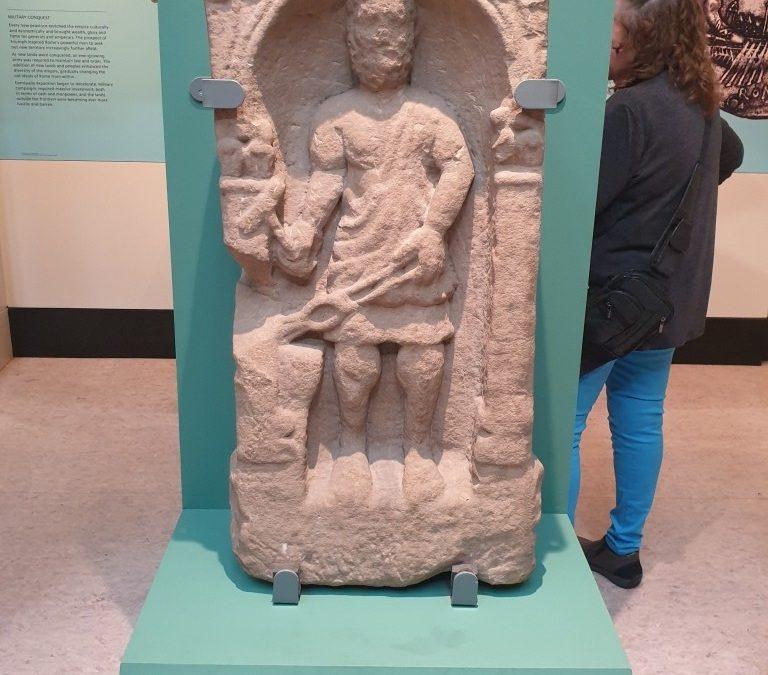
Today's Image: A blacksmith at work
Source: My Own Photo
Site: York Roman Museum
Here is a text only version. (See below for an interactive version)
Post breve tempus a piscatore quodam reperta est, et ad domum regis Polydectis adducta est. Ille matrem et puerum benigne excepit, et sedem tutam in finibus suis dedit. Danae hoc donum libenter accepit, et pro tanto beneficio regi gratias egit.
3 Perseus igitur multos annos ibi habitavit, et cum matre sua vitam egit beatam. At Polydectes Danaen magnopere amabat atque eam in matrimonium ducere volebat. Hoc tamen consilium Perseo minime gratum erat. Polydectes Igitur Perseum dimittere constituit. Tum juvenem ad se vocavit et haec dixit: "Turpe est vitam hanc ignavam agere; jam dudum tu adulescens es; quousque hic manebis? Tempus est arma capere et virtutem praestare. Hinc abi, et caput Medusae mihi refer."
How To Read the Interactive Text
To Read the Interactive Text Below Without a Dictionary-
On a Computer: you hover over a word and get all the possible parts of speech; declensions; and conjugations of every word.
How To Read the Interactive Text
To Read the Interactive Text Below Without a Dictionary-
On a Phone or Tablet: don't 'hover' -'tap' the word. To remove the 'definition box' you 'tap' to the side of the text box.
INTERACTIVE DICTIONARY FREE TEXT
Post breve tempus a piscatore quodam reperta est,
You Need to be a Member to Access the Interactive Dictionary
et ad domum regis Polydectis adducta est.
Ille matrem et puerum benigne excepit, et sedem tutam in finibus suis dedit.
Danae hoc donum libenter accepit, et pro tanto beneficio regi gratias egit.
3 Perseus igitur multos annos ibi habitavit, et cum matre sua vitam egit beatam.
At Polydectes Danaen magnopere amabat atque eam in matrimonium ducere volebat.
Hoc tamen consilium Perseo minime gratum erat. Polydectes Igitur Perseum dimittere constituit.
Tum juvenem ad se vocavit et haec dixit: "Turpe est vitam hanc ignavam agere; jam dudum tu adulescens es; quousque hic manebis?
Tempus est arma capere et virtutem praestare.
Hinc abi, et caput Medusae mihi refer."
Recent Comments