
narro - let me tell you
The Latin verb narro, meaning ‘to relate’ or ‘to tell’, is a key term in classical literature, often used to signal the act of storytelling or recounting events with clarity and purpose. It derives from gnarus, meaning ‘knowing’, and thus carries a connotation of informed narration—more than mere speech, it implies a speaker who understands what they convey.
In prose, narro frequently appears in historical and rhetorical contexts. Cicero, for instance, uses it in judicial speeches to introduce factual accounts, distinguishing between persuasive argument and narrative exposition. In Pro Milone, he employs narrare to present a sequence of events with forensic precision, guiding the audience through the logic of his defence. The verb thus serves as a rhetorical tool, framing the speaker as a reliable witness.
In historiography, authors like Livy and Sallust use narro to transition from general commentary to specific episodes. Livy’s use of narro often marks a shift from annalistic summary to vivid anecdote, allowing him to dramatise Roman virtues or vices through individual actions. Sallust, more terse in style, uses narro sparingly but effectively, often to highlight the contrast between public ideals and private motives.
In poetry, narro is less frequent but still significant. Ovid uses it in Metamorphoses to frame embedded tales within the larger epic, often through a character who narrat a mythic transformation. This layered storytelling reflects the poem’s thematic concern with change and perspective. The verb thus becomes a signal of narrative recursion, drawing attention to the act of telling as part of the poetic structure.
Overall, narro in classical Latin is not merely a verb of speech but a marker of narrative authority. Whether in courtroom, chronicle, or myth, it denotes a speaker who claims insight and invites the listener to trust the tale.
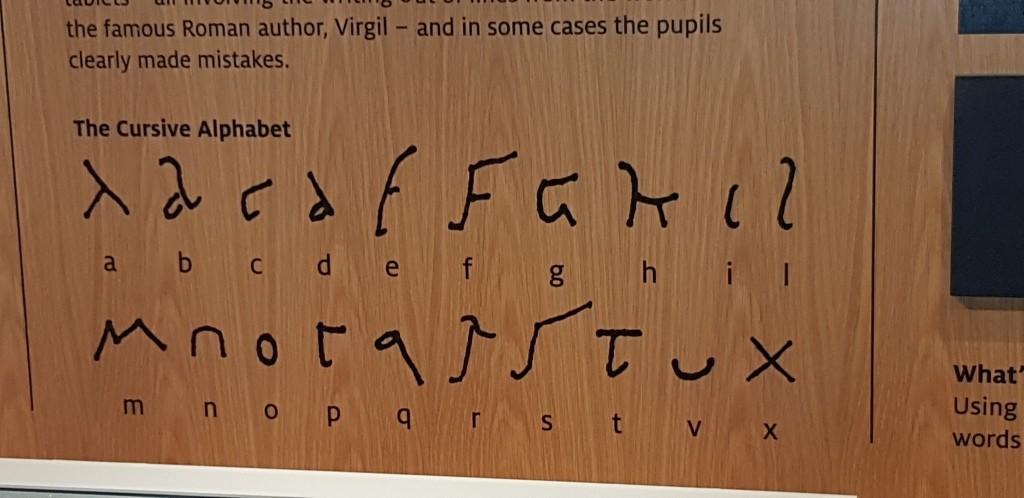
Today's Image: A display of writing of the Latin alphabet
Source: My Own Photo
Site: Vindolanda Museum
Here is a text only version. (See below for an interactive version)
1 Haec narrantur a poetis de Perseo. Perseus filius erat Jovis, maximi deorum. Avus ejus Acrisius appellabatur. Acrisius volebat Perseum, nepotem suum, necare; nam propter oraculum puerum timebat. Comprehendit igitur Perseum, adhuc infantem, et cum matre in arca lignea inclusit. Tum arcam ipsam in mare conjecit. Danae, Persei mater, magnopere territa est; tempestas enim magna mare turbabat. Perseus autem in sinu matris dormiebat.
2 Juppiter tamen haec omnia vidit, et filium suum servare constituit. Fecit igitur mare tranquillum, et arcam ad insulam Seriphum perduxit. Hujus insulae Polydectes tum rex erat. Postquam arca ad litus appulsa est, Danae in harena quietem capiebat.
How To Read the Interactive Text
To Read the Interactive Text Below Without a Dictionary-
On a Computer: you hover over a word and get all the possible parts of speech; declensions; and conjugations of every word.
How To Read the Interactive Text
To Read the Interactive Text Below Without a Dictionary-
On a Phone or Tablet: don't 'hover' -'tap' the word. To remove the 'definition box' you 'tap' to the side of the text box.
INTERACTIVE DICTIONARY FREE TEXT
1 Haec narrantur a poetis de Perseo. Perseus filius erat Jovis, maximi deorum.
You Need to be a Member to Access the Interactive Dictionary
Avus ejus Acrisius appellabatur. Acrisius volebat Perseum, nepotem suum, necare; nam propter oraculum puerum timebat.
Comprehendit igitur Perseum, adhuc infantem, et cum matre in arca lignea inclusit.
Tum arcam ipsam in mare conjecit. Danae, Persel mater, magnopere territa est; tempestas enim magna mare turbabat.
Perseus autem in sinu matris dormiebat.
2 Juppiter tamen haec omnia vidit, et filium suum servare constituit.
Fecit igitur mare tranquillum, et arcam ad insulam Seriphum perduxit. Hujus insulae Polydectes tum rex erat.
Postquam arca ad litus appulsa est, Danae in harena quietem capiebat.
Recent Comments