
tum - then at that time
The Latin adverb tum, meaning 'then' or 'at that time', plays a subtle yet powerful role in Virgil’s poetic architecture. It functions not merely as a temporal marker but as a rhythmic and thematic device that guides the reader through sequences of action, emotional shifts, and divine interventions. In Aeneid, tum frequently appears at pivotal narrative junctures, often signaling a transition from one scene to another or the onset of a consequential event.
Virgil uses tum to establish narrative momentum. For instance, in battle scenes, tum introduces a new phase of combat or a shift in fortune. It can mark the moment a hero takes decisive action or when divine forces intervene. This temporal precision allows Virgil to maintain dramatic tension while anchoring the reader in the unfolding chronology.
Stylistically, tum contributes to Virgil’s syntactic balance. It often appears in parallel constructions or in coordination with cum (when), reinforcing cause-and-effect relationships. In passages describing fate or prophecy, tum underscores inevitability—what must happen at a destined time. It is not merely 'then' in a casual sense, but 'then' as ordained by fate or divine will.
In more introspective moments, tum introduces emotional or psychological shifts. When Aeneas reflects on past suffering or anticipates future trials, tum marks the turning point in his thoughts. It can signal the moment hope rekindles, fear arises, or resolve hardens. Virgil’s use of tum in these contexts is economical yet evocative, allowing a single word to carry the weight of transformation.
Moreover, tum appears in descriptive passages to structure visual or atmospheric changes. When Virgil paints scenes of nature, divine manifestations, or cityscapes, tum helps sequence the imagery, guiding the reader’s eye from one detail to the next.
In Virgil’s hands, tum is more than a temporal adverb—it is a narrative hinge, a poetic pulse, and a subtle cue to the reader’s emotional and interpretive engagement.
Today's Artwork:
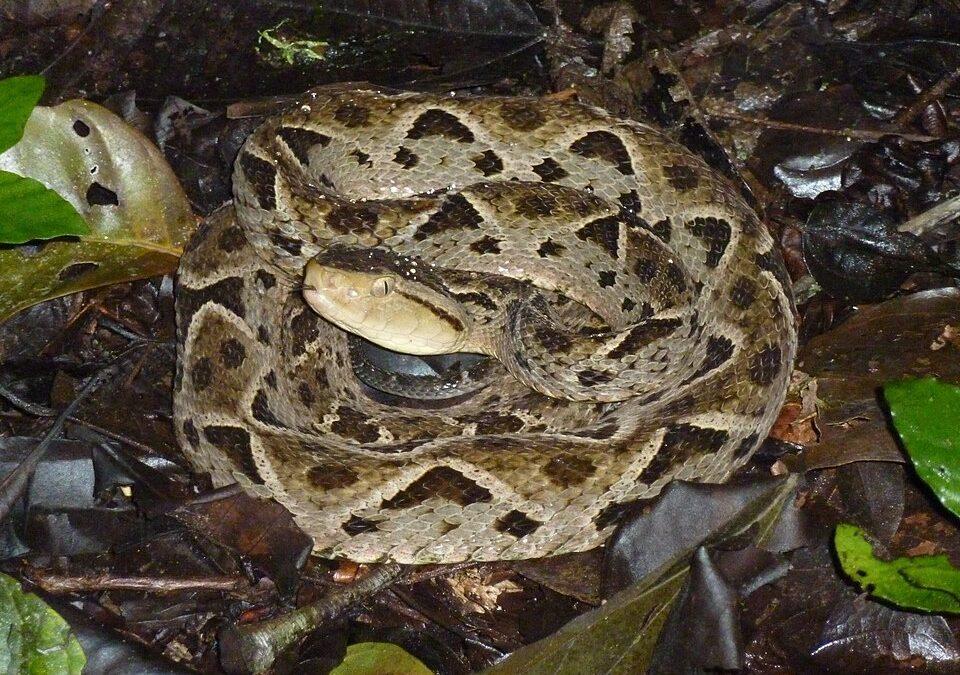
Image: Pit Viper - Bothrops asper Bothrops, comes from the Greek words bothros and ops, which mean 'pit' and 'face' (or 'eye'), respectively. This is a reference to these snakes' highly sensitive heat-detecting pit organs. The specific epithet, asper, which is a Latin word meaning 'rough' or 'harsh', may allude to the species' keeled dorsal scales
Source: wikipedia.org
Red and Green Vocab
The words in red and green are found among the 3057 Most Common Words in the Classical Latin texts that we will explore on CentumVerba.com and are essential to your understanding of the texts of Caesar, Vergil and Cicero. The green words appear frequently (at least five times) among Vergil's Aeneid (books I-VI), Caesar de bello Gallico (books I-V) and in Cicero's works - in Catilinam (books I-IV), de lege Manilia (also known as de Imperio Cn. Pompei), and pro Achia. These works constituted the curriculum for Latin over 4 years in American High Schools at the start of the 20th Century. The bulk of my information is taken from The Vocabulary of High School Latin by Gonzalez Lodge. I have added to these 2000 words from varioius other sources to compile my own list of The 3057 Most Common Latin Words.
The black words do not appear frequently in Classical Latin.
The red words are the first occurrences of these words in this author and this word will appear as green the next time you encounter it.
If you are serious about building your vocabulary then you should learn the red words as they occur and you should already know the green ones!
I have provided a FLASHCARD set to help - see below.
How To Read the Interactive Text
To Read the Interactive Text Below Without a Dictionary-
On a Computer: you hover over a word and get all the possible parts of speech; declensions; and conjugations of every word.
Red and Green Vocab
The words in red and green are found among the 3057 Most Common Words in the Classical Latin texts that we will explore on CentumVerba.com and are essential to your understanding of the texts of Caesar, Vergil and Cicero. The green words appear frequently (at least five times) among Vergil's Aeneid (books I-VI), Caesar de bello Gallico (books I-V) and in Cicero's works - in Catilinam (books I-IV), de lege Manilia (also known as de Imperio Cn. Pompei), and pro Achia. These works constituted the curriculum for Latin over 4 years in American High Schools at the start of the 20th Century. The bulk of my information is taken from The Vocabulary of High School Latin by Gonzalez Lodge. I have added to these 2000 words from varioius other sources to compile my own list of The 3057 Most Common Latin Words.
The black words do not appear frequently in Classical Latin.
The red words are the first occurrences of these words in this author and this word will appear as green the next time you encounter it.
If you are serious about building your vocabulary then you should learn the red words as they occur and you should already know the green ones!
I have provided a FLASHCARD set to help - see below.
How To Read the Interactive Text
To Read the Interactive Text Below Without a Dictionary-
On a Phone or Tablet: don't 'hover' -'tap' the word. To remove the 'definition box' you 'tap' to the side of the text box.
INTERACTIVE DICTIONARY FREE TEXT
Aspera tum positis mitescent saecula bellis; cana Fides, et Vesta, Remo cum fratre Quirinus, iura dabunt;
You Need to be a Member to Access the Interactive Dictionary
dirae ferro et compagibus artis claudentur Belli portae; Furor impius intus, saeva sedens super arma, et centum vinctus aenis post tergum nodis, fremet horridus ore cruento.”
Haec ait, et Maia genitum demittit ab alto, ut terrae, utque novae pateant Karthaginis arces hospitio Teucris, ne fati nescia Dido finibus arceret: volat ille per aera magnum remigio alarum, ac Libyae citus adstitit oris.
Et iam iussa facit, ponuntque ferocia Poeni corda volente deo; in primis regina quietum accipit in Teucros animum mentemque benignam.
At pius Aeneas, per noctem plurima volvens, ut primum lux alma data est, exire locosque explorare novos, quas vento accesserit oras, qui teneant, nam inculta videt, hominesne feraene, quaerere constituit, sociisque exacta referre.
INTERACTIVE DICTIONARY FREE TEXT
Hic iam ter centum totos regnabitur annos gente sub Hectorea,
You Need to be a Member to Access the Interactive Dictionary
donec regina sacerdos, Marte gravis, geminam partu dabit Ilia prolem.
Inde lupae fulvo nutricis tegmine laetus Romulus excipiet gentem, et Mavortia condet moenia, Romanosque suo de nomine dicet.
His ego nec metas rerum nec tempora pono; imperium sine fine dedi.
Quin aspera Iuno, quae mare nunc terrasque metu caelumque fatigat, consilia in melius referet, mecumque fovebit Romanos rerum dominos gentemque togatam: sic placitum.
Veniet lustris labentibus aetas, cum domus Assaraci Phthiam clarasque Mycenas servitio premet, ac victis dominabitur Argis.
Nascetur pulchra Troianus origine Caesar, imperium oceano, famam qui terminet astris,— Iulius, a magno demissum nomen Iulo.
Hunc tu olim caelo, spoliis Orientis onustum, accipies secura; vocabitur hic quoque votis.
I have prepared online Flashcards at CRAM.com to make learning the vocabulary much easier. I have no financial gain from you using the app as it is FREE to use.
I have created a stack of the 32 new words in this passage.
Here is the link to the FLASHCARDS
USING THE FLASHCARD APP:
To make the most of the online Flashcards use the "Click or use spacebar to begin" and the Latin word should appear. (The 'Shuffle' button will take the cards out of alphabetical order.) Type 'H' to get the conjugation / declension of the word if you want to see it. 'H' takes tyou back to the word. Click 'See Answer' or use the Spacebar to see the English.
If you were correct or close enough then select "I was right" or else "I was wrong". After you have completed the set it will start again but it will only display the ones you got wrong.
Continue through this process to learn all the words. I hope this is helpful!
Recent Comments