
moveo - move along please!
The Latin verb moveo is fundamentally a word of action, but its literary applications reach far beyond physical motion. It appears frequently across genres as a mechanism to express emotional, rhetorical, and transformative force.
In epic poetry, Virgil employs moveo to indicate divine manipulation and emotional disturbance. When Juno unleashes the storm upon Aeneas in Book I of the Aeneid, the waves are motus not just by wind, but by divine wrath. Later, Dido's inner turmoil is reflected when she is movetur by Aeneas's recounting of Troy—an emotional unraveling catalyzed by narrative. Virgil’s use allows moveo to act as a hinge between the cosmic and the personal, suggesting that movement is not just kinetic, but fate-laden.
In rhetorical prose, Cicero adapts moveo to describe intellectual and emotional persuasion. His speeches often hinge on audience reaction: haec oratio movebit vos, he claims, predicting that reason and pathos will stir the senate. In Pro Ligario, moveo frames a subtle appeal to Caesar’s empathy, as grief is said to have moved him more than argument. Here, moveo is a tactical verb—it marks the success of rhetoric over logic.
Ovid, meanwhile, gives moveo a metamorphic edge. In the Metamorphoses, gods and mortals are motus toward change, often unwillingly. Daphne’s transformation into a tree is initiated by her fleeing limbs being moventur, suggesting motion as the gateway to mutation. Ovid’s moveo always foreshadows transition—love, loss, metamorphosis.
In Livy’s historical writings, moveo serves to animate the political landscape. Crowd reactions to omens or speeches are motus, indicating not chaos but mobilization. The verb allows Livy to chart the momentum of history, as events are rarely static but always in flux.
Across classical Latin literature, moveo operates less as a simple verb of movement and more as an agent of shift—emotional, rhetorical, divine, political. Its utility lies in its versatility; its power in the capacity to evoke change.
Today's Image
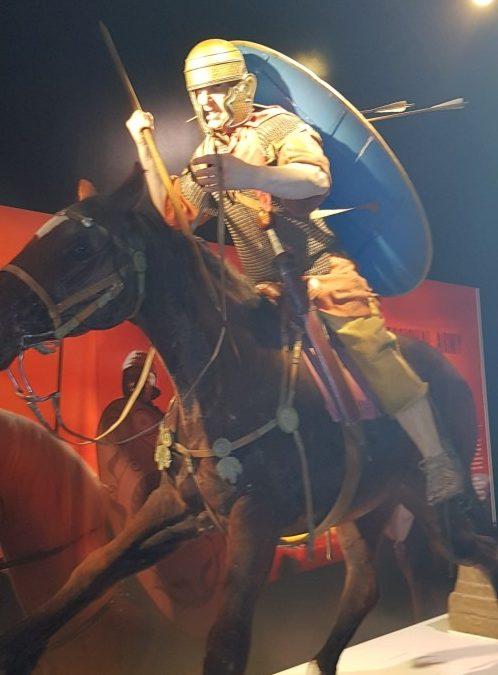
A Roman mounted soldier
Source: My own photo
Here is a text only version. (See below for an interactive version)
15 Postero die castra ex eo loco movent. Idem facit Caesar equitatumque omnem, ad numerum quattuor milium, quem ex omni provincia et Haeduis atque eorum sociis coactum habebat, praemittit, qui videant quas in partes hostes iter faciant. Qui cupidius novissimum agmen insecuti alieno loco cum equitatu Helvetiorum proelium committunt; et pauci de nostris cadunt. Quo proelio sublati Helvetii, quod quingentis equitibus tantam multitudinem equitum propulerant, audacius subsistere non numquam et novissimo agmine proelio nostros lacessere coeperunt. Caesar suos a proelio continebat, ac satis habebat in praesentia hostem rapinis, pabulationibus populationibusque prohibere. Ita dies circiter XV iter fecerunt uti inter novissimum hostium agmen et nostrum primum non amplius quinis aut senis milibus passuum interesset.
Need Help Understanding the Latin?
You might find it helpful to start with the Side-by-Side Version which allows you to see my own very literal translation of the text which is almost a word-for-word translation - in an attempt to make it easier to understand the Latin!
Finally come back to this page - Classical Text and you should be able to better understand and competently read the original Latin text.
Vocabulary Version
I have prepared a Vocabulary Version of the passage (link at bottom of the page) which highlights the 3057 Most Common Words in the texts of Vergil, Caesar and Cicero that we will explore on CentumVerba.com
If you are serious about building your vocabulary, the FLASHCARD set should help you learn them.
How To Read the Interactive Text
To Read the Interactive Text Below Without a Dictionary-
On a Computer: you hover over a word and get all the possible parts of speech; declensions; and conjugations of every word.
Need Help Understanding the Latin?
You might find it helpful to start with the Side-by-Side Version which allows you to see my own very literal translation of the text which is almost a word-for-word translation - in an attempt to make it easier to understand the Latin!
Finally come back to this page - Classical Text and you should be able to better understand and competently read the original Latin text.
Vocabulary Version
I have prepared a Vocabulary Version of the passage (link at bottom of the page) which highlights the 3057 Most Common Words in the texts of Vergil, Caesar and Cicero that we will explore on CentumVerba.com
If you are serious about building your vocabulary, the FLASHCARD set should help you learn them.
How To Read the Interactive Text
To Read the Interactive Text Below Without a Dictionary-
On a Phone or Tablet: don't 'hover' -'tap' the word. To remove the 'definition box' you 'tap' to the side of the text box.
Dictionary-Free Interactive Text
15 Postero die castra ex eo loco movent.
You Need to be a Member to Access the Interactive Dictionary
Idem facit Caesar equitatumque omnem, ad numerum quattuor milium, quem ex omni provincia et Haeduis atque eorum sociis coactum habebat, praemittit, qui videant quas in partes hostes iter faciant.
Qui cupidius novissimum agmen insecuti alieno loco cum equitatu Helvetiorum proelium committunt; et pauci de nostris cadunt.
Quo proelio sublati Helvetii, quod quingentis equitibus tantam multitudinem equitum propulerant, audacius subsistere non numquam et novissimo agmine proelio nostros lacessere coeperunt.
Caesar suos a proelio continebat, ac satis habebat in praesentia hostem rapinis, pabulationibus populationibusque prohibere.
Ita dies circiter XV iter fecerunt uti inter novissimum hostium agmen et nostrum primum non amplius quinis aut senis milibus passuum interesset.
INTERACTIVE DICTIONARY-FREE TEXT
15 Postero die castra ex eo loco movent.
You Need to be a Member to Access the Interactive Dictionary
Idem facit Caesar equitatumque omnem, ad numerum quattuor milium, quem ex omni provincia et Haeduis atque eorum sociis coactum habebat, praemittit, qui videant quas in partes hostes iter faciant.
Qui cupidius novissimum agmen insecuti alieno loco cum equitatu Helvetiorum proelium committunt; et pauci de nostris cadunt.
Quo proelio sublati Helvetii, quod quingentis equitibus tantam multitudinem equitum propulerant, audacius subsistere non numquam et novissimo agmine proelio nostros lacessere coeperunt.
Caesar suos a proelio continebat, ac satis habebat in praesentia hostem rapinis, pabulationibus populationibusque prohibere.
Ita dies circiter XV iter fecerunt uti inter novissimum hostium agmen et nostrum primum non amplius quinis aut senis milibus passuum interesset.
Recent Comments