
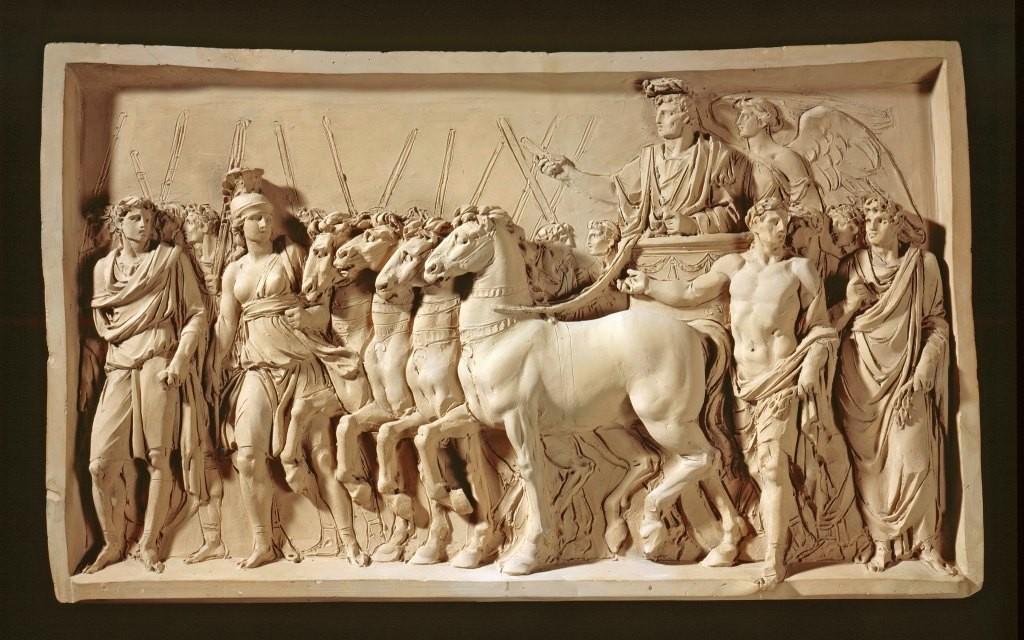
Victoria
In Latin, victoria means victory, triumph, or conquest, and it holds a central place in Roman cultural, military, and religious life. A first-declension feminine noun, its forms include victoria, victoriae, victoriae, victoriam, victoria, victoriae, victoriarum, victoriis, victorias, victoriis. Derived from the verb vincere (to conquer), victoria represents not just the outcome of battle but the divine favour and moral superiority that Romans believed justified their expansion.
In Roman literature, victoria is often personified and celebrated. Livy’s histories are filled with accounts of Roman generals achieving victoria over foreign enemies, reinforcing the narrative of Rome’s destined supremacy. In Virgil’s Aeneid, victoria is both a literal goal and a divine promise—Aeneas’s journey is framed as a divinely sanctioned path to eventual Roman victoria. The word appears in contexts that emphasise not only military success but also the endurance and virtue required to attain it.
The goddess Victoria was the Roman counterpart to the Greek Nike, and she was worshipped as a divine embodiment of success in war and politics. Her imagery—often winged and bearing a laurel wreath—appears on coins, monuments, and in triumphal art. The Arch of Titus, for example, includes depictions of Victoriae crowning the emperor’s achievements. Her temple on the Palatine Hill symbolised the close relationship between divine favour and Roman military might.
Cicero and other orators used victoria rhetorically to frame political victories as moral ones. In Pro Milone, Cicero argues that Milo’s actions, though violent, were in service of the Republic’s victoria over chaos. Thus, victoria could be invoked to justify controversial actions when framed as serving the greater good.
The legacy of victoria extends into modern languages and cultures. It survives as a personal name—Victoria—and in words like victorious, victory, and even the name of Queen Victoria, whose reign was associated with imperial expansion and national pride. The concept also lives on in mottos such as per aspera ad victoria (through hardships to victory), reflecting the Roman belief that true triumph is earned through struggle.
Ultimately, victoria in Latin literature is more than a military term—it is a symbol of divine favour, moral righteousness, and the enduring spirit of Rome.
Today's Image
A reconstructed relief panel from the original on the Arch of Titus, Rome, c. 81 CE. The scene, showing the triumph of Titus
Artist: Jean-Guillaume Moitte (France, Paris, 1746-1810, active Italy, Rome)
circa 1791Source: Los Angeles County Museum of Art
Here is a text only version. (See below for an interactive version)
[14.3] Quod sua victoria tam insolenter gloriarentur quodque tam diu se impune iniurias tulisse admirarentur, eodem pertinere. Consuesse enim deos immortales, quo gravius homines ex commutatione rerum doleant, quos pro scelere eorum ulcisci velint, his secundiores interdum res et diuturniorem impunitatem concedere. Cum ea ita sint, tamen, si obsides ab iis sibi dentur, uti ea quae polliceantur facturos intellegat, et si Haeduis de iniuriis quas ipsis sociisque eorum intulerint, item si Allobrogibus satis faciunt, sese cum iis pacem esse facturum.
Divico respondit: ita Helvetios a maioribus suis institutos esse uti obsides accipere, non dare, consuerint; eius rei populum Romanum esse testem. Hoc responso dato discessit.
Need Help Understanding the Latin?
You might find it helpful to start with the Side-by-Side Version which allows you to see my own very literal translation of the text which is almost a word-for-word translation - in an attempt to make it easier to understand the Latin!
Finally come back to this page - Classical Text and you should be able to better understand and competently read the original Latin text.
Vocabulary Version
I have prepared a Vocabulary Version of the passage (link at bottom of the page) which highlights the 3057 Most Common Words in the texts of Vergil, Caesar and Cicero that we will explore on CentumVerba.com
If you are serious about building your vocabulary, the FLASHCARD set should help you learn them.
How To Read the Interactive Text
To Read the Interactive Text Below Without a Dictionary-
On a Computer: you hover over a word and get all the possible parts of speech; declensions; and conjugations of every word.
Need Help Understanding the Latin?
You might find it helpful to start with the Side-by-Side Version which allows you to see my own very literal translation of the text which is almost a word-for-word translation - in an attempt to make it easier to understand the Latin!
Finally come back to this page - Classical Text and you should be able to better understand and competently read the original Latin text.
Vocabulary Version
I have prepared a Vocabulary Version of the passage (link at bottom of the page) which highlights the 3057 Most Common Words in the texts of Vergil, Caesar and Cicero that we will explore on CentumVerba.com
If you are serious about building your vocabulary, the FLASHCARD set should help you learn them.
How To Read the Interactive Text
To Read the Interactive Text Below Without a Dictionary-
On a Phone or Tablet: don't 'hover' -'tap' the word. To remove the 'definition box' you 'tap' to the side of the text box.
Dictionary-Free Interactive Text
[14.3] Quod sua victoria tam insolenter gloriarentur quodque tam diu se impune iniurias tulisse admirarentur, eodem pertinere.
You Need to be a Member to Access the Interactive Dictionary
Consuesse enim deos immortales, quo gravius homines ex commutatione rerum doleant, quos pro scelere eorum ulcisci velint, his secundiores interdum res et diuturniorem impunitatem concedere.
Cum ea ita sint, tamen, si obsides ab iis sibi dentur, uti ea quae polliceantur facturos intellegat, et si Haeduis de iniuriis quas ipsis sociisque eorum intulerint, item si Allobrogibus satis faciunt, sese cum iis pacem esse facturum.
Divico respondit: ita Helvetios a maioribus suis institutos esse uti obsides accipere, non dare, consuerint; eius rei populum Romanum esse testem. Hoc responso dato discessit.
INTERACTIVE DICTIONARY-FREE TEXT
[14.3] Quod sua victoria tam insolenter gloriarentur quodque tam diu se impune iniurias tulisse admirarentur, eodem pertinere.
You Need to be a Member to Access the Interactive Dictionary
Consuesse enim deos immortales, quo gravius homines ex commutatione rerum doleant, quos pro scelere eorum ulcisci velint, his secundiores interdum res et diuturniorem impunitatem concedere.
Cum ea ita sint, tamen, si obsides ab iis sibi dentur, uti ea quae polliceantur facturos intellegat, et si Haeduis de iniuriis quas ipsis sociisque eorum intulerint, item si Allobrogibus satis faciunt, sese cum iis pacem esse facturum.
Divico respondit: ita Helvetios a maioribus suis institutos esse uti obsides accipere, non dare, consuerint; eius rei populum Romanum esse testem. Hoc responso dato discessit.
Recent Comments