
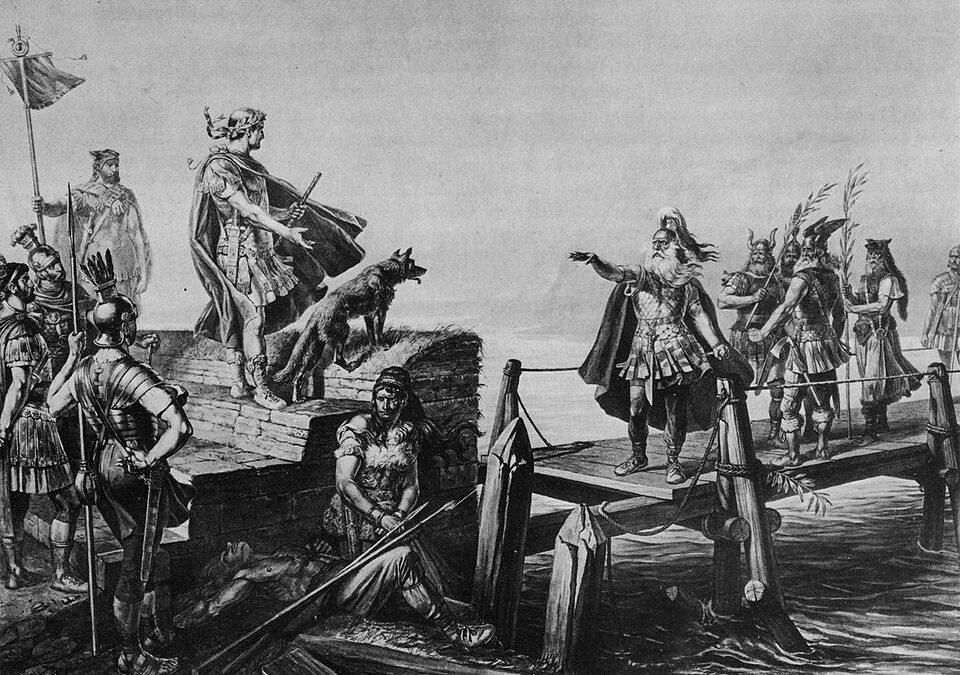
Divico
Divico, a prominent leader of the Helvetii tribe, emerges in Julius Caesar's Commentarii de Bello Gallico as a symbol of Gallic pride, tenacity, and tragic defiance. He is remembered for his commanding presence during two key episodes: the Helvetian victory over Roman consul Lucius Cassius Longinus in 107 BCE, and the subsequent encounter with Caesar nearly fifty years later.
As a young chieftain, Divico led the Helvetii in their decisive ambush at Burdigala, where the Roman army suffered a humiliating defeat. The surviving soldiers were forced to pass sub iugum—under a yoke made of spears—a symbolic and degrading surrender. This event became an enduring insult in Roman memory, setting the tone for Caesar’s later campaign against the Helvetii.
In De Bello Gallico 1.13, Divico reappears as an aged emissary sent to negotiate peace with Caesar during the Helvetii’s westward migration. Though older, he is portrayed as proud and sharp-tongued. When Caesar demands reparations for the earlier Roman defeat, Divico boldly refuses, declaring that the Helvetii are as brave now as they were then, and that the Romans should beware repeating past mistakes.
Divico’s rhetoric is fiery and dignified—he does not plead for mercy but stands as the voice of a people who remember their own victories. Caesar records the exchange with political flourish, casting himself as the calm Roman commander and Divico as the proud barbarian envoy. Nevertheless, Divico’s words resonate: his sense of honor and tribal identity shine through even amid inevitable defeat.
Though his fate after the negotiations is not detailed, Divico’s role is emblematic of Gallic resistance. He straddles myth and memory, embodying the long arc of conflict between Rome and the Celtic world. In Caesar’s narrative, he is both a foil and a witness—an aging warrior who carries the weight of a nation's defiance on his shoulders. A man who, even in diplomacy, fought with fire in his voice.
Today's Image
Julius Caesar and Divico parley after the battle at the Saône
Artist: Karl Jauslin (1842-1904)
Here is a text only version. (See below for an interactive version)
Helvetii repentino eius adventu commoti cum id quod ipsi diebus XX aegerrime confecerant, ut flumen transirent, illum uno die fecisse intellegerent, legatos ad eum mittunt; cuius legationis Divico princeps fuit, qui bello Cassiano dux Helvetiorum fuerat.
Is ita cum Caesare egit: si pacem populus Romanus cum Helvetiis faceret, in eam partem ituros atque ibi futuros Helvetios ubi eos Caesar constituisset atque esse voluisset; sin bello persequi perseveraret, reminisceretur et veteris incommodi populi Romani et pristinae virtutis Helvetiorum.
Quod improviso unum pagum adortus esset, cum ii qui flumen transissent suis auxilium ferre non possent, ne ob eam rem aut suae magnopere virtuti tribueret aut ipsos despiceret.
Need Help Understanding the Latin?
You might find it helpful to start with the Side-by-Side Version which allows you to see my own very literal translation of the text which is almost a word-for-word translation - in an attempt to make it easier to understand the Latin!
Finally come back to this page - Classical Text and you should be able to better understand and competently read the original Latin text.
Vocabulary Version
I have prepared a Vocabulary Version of the passage (link at bottom of the page) which highlights the 3057 Most Common Words in the texts of Vergil, Caesar and Cicero that we will explore on CentumVerba.com
If you are serious about building your vocabulary, the FLASHCARD set should help you learn them.
How To Read the Interactive Text
To Read the Interactive Text Below Without a Dictionary-
On a Computer: you hover over a word and get all the possible parts of speech; declensions; and conjugations of every word.
Need Help Understanding the Latin?
You might find it helpful to start with the Side-by-Side Version which allows you to see my own very literal translation of the text which is almost a word-for-word translation - in an attempt to make it easier to understand the Latin!
Finally come back to this page - Classical Text and you should be able to better understand and competently read the original Latin text.
Vocabulary Version
I have prepared a Vocabulary Version of the passage (link at bottom of the page) which highlights the 3057 Most Common Words in the texts of Vergil, Caesar and Cicero that we will explore on CentumVerba.com
If you are serious about building your vocabulary, the FLASHCARD set should help you learn them.
How To Read the Interactive Text
To Read the Interactive Text Below Without a Dictionary-
On a Phone or Tablet: don't 'hover' -'tap' the word. To remove the 'definition box' you 'tap' to the side of the text box.
Dictionary-Free Interactive Text
[13.2] Helvetii repentino eius adventu commoti cum id quod ipsi diebus XX aegerrime confecerant,
You Need to be a Member to Access the Interactive Dictionary
cuius legationis Divico princeps fuit, qui bello Cassiano dux Helvetiorum fuerat.
Is ita cum Caesare egit: si pacem populus Romanus cum Helvetiis faceret, in eam partem ituros atque ibi futuros Helvetios ubi eos Caesar constituisset atque esse voluisset;
sin bello persequi perseveraret, reminisceretur et veteris incommodi populi Romani et pristinae virtutis Helvetiorum.
Quod improviso unum pagum adortus esset, cum ii qui flumen transissent suis auxilium ferre non possent, ne ob eam rem aut suae magnopere virtuti tribueret aut ipsos despiceret.
INTERACTIVE DICTIONARY-FREE TEXT
[13.2] Helvetii repentino eius adventu commoti cum id quod ipsi diebus XX aegerrime confecerant,
You Need to be a Member to Access the Interactive Dictionary
cuius legationis Divico princeps fuit, qui bello Cassiano dux Helvetiorum fuerat.
Is ita cum Caesare egit: si pacem populus Romanus cum Helvetiis faceret, in eam partem ituros atque ibi futuros Helvetios ubi eos Caesar constituisset atque esse voluisset;
sin bello persequi perseveraret, reminisceretur et veteris incommodi populi Romani et pristinae virtutis Helvetiorum.
Quod improviso unum pagum adortus esset, cum ii qui flumen transissent suis auxilium ferre non possent, ne ob eam rem aut suae magnopere virtuti tribueret aut ipsos despiceret.
Recent Comments