
pagus - nothing to do with a page
The Latin term pagus (plural pagi) originally referred to a rural district or canton within a larger tribe or territory. Rooted in the same etymological family as pango ('to fix, to fasten'), it suggests a 'fixed area' or bounded subdivision of land, often inhabited by a clan or smaller ethnic group. In Classical Latin, pagus stood in contrast to urbs (city), emphasizing the countryside and tribal organization.
In Caesar, pagus features prominently as a term to describe the internal structures of Gallic and Germanic tribes. Caesar uses it to highlight the decentralized, quasi-democratic nature of Gallic society—where tribal confederations were frequently subdivided into pagi, each with its own chieftains and councils. This granular detail served not only to inform Roman audiences but also to underscore the strategic advantages and weaknesses in tribal governance.
For example, later in De Bello Gallico 1.27, Caesar describes how he dealt with the Helvetii: 'in singulos pagos principum nobilissimos evocavit' ('he summoned the noblest leaders from each pagus'). This illustrates how Roman diplomacy and warfare often operated at the pagus level, negotiating with or coercing smaller units to destabilize larger coalitions. The fragmentation of tribal societies into pagi allowed Caesar to apply his famed divide et impera strategy with remarkable effect.
Moreover, pagus became a useful linguistic tool for Caesar to frame his enemies as disunited and primitive. While Romans prided themselves on centralized authority, the division into pagi could be portrayed as a weakness—inviting Roman intervention as a unifying force. At the same time, the detailed naming of specific pagi reveals Caesar’s nuanced knowledge of the regions he conquered and his effort to present himself as both a military tactician and an ethnographer.
In later Latin, pagus evolved further, contributing to medieval place names and the modern French word pays ('country')—proof of its lasting imprint. But in Caesar’s hands, the pagus was more than geography: it was a strategic lens through which the Roman reader viewed conquest, culture, and control. A rural boundary, perhaps, but one that shaped the empire.
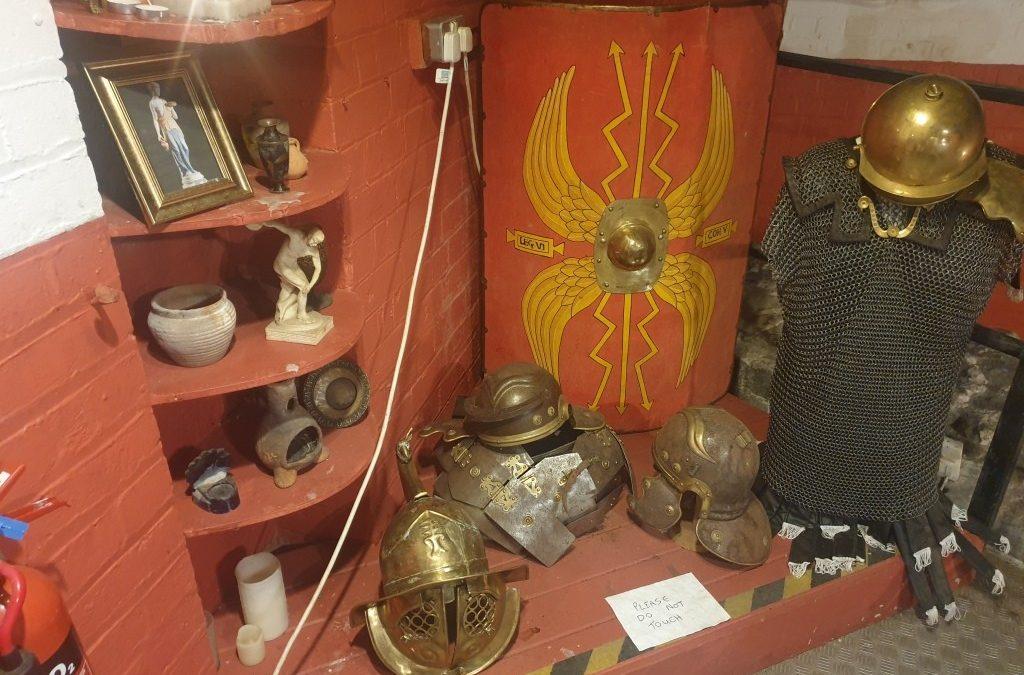
Today's Image: Roman Military uniform
Location: York Roman Bath Museum
Source: My own photo
Red and Green Vocab
The words in red and green are found among the 3057 Most Common Words in the Classical Latin texts that we will explore on CentumVerba.com and are essential to your understanding of the texts of Caesar, Vergil and Cicero. The green words appear frequently (at least five times) among Vergil's Aeneid (books I-VI), Caesar de bello Gallico (books I-V) and in Cicero's works - in Catilinam (books I-IV), de lege Manilia (also known as de Imperio Cn. Pompei), and pro Achia. These works constituted the curriculum for Latin over 4 years in American High Schools at the start of the 20th Century. The bulk of my information is taken from The Vocabulary of High School Latin by Gonzalez Lodge. I have added to these 2000 words from varioius other sources to compile my own list of The 3057 Most Common Latin Words.
The black words do not appear frequently in Classical Latin.
The red words are the first occurrences of these words in this author and this word will appear as green the next time you encounter it.
If you are serious about building your vocabulary then you should learn the red words as they occur and you should already know the green ones!
I have provided a FLASHCARD set to help - see below.
How To Read the Interactive Text
To Read the Interactive Text Below Without a Dictionary-
On a Computer: you hover over a word and get all the possible parts of speech; declensions; and conjugations of every word.
Red and Green Vocab
The words in red and green are found among the 3057 Most Common Words in the Classical Latin texts that we will explore on CentumVerba.com and are essential to your understanding of the texts of Caesar, Vergil and Cicero. The green words appear frequently (at least five times) among Vergil's Aeneid (books I-VI), Caesar de bello Gallico (books I-V) and in Cicero's works - in Catilinam (books I-IV), de lege Manilia (also known as de Imperio Cn. Pompei), and pro Achia. These works constituted the curriculum for Latin over 4 years in American High Schools at the start of the 20th Century. The bulk of my information is taken from The Vocabulary of High School Latin by Gonzalez Lodge. I have added to these 2000 words from varioius other sources to compile my own list of The 3057 Most Common Latin Words.
The black words do not appear frequently in Classical Latin.
The red words are the first occurrences of these words in this author and this word will appear as green the next time you encounter it.
If you are serious about building your vocabulary then you should learn the red words as they occur and you should already know the green ones!
I have provided a FLASHCARD set to help - see below.
How To Read the Interactive Text
To Read the Interactive Text Below Without a Dictionary-
On a Phone or Tablet: don't 'hover' -'tap' the word. To remove the 'definition box' you 'tap' to the side of the text box.
INTERACTIVE DICTIONARY FREE TEXT
Is pagus appellabatur Tigurinus; nam omnis civitas Helvetia in quattuor pagos divisa est.
You Need to be a Member to Access the Interactive Dictionary
Hic pagus unus, cum domo exisset, patrum nostrorum memoria L. Cassium consulem interfecerat et eius exercitum sub iugum miserat.
Ita sive casu sive consilio deorum immortalium quae pars civitatis Helvetiae insignem calamitatem populo Romano intulerat, ea princeps poenam persolvit.
Qua in re Caesar non solum publicas, sed etiam privatas iniurias ultus est, quod eius soceri L. Pisonis avum, L. Pisonem legatum, Tigurini eodem proelio quo Cassium interfecerant.
CAPUT XIII
Hoc proelio facto, reliquas copias Helvetiorum ut consequi posset, pontem in Arari faciendum curat atque ita exercitum traducit.
You Need to be a Member to Access the Interactive Dictionary
I have prepared online Flashcards at CRAM.com to make learning the vocabulary much easier. I have no financial gain from you using the app as it is FREE to use.
I have created a stack of the 15 new words in this passage.
Here is the link to the FLASHCARDS
USING THE FLASHCARD APP:
To make the most of the online Flashcards use the "Click or use spacebar to begin" and the Latin word should appear. (The 'Shuffle' button will take the cards out of alphabetical order.) Type 'H' to get the conjugation / declension of the word if you want to see it. 'H' takes tyou back to the word. Click 'See Answer' or use the Spacebar to see the English.
If you were correct or close enough then select "I was right" or else "I was wrong". After you have completed the set it will start again but it will only display the ones you got wrong.
Continue through this process to learn all the words. I hope this is helpful!
Recent Comments