
Tigurinus tribe
The Tigurinus tribe, a sub-group of the larger Helvetii confederation, occupies a fleeting but critical moment in Julius Caesar's Commentarii de Bello Gallico. Caesar references the Tigurini in Book 1 as part of his broader justification for waging war against the migrating Helvetii in 58 BCE.
According to Caesar, the Tigurini were one of four major divisions of the Helvetii, along with the Verbigeni, the Tougeni, and the Helvetii proper. Decades earlier, the Tigurini had played a notorious role in Roman history during the campaign of Lucius Cassius Longinus in 107 BCE. In that disastrous encounter, the Tigurini ambushed and routed the Roman forces near Burdigala (modern-day Bordeaux), killing Cassius and forcing surviving Romans to pass under the yoke (sub iugum)—a profound humiliation in Roman military culture.
Caesar does not forget this affront. In De Bello Gallico 1.12, he notes with cold precision: ‘una pars… Tigurinorum, quae Cassium consulem interfecerat’ ('the one part… the Tigurini, who had killed the consul Cassius'). This statement is not mere recollection—it serves to frame Caesar's campaign as an act of long-delayed retribution. By portraying the Helvetii migration as both a current threat and a continuation of past aggression, Caesar crafts a compelling narrative of righteous vengeance and Roman justice.
The Tigurini themselves are not extensively described beyond this historical note. However, their identity becomes a convenient symbol of Gallic defiance and Roman injury. Their destruction in Caesar’s campaign is presented not simply as tactical necessity, but as a moral reckoning.
Beyond Caesar’s account, the Tigurini fade from historical visibility. Their legacy, like that of many Gallic tribes, is largely constructed through Roman eyes—especially Caesar’s, who shaped his commentaries as much for political impact in Rome as for historical record.
Thus, the Tigurini exemplify how Roman historiography could elevate a tribal skirmish into a justification for empire. They are remembered not for who they were, but for the moment they stood in Rome’s path—and, briefly, won. That, to Caesar, was a debt to settle.
Today's Image
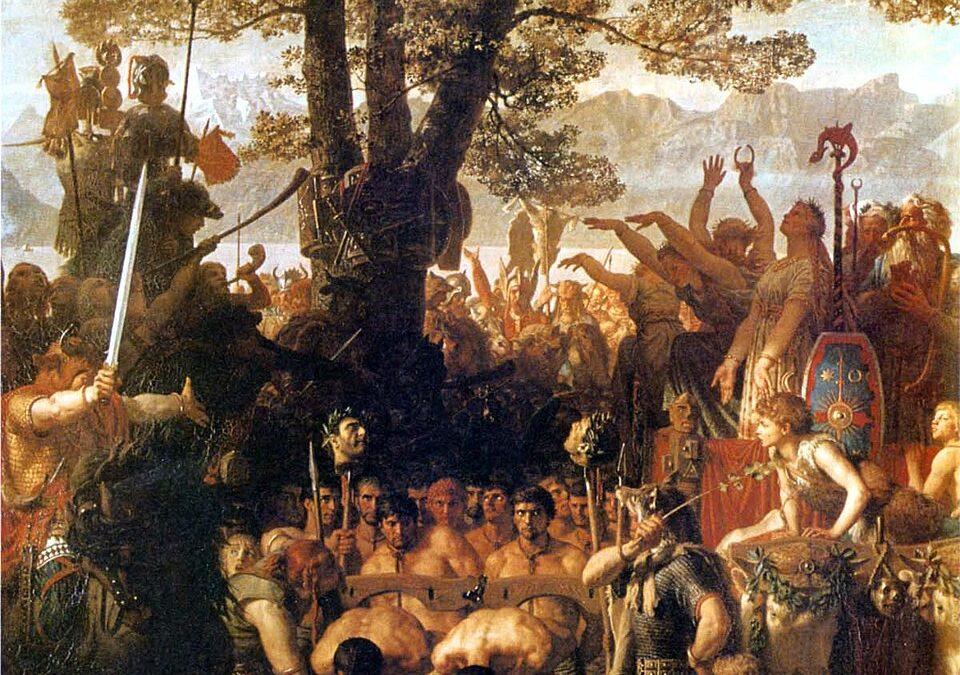
The Helvetians force the Romans to pass under the yoke celebrating the Helvetian victory over the Romans at Agen (107 BC) under Divico's command.
Charles Gleyre (19th century)
Here is a text only version. (See below for an interactive version)
[12.5] Is pagus appellabatur Tigurinus; nam omnis civitas Helvetia in quattuor pagos divisa est. Hic pagus unus, cum domo exisset, patrum nostrorum memoria L. Cassium consulem interfecerat et eius exercitum sub iugum miserat. Ita sive casu sive consilio deorum immortalium quae pars civitatis Helvetiae insignem calamitatem populo Romano intulerat, ea princeps poenam persolvit. Qua in re Caesar non solum publicas, sed etiam privatas iniurias ultus est, quod eius soceri L. Pisonis avum, L. Pisonem legatum, Tigurini eodem proelio quo Cassium interfecerant.
13 Hoc proelio facto, reliquas copias Helvetiorum ut consequi posset, pontem in Arari faciendum curat atque ita exercitum traducit.
Need Help Understanding the Latin?
You might find it helpful to start with the Side-by-Side Version which allows you to see my own very literal translation of the text which is almost a word-for-word translation - in an attempt to make it easier to understand the Latin!
Finally come back to this page - Classical Text and you should be able to better understand and competently read the original Latin text.
Vocabulary Version
I have prepared a Vocabulary Version of the passage (link at bottom of the page) which highlights the 3057 Most Common Words in the texts of Vergil, Caesar and Cicero that we will explore on CentumVerba.com
If you are serious about building your vocabulary, the FLASHCARD set should help you learn them.
How To Read the Interactive Text
To Read the Interactive Text Below Without a Dictionary-
On a Computer: you hover over a word and get all the possible parts of speech; declensions; and conjugations of every word.
Need Help Understanding the Latin?
You might find it helpful to start with the Side-by-Side Version which allows you to see my own very literal translation of the text which is almost a word-for-word translation - in an attempt to make it easier to understand the Latin!
Finally come back to this page - Classical Text and you should be able to better understand and competently read the original Latin text.
Vocabulary Version
I have prepared a Vocabulary Version of the passage (link at bottom of the page) which highlights the 3057 Most Common Words in the texts of Vergil, Caesar and Cicero that we will explore on CentumVerba.com
If you are serious about building your vocabulary, the FLASHCARD set should help you learn them.
How To Read the Interactive Text
To Read the Interactive Text Below Without a Dictionary-
On a Phone or Tablet: don't 'hover' -'tap' the word. To remove the 'definition box' you 'tap' to the side of the text box.
Dictionary-Free Interactive Text
[12.5] Is pagus appellabatur Tigurinus; nam omnis civitas Helvetia in quattuor pagos divisa est.
INTERACTIVE DICTIONARY-FREE TEXT
[12.5] Is pagus appellabatur Tigurinus; nam omnis civitas Helvetia in quattuor pagos divisa est.
Recent Comments